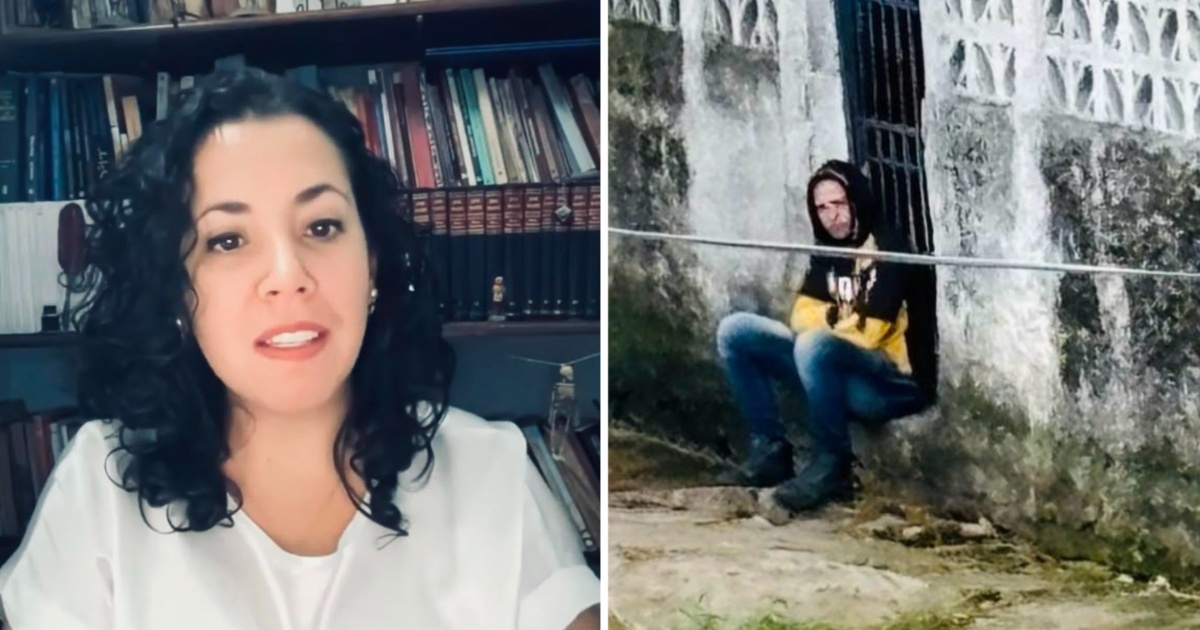
Independent journalist Camila Acosta found herself under surveillance at her home this Saturday, as political police once again surrounded her residence. This has become a recurring tactic employed by the Cuban regime to mark the anniversary of the July 11 protests, a date of significant civil unrest.
Acosta shared her ordeal on Facebook, identifying the officer stationed outside her home as Mario Raciel Soulary Garcés. This State Security official has been monitoring her residence for several months, she claims.
"As has become customary on each 11J anniversary, I woke up today with political police stationed around my home," Acosta wrote, posting a photo taken from a distance. She confirmed that it depicted "the same State Security officer who has been performing these duties for months."
Soulary Garcés is listed in the public database Represores Cubanos (FHRC) under the "Violent" category, accused of infringing on freedoms of opinion, expression, and information as outlined in Article 19 of the Universal Declaration of Human Rights.
The Cuban Observatory for Human Rights had previously identified him for arbitrarily detaining a citizen filming in public.
Acosta highlighted the irony of the situation: while millions of Cubans suffer from power outages due to the second breakdown of the National Electric System in less than a week—partially due to fuel shortages—the regime manages to allocate resources for intimidating independent journalists.
"For repression and harassment of independent media, the regime spares no resources," she noted.
This fifth anniversary of 11J comes amid unprecedented repression. Cuba has recorded between 1,260 and 1,281 political prisoners, according to Prisoners Defenders and Justicia 11J, which is a record number. At least 338 individuals remain jailed for their involvement in the 2021 protests.
The April 2026 pardon, which released over 2,000 inmates, explicitly excluded those convicted of "crimes against authority," a charge used to criminalize 11J protesters.
The operation against Acosta this Saturday is not an isolated event. In May 2026, six people, including uniformed officers and members of the "Las Marianas" group, were stationed outside her home.
In June, she exposed another State Security agent monitoring her residence on social media. In July 2025, agents attempted to intercept a vehicle from the U.S. Embassy she was traveling in to prevent her from attending a diplomatic reception.
Acosta was arrested on July 12, 2021, for covering the 11J protests and endured over ten months of house arrest, charged with "public disorder" and "inciting to commit a crime."
The case concluded in May 2022 with a fine of 1,000 Cuban pesos. Since then, independent organizations have documented at least nine assaults against her.
Other journalists have reported similar repressive operations leading up to the anniversary. Yoani Sánchez mentioned a political police operation on July 4, stationed beneath her building, hindering her from leaving.
"#CubaIsADictatorship, and they won't leave power willingly," Acosta asserted in her post. Notably, she won the 2026 Manuel Márquez Sterling Non-Fiction Literature Prize in June for her book "Under Siege: Journalism and Resistance in Cuba," a title that holds particularly literal significance this Saturday.
Understanding the Repression of Journalists in Cuba
What is the significance of the 11J anniversary in Cuba?
The 11J anniversary marks the July 11 protests in Cuba, a major civil unrest event where citizens demonstrated against the government, leading to widespread repression and arrests.
Who is Camila Acosta?
Camila Acosta is an independent journalist in Cuba who has faced surveillance and harassment by the Cuban regime for her reporting on political events, notably the 11J protests.
How does the Cuban regime target independent journalists?
The Cuban regime targets independent journalists through surveillance, house arrests, and harassment, often using state security forces to intimidate and restrict their freedom of expression.