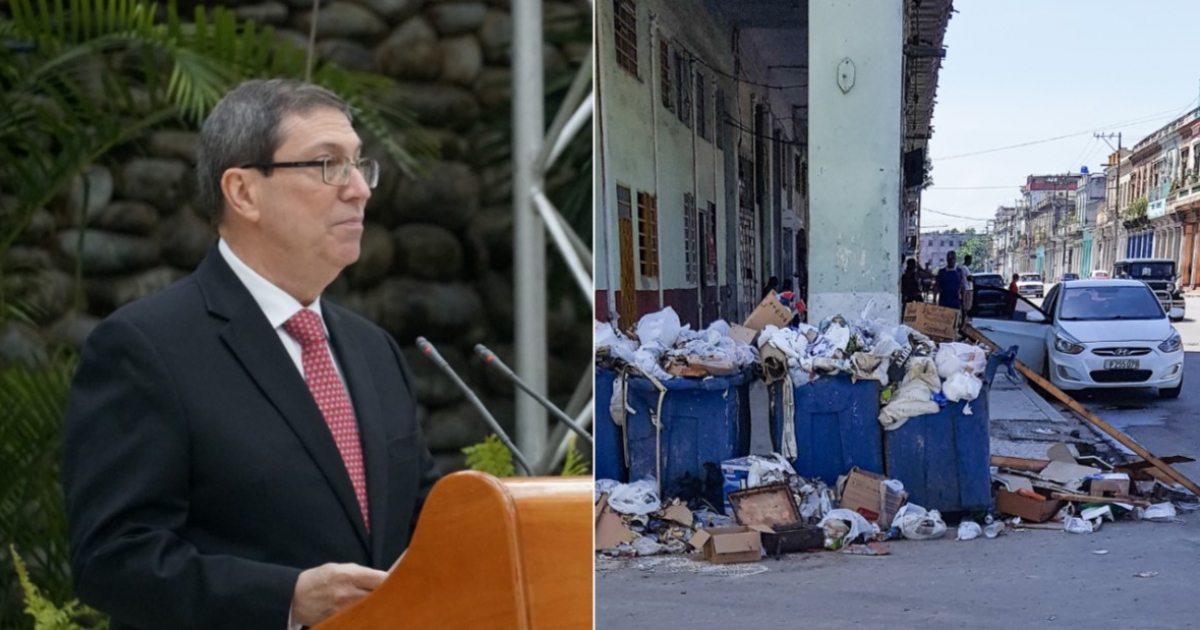
On Saturday, Cuban Foreign Minister Bruno Rodríguez Parrilla took the opportunity of World Population Day to issue a statement on social media platform X, where the regime claimed to reaffirm its "commitment to the well-being of the people" and the "social justice principles of the Revolution." This declaration comes at a time when Cuba is facing the most severe demographic crisis in its history alongside the fifth anniversary of the largest social uprising since 1959.
In his official post, Rodríguez Parrilla, accompanied by an institutional image from the Ministry of Foreign Affairs, attributed the country's "difficult socioeconomic situation" to the "tightened embargo, secondary sanctions, energy blockade, and threats of military aggression," while conveniently omitting any mention of the demographic disaster that the regime itself has contributed to.
What the message fails to acknowledge is that over a million Cubans have fled the island since 2021, the fertility rate has plummeted to 1.29 children per woman, and only 68,051 births were recorded in 2025—a record low since 1899.
Cuba's Aging Population and Demographic Decline
The United Nations warns that if the current trend isn't reversed, Cuba's population could dwindle to 5.6 million by 2100, compared to the estimated range of eight to 9.4 million currently, following the massive exodus.
A staggering 25.7% of Cubans are over sixty, making the island the most aged nation in Latin America. The government had postponed the 2025 census due to the economic crisis, rescheduling it for this year, leaving the actual population size unknown.
This statement arrives amid profound contradictions; it marks five years since the July 11, 2021 protests, the largest popular demonstrations in Cuba since 1959.
Political and Energy Crises Deepen
At least 338 individuals remain imprisoned for their direct involvement in those events, among a total of 1,260 to 1,281 political prisoners reported by human rights organizations as of May 2026.
The humanitarian pardon on April 2, 2026, which released 2,010 inmates, explicitly excluded the July 11 protesters.
The political contradiction is compounded by an energy crisis. On the eve of this anniversary, the National Electric System experienced its fourth total blackout of 2026 at 4:30 PM, the eighth in the past 18 months, sparking a wave of ironic comments on social media linking the blackout to the 11J anniversary. "Remember that tomorrow is July 11. It went out on the 10th and won't return until the 12th," quipped a Cuban user.
The record-breaking electricity deficit of 2,341 MW was recorded on July 8, with only 935 MW available to meet a demand of 3,100 MW. In Havana, power outages have averaged 15 hours daily in July, with some areas enduring over 72 consecutive hours without electricity.
Days earlier, Rodríguez Parrilla had launched a diplomatic offensive at the UN on July 7 to denounce the U.S. embargo, estimating damages at 8.103 billion dollars between March 2025 and February 2026.
Nevertheless, the deterioration of infrastructure like the Antonio Guiteras thermoelectric plant, without major maintenance since 2010 and with 17 system failures in 2026 alone, reflects decades of neglect that cannot be blamed solely on external factors.
While the foreign minister reiterated on social media the Party and Government's "commitment" to "sustainable development," thousands of Cubans endured this Saturday without electricity, marking the fifth anniversary of protests that the regime has never acknowledged for what they were: a desperate cry from a weary population.
Understanding Cuba's Demographic and Energy Challenges
What is the current demographic crisis in Cuba?
Cuba is experiencing a significant demographic crisis, with a declining fertility rate, a shrinking population due to mass emigration, and an aging populace. The fertility rate has dropped to 1.29 children per woman, and the population is projected to fall to 5.6 million by 2100 if current trends continue.
How is Cuba's energy crisis affecting its population?
Cuba is facing a severe energy crisis, with frequent and prolonged power outages affecting daily life. The electricity deficit reached a record high in July, with blackouts averaging 15 hours a day in Havana, and some areas experiencing outages of up to 72 consecutive hours.