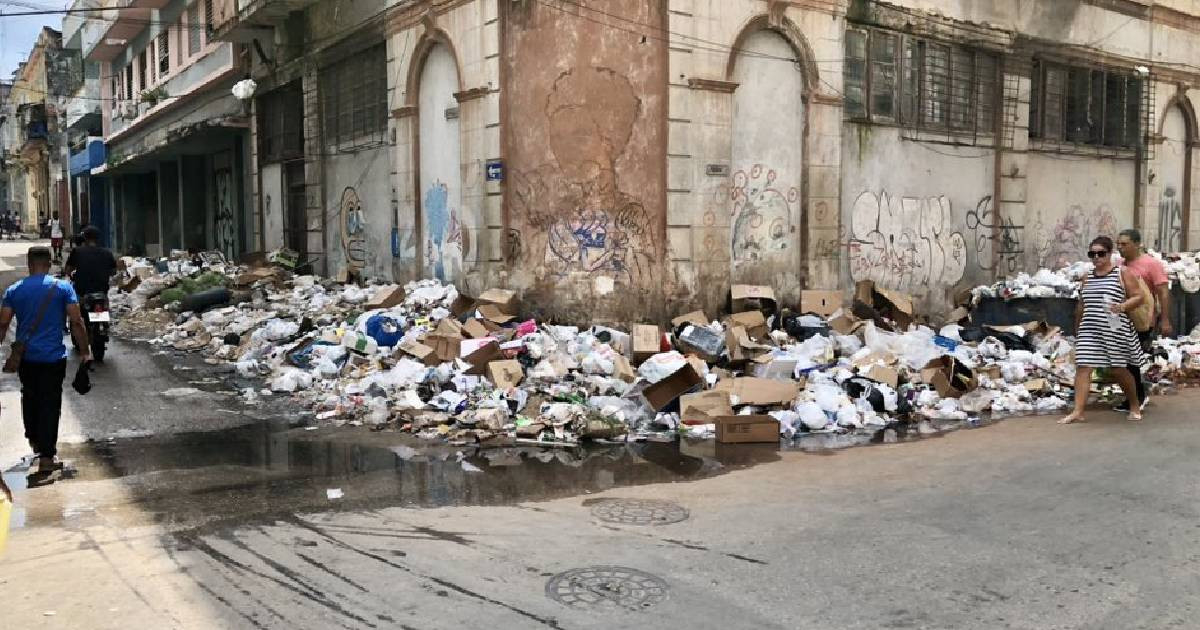
July's rainfall has unveiled the dire state of Havana's sanitary conditions. In neighborhoods where water is unavailable for up to five or ten days, residents are forced to resort to using plastic bags for defecation, which they then discard in makeshift dumps or even throw from buildings onto public streets. This alarming situation was highlighted on Saturday by historian Julio César González Pagés.
The issue predominantly affects areas such as Old Havana, Central Havana, and Cerro. González Pagés reports that with rainfall, the accumulated waste reemerges on the streets, and many bags burst under passing vehicles, spreading foul odors and attracting swarms of flies into homes.
"As summer arrives, Havana finds itself amidst garbage and feces, with scarce water, hygiene, and medicine, recalling the worst of its colonial past," summarized the historian in a social media post.
The Historical Echoes of Havana's Current Dilemma
Drawing a stark comparison to the past, González Pagés noted that in 1735, Captain General Juan F. Güemes (1681-1766) initiated the first systematic street cleaning in Havana due to similar waste accumulation issues. Back then, large dumps also posed a constant fire hazard—a risk that has resurfaced today.
This danger is not merely historical. On June 19, a fire sparked by burning garbage destroyed the side door of the Parroquia de los Escolapios in Central Havana. This marked the fourth such incident at the temple in less than three months.
Infrastructure Collapse and its Consequences
Havana's current predicament is the result of decades of neglect. The city’s sewer system, originally built between 1908 and 1914 for a population of approximately 600,000, now serves nearly two million people without having undergone any major upgrades.
Adding to the crisis is the collapse of waste collection services. Since February of 2026, only 44 out of 106 garbage trucks are operational due to diesel shortages and mechanical failures. Consequently, daily uncollected trash amounts to as much as 23,814 cubic meters from the 24,000 to 30,000 cubic meters of waste generated by the city.
Moreover, Havana has a mere 10,000 garbage containers, but requires between 20,000 and 30,000 to meet the actual demand. In June, the system's failure was so pronounced that young military service members were deployed to manually collect trash with shovels and bags across various locations in the capital.
Health Risks and Public Safety Concerns
Experts warn that the growing heaps of garbage and feces are a direct threat to public health. The Food Monitor Program has cautioned that flies, cockroaches, rats, and other vectors can carry pathogens to food consumed by the populace. According to a biologist consulted by the organization, the current conditions are ripe for a gastroenteritis epidemic to occur at any time.
The impact on public health is already evident. Cuba ended 2025 with at least 81,909 cases of dengue and chikungunya, and 65 officially acknowledged deaths. The outbreak persists into 2026, with over 2,800 cases reported across 134 municipalities.
In this bleak scenario, images of food being sold on streets lined with trash piles and accounts from residents who claim they have "hit rock bottom" portray a city where the lack of water, garbage accumulation, and deteriorating basic services have thrust vast areas of Havana back into sanitary conditions reminiscent of centuries past.
Understanding Havana's Sanitation Crisis
What are the main areas affected by Havana's sanitary issues?
The areas most impacted are Old Havana, Central Havana, and Cerro.
What historical parallels exist with Havana's current situation?
Historian Julio César González Pagés draws parallels with the colonial period, specifically referencing Captain General Juan F. Güemes' 1735 mandate for street cleaning due to similar waste issues.
How has the waste collection system in Havana failed?
The system has collapsed due to diesel shortages and mechanical failures, with only 44 out of 106 garbage trucks operational, leaving up to 23,814 cubic meters of trash uncollected daily.
What are the health risks associated with the sanitation crisis?
The accumulation of waste poses a direct threat to public health by facilitating the spread of pathogens through vectors such as flies and rats, increasing the likelihood of disease outbreaks like gastroenteritis.