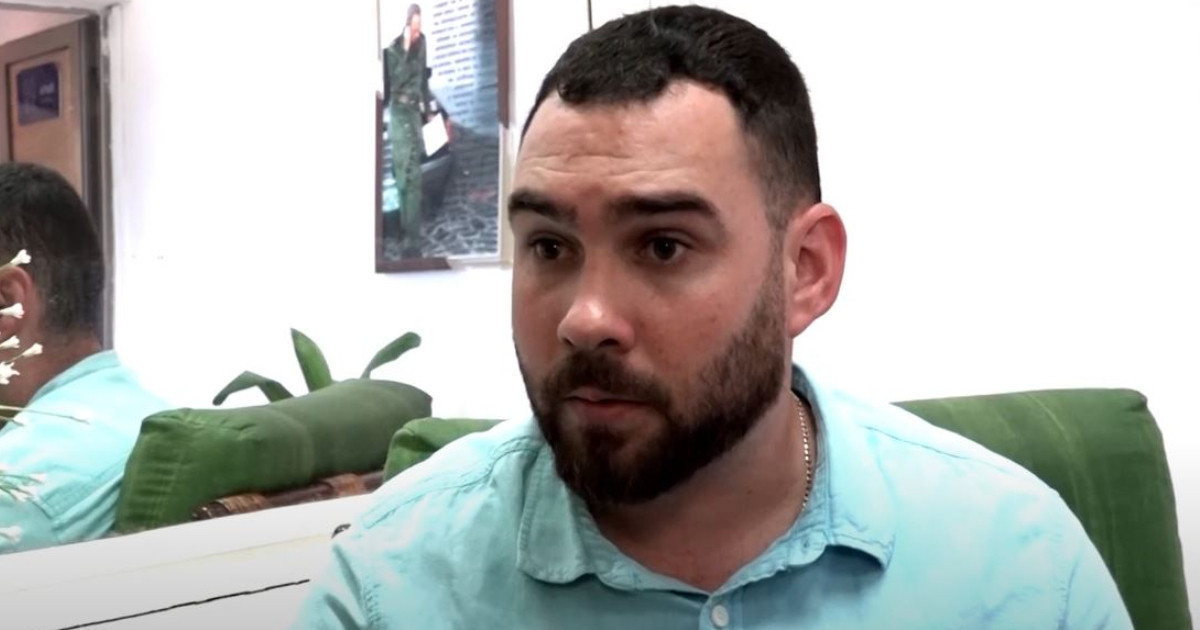
Elián González, a member of Cuba's National Assembly, has pointed fingers at the media, particularly those based in the United States, for distorting the island's image on the global stage. His comments came during an interview published on Friday.
"The issue with Cuba is heavily manipulated by media outlets operating from the United States, which portray us negatively. The average Spaniard only knows that Cuba is communist and thinks it's the worst," the 32-year-old lawmaker stated in an interview with the Spanish magazine Contexto y Acción (Ctxt).
González made these remarks while visiting Spain under the auspices of the Movimiento Estatal de Solidaridad con Cuba (MESC), aiming to "convey to Spain the reality of what is happening in Cuba."
The former child rafter, famously returned to his father in 2000, went further by addressing those who view Cuba as a dictatorship that oppresses its people.
"They believe that narrative, that rhetoric of Cuba as a country with a dictatorship and a repressed population," he asserted.
Comparisons and Contradictions
González argued that the lack of support for Cuba in Spain stems from a lack of information through media channels, drawing a comparison to the conflict in Gaza.
"Take Palestine as an example: that news reached people. They saw a slaughtered population, which spurred widespread popular mobilizations," he explained.
However, González refrained from offering any self-criticism regarding the Cuban regime's management. When asked by the newspaper El Comercio to point out government errors, he responded, "It's difficult for me to say. I wish I knew what should be done to improve the situation."
This stance aligns with his past statements. In October 2025, González claimed that the Cuban government "does not make major mistakes" and blamed Washington for the entire crisis.
Ambiguous Economic Reforms
Regarding reforms led by President Miguel Díaz-Canel, González sidestepped questions about whether they signal a shift toward a mixed economic model, maintaining an ambiguous stance.
"We are not copying any model. We haven't copied the Russian or Chinese models. We are trying to build our own socialism," he remarked.
The lawmaker described Cuba's current situation as "the worst blockade experienced in the revolutionary era," deeming it a "medieval, brutal siege without any legitimacy," while placing sole responsibility for Cuba's multiple crises on U.S. sanctions, ignoring the regime's decades of mismanagement.
Controversial Public Appearances
During his stay in Spain, González participated in a roundtable at the Semana Negra de Gijón on July 5, alongside Fidel Castro Smirnov, grandson of dictator Fidel Castro (1926-2016). There, he claimed that being a revolutionary in Cuba "requires criticism, self-criticism, and creativity."
The event was disrupted by Cuban activist Adelainys Castán, who shouted "Murderers!" and sang "Patria y Vida" before being removed from the venue.
González also discussed the July 7 vote at the United Nations, which approved an urgent debate on the embargo against Cuba with 136 votes in favor—a significant decrease from the 165 votes in October 2025—and 30 abstentions, double the previous year.
He accused Secretary of State Marco Rubio of sending a diplomatic cable to pressure ambassadors to block the debate, calling it "the height of hypocrisy."
The regime celebrated the U.N. outcome but concealed the doubling of abstentions, a fact that González also omitted in his public statements.
Understanding Media Influence on Cuba's Image
How does Elián González view the role of media in shaping Cuba's image?
Elián González believes that media, especially those from the United States, manipulate Cuba's image, portraying it negatively and misleading the international community about the country's reality.
What comparison did González make regarding media coverage?
González compared the lack of media coverage on Cuba to the situation in Palestine, noting that the latter received significant attention, leading to popular mobilizations, unlike the Cuban scenario.