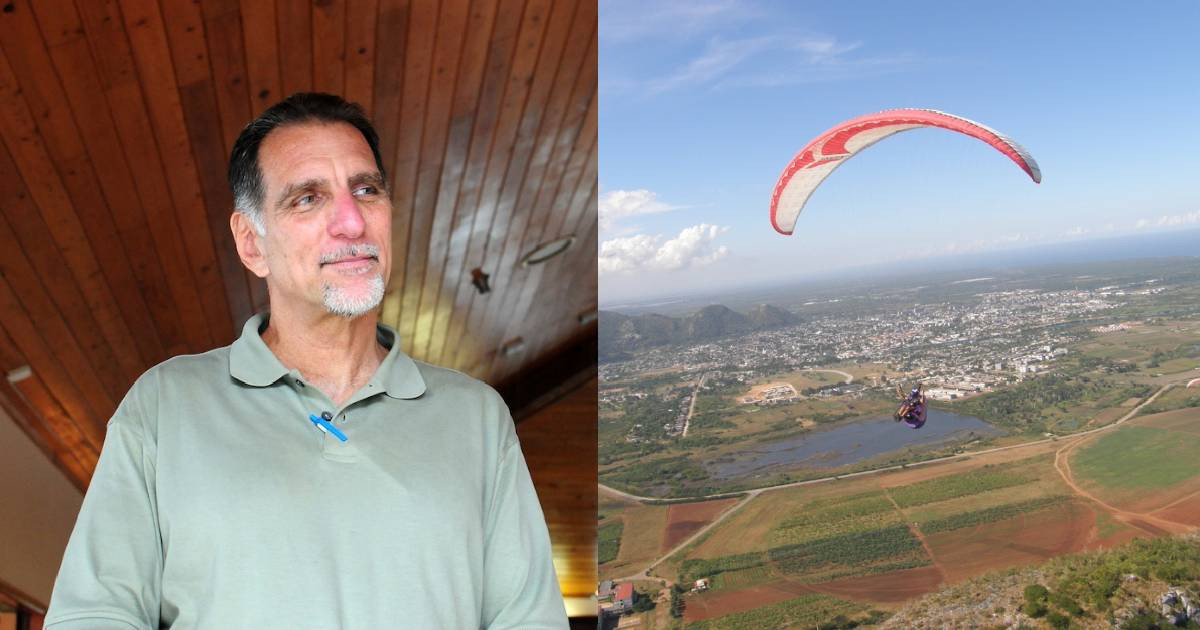
On Friday, René González Sehwerert, the president of the Cuban Aviation Club (CAC), publicly defended his organization and the pilot involved after a tragic paragliding accident resulted in the death of a 12-year-old boy named Alejandro on Saturday, July 5, in Isla de la Juventud.
The young boy, a resident of the Abel Santamaría neighborhood, was participating in a tandem flight at Minint Beach, located in the Cayos Los Monos area, when a sudden strong gust of wind blew the aircraft out to sea, necessitating an emergency landing approximately 500 meters from the shore.
While attempting to unbuckle the harnesses in the water, the pilot lost control over the passenger. According to the official statement released by the CAC, the young boy "disappeared before he could be rescued."
After more than 21 hours of intense searching, his body was discovered around 12:30 p.m. on Monday, July 7.
In response to the public outcry, González issued a statement in an effort to downplay the organization's responsibility.
"This is the first fatality the CAC has encountered in 15 years, during which 60,000 tandem parachute jumps have been completed," he stated, adding that "thousands of paramotor and paragliding flights, including hundreds with minors," have been conducted in that time frame.
He also defended the pilot's decision to release the harnesses, arguing that "releasing the harnesses is essential to assist the passenger in the water, as the equipment could drag both down if not freed."
González urged caution before passing judgment, pending the completion of an investigation to determine whether safety protocols were followed.
However, his account was publicly disputed by the aerial sports community, which documented at least four previous fatalities in Cuban air sports between 2022 and 2023.
The Facebook page "Amantes de la Aviación Cubana" identified the victims: Fabián Batista Hidalgo, who died in a paragliding accident in Santiago de Cuba in December 2022; Raidel Cobas, in a skydiving incident in March 2023; along with Miladis Ríos Góngora and Edelio Varona Pino.
The Cuban Parachuting Federation itself contradicted González's narrative by stating that "the aerial sports community is in mourning," a phrase suggesting familiarity with past tragedies, rather than an unprecedented event.
González, a former spy from the Wasp Network who was convicted in the United States for espionage in the 1990s and later honored as a Hero of the Republic upon his return to Cuba, has been leading the CAC since his homecoming, guiding the country's aerial sports.
A joint commission from the CAC and the Cuban Civil Aviation Institute (IACC) departed for Isla de la Juventud on Tuesday, July 8, to assess the legal, technical, and safety aspects of the flight. The findings of this investigation have yet to be released.
Paragliding Safety and Regulations in Cuba
What caused the paragliding accident in Isla de la Juventud?
A sudden strong gust of wind blew the paragliding aircraft out to sea, resulting in an emergency landing about 500 meters from the shore. The pilot lost control while attempting to release the harnesses in the water.
How did René González defend the actions of the pilot and the CAC?
René González cited the organization's safety record, highlighting that it was the first fatality in 15 years with thousands of successful flights. He stressed the necessity of releasing harnesses in water emergencies to prevent both pilot and passenger from being dragged down.
What is the current status of the investigation into the accident?
A joint commission from the Cuban Aviation Club and the Cuban Civil Aviation Institute is investigating the incident, focusing on legal, technical, and safety elements. The results have not yet been published.