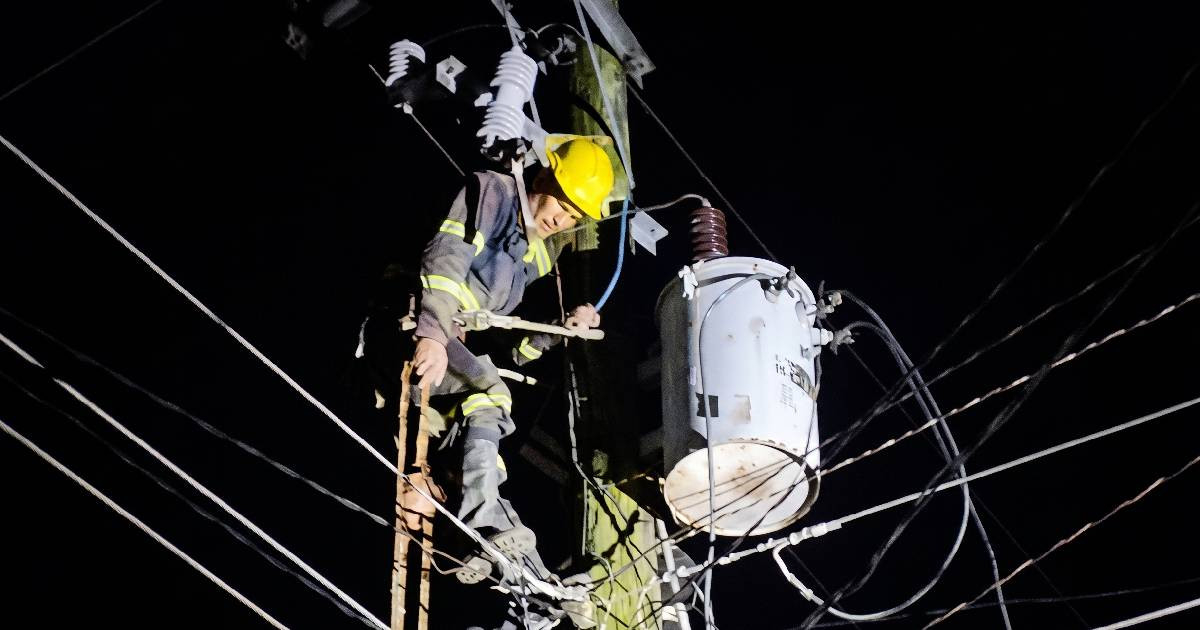
A failure in the 220 kV transmission line linking Santa Clara to Sancti Spíritus triggered Cuba's fourth complete blackout of 2026 this past Friday. According to a post by Unión Eléctrica on Facebook, the incident began at 3:55 PM, leading to a full disconnect of the National Electric System (SEN) by 4:30 PM, just 35 minutes later.
The state-run company detailed a rapid sequence of events: "At 3:55 PM, a failure occurred in the 220 kV line from Santa Clara to Sancti Spíritus, causing a split in the National Electric System, the shutdown of several thermal units, and a fluctuation in SEN parameters. Collectively, this resulted in a total disconnection at 4:30 PM," the UNE noted in its statement.
Severe Energy Deficit Exacerbates Crisis
The collapse unfolded amidst an extremely fragile energy landscape. On the same day, the SEN's availability was a mere 935 MW against a demand of 3,100 MW, forecasting a shortfall exceeding 2,100 MW. Additionally, 106 distributed generation plants were inactive due to a lack of fuel, representing 890 MW more out of service.
The day began with a promise that few believed: the Antonio Guiteras Thermoelectric Plant declared it would begin startup procedures to join the SEN during peak demand hours. This plant, which has lacked comprehensive maintenance since 2010, has experienced 17 outages so far this year alone.
Political Tensions and Public Outrage
This blackout marks the eighth in roughly two years and the fourth in 2026 alone. Merely four days earlier, on July 6, Cuba experienced its third nationwide blackout, plunging about 9.6 million people into darkness. On July 8, the country witnessed its largest energy deficit in history: 2,341 MW, affecting 73% of the population simultaneously.
The political backdrop adds further weight to this event: the blackout coincided with the eve of July 11, the anniversary of the massive 2021 protests. Several users highlighted this timing in comments on the official post, with phrases like "just hours away from July 11." Meanwhile, Miguel Díaz-Canel has only called for "better organization" of blackouts without introducing any measures to boost electricity generation.
On social media, the public's reaction mixed outrage, disbelief, and sarcasm. Many questioned the UNE's technical explanation: "And in those 35 minutes, is there no action plan in the SEN to prevent such a failure in the 220 kV line between the two cities from going beyond the local scope? Or at least limit it to a partial disconnection?" one user asked. Another summed up the situation with irony: "Now, even a short circuit in a household outlet can bring down the SEN."
Underlying Issues and Regime Denial
Other comments pointed to the real cause that the regime avoids acknowledging: "Let's say there's no fuel," one commenter wrote. Cuba has been over three months without receiving oil shipments, operating on solar energy, natural gas, and poorly maintained plants. The country's thermoelectric stations range from 40 to 60 years old without comprehensive maintenance.
That same day, Havana abandoned managing blackouts by blocks, switching to a circuit-based system due to the inability to maintain any rotation scheme. In some areas of Matanzas, outages have lasted up to 87 consecutive hours, while in Havana, the average is 15 hours daily without power. Restoring service after a total disconnection requires creating regional microsystems before reconnecting the major thermoelectric plants, a process that can stretch over several days, as one user bitterly noted: "The never-ending story."
Understanding Cuba's Energy Crisis
What caused the recent nationwide blackout in Cuba?
A failure in the 220 kV transmission line between Santa Clara and Sancti Spíritus led to the total disconnection of Cuba's National Electric System.
How has the energy deficit affected Cuba?
Cuba faces a severe energy deficit with a demand of 3,100 MW and availability of only 935 MW, leading to frequent blackouts and affecting daily life significantly.
How has the public reacted to the blackouts in Cuba?
Public reaction has been a mix of outrage, disbelief, and sarcasm, with many questioning the government's explanations and management of the crisis.