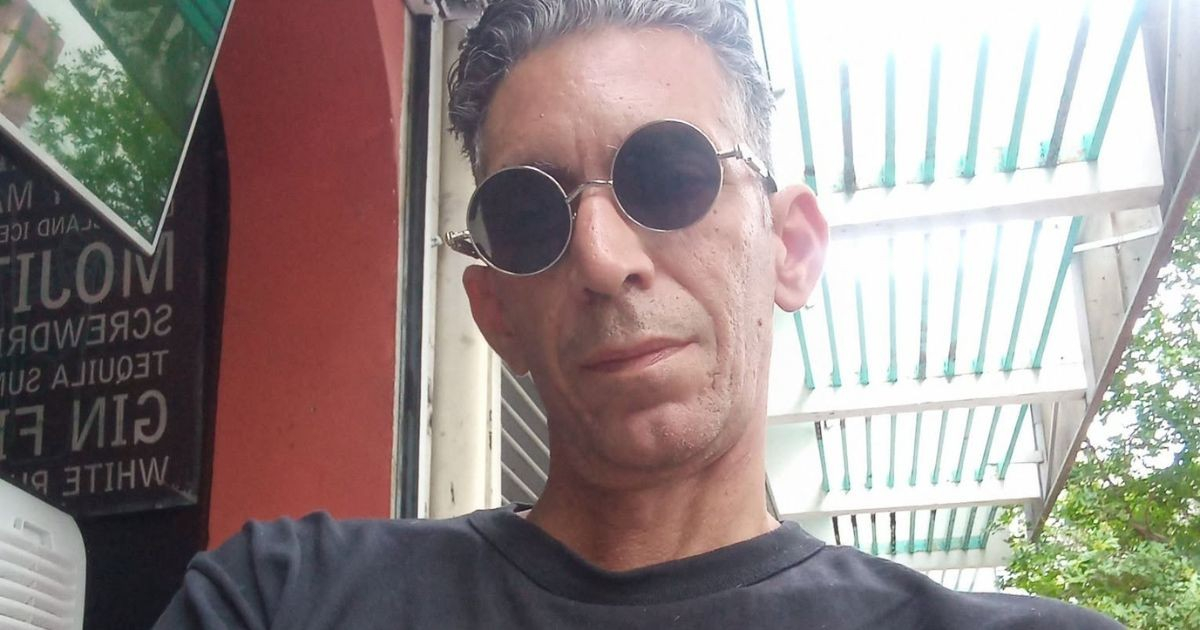
On Friday, Cuban poet Poe Cid shared a poignant piece on his Facebook profile—a poem composed of three eleven-syllable stanzas that starkly captures the spiritual devastation inflicted by the totalitarian regime on his generation. It concludes with the striking lines: "I was a model pioneer, now I'm left / wounded, without a homeland... distant... mad."
Known by his pen name, Poe Cid, Jorge García Prieto hails from Havana, born in 1979. A cultural promoter from the Arroyo Naranjo municipality, he has been recognized with accolades such as the National Décima Francisco Riverón Hernández Award in 2017, the Ciudad del Che Award in 2022, and the Cucalambé Décima Award in 2023. His voice doesn't belong to an outsider of the system; rather, it reflects someone who was nurtured by it, served it, and was ultimately betrayed by it, like so many others.
The Power of Unanswered Questions
The poem confronts the regime’s authority, embodied in an image of Raúl Castro and his grandson Raúl Guillermo (El Cangrejo), by posing a series of unanswered questions. It begins with: "Is your job to make me endure? / Is my job to make you thrive?" This opening stanza ends with an indictment: "There’s a blacklist, and I’m on it." This reference to blacklists, used by the regime to marginalize critical artists and intellectuals, is not merely symbolic; it’s a well-documented tactic that has silenced generations of Cuban creatives.
Echoes of Historical Brutality
At the heart of the poem lies a haunting image: "And Abel Santamaría's eyes?" This alludes to the young martyr of the 1953 Moncada Barracks assault, who was captured, tortured, and killed at 25. The brutality the regime claims to condemn in its foundational martyrs, the poet argues, is the same brutality it enacts today against its own citizens.
Existential Despair and Irony
The second stanza escalates to existential exhaustion: "My time is already burned. At my age / they have pulled out the nails. Already festering." It then turns to a bitter irony that borders on the absurd: "Could there at least be another torture / without resorting to so much darkness? / For instance: the drop on the head. / Or perhaps, I don't know: the guillotine / and chasss, it’s over. Yet it never ends."
The final lines encapsulate the tragedy of a generation indoctrinated from childhood. The reference to the "model pioneer" nods to the José Martí Pioneer Organization (OPJM), established in 1961, which historically grouped 98.5% of Cuban children under the slogan "Pioneers for Communism... We will be like Che." These children were promised a future of dignity. The poem is the reckoning of that broken promise: "Don't torture me anymore... turn off the light. / Don't interrogate me anymore... they have undone me."
A Nation in Crisis
The poem emerges amid heightened social tension. This Friday, Cuba faced a power generation deficit exceeding 2,341 MW, leaving 73% of the country without electricity, while average monthly salaries hover between 10 and 15 dollars, and the economy is expected to contract by at least 6.5% by 2026. Some independent forecasts predict a contraction exceeding 10%.
The chasm between the populace and the elite has been given a face in the recent public discourse: Raúl Guillermo Rodríguez Castro, who in an interview with USA Today wore Hermès sneakers, a Hugo Boss shirt, and a Rolex watch, lamenting, "It pains me deeply that people can't live like I do." The outrage sparked by these words reverberates through every line of the poem as an unintentional counterpoint.
Julio César González Pagés, a noted academic, remarked this week that "the misery and desolation experienced by ordinary Cubans is the backdrop for many creative discourses" centered on homeland and nation. He added, "Time keeps passing, and those concentrated in silence continue to die in dark hospitals and homes without medicine, food, water, and electricity." Poe Cid's poem is precisely that voice that refuses to die in silence: "From there, certainty led to suicide. / Little foam in the sea and beer. / Few spores in the good. Everything very little."
Understanding the Impact of Cuban Poetry
What is the significance of the "model pioneer" in the poem?
The "model pioneer" refers to the José Martí Pioneer Organization, which indoctrinated Cuban children with promises of a dignified future under communism. The poem highlights the disappointment and betrayal felt by a generation that was raised with these ideals.
How does the poem reflect the current socio-economic situation in Cuba?
The poem reflects the dire socio-economic conditions in Cuba, where power outages, low wages, and economic contraction exacerbate the sense of betrayal and despair among the populace.