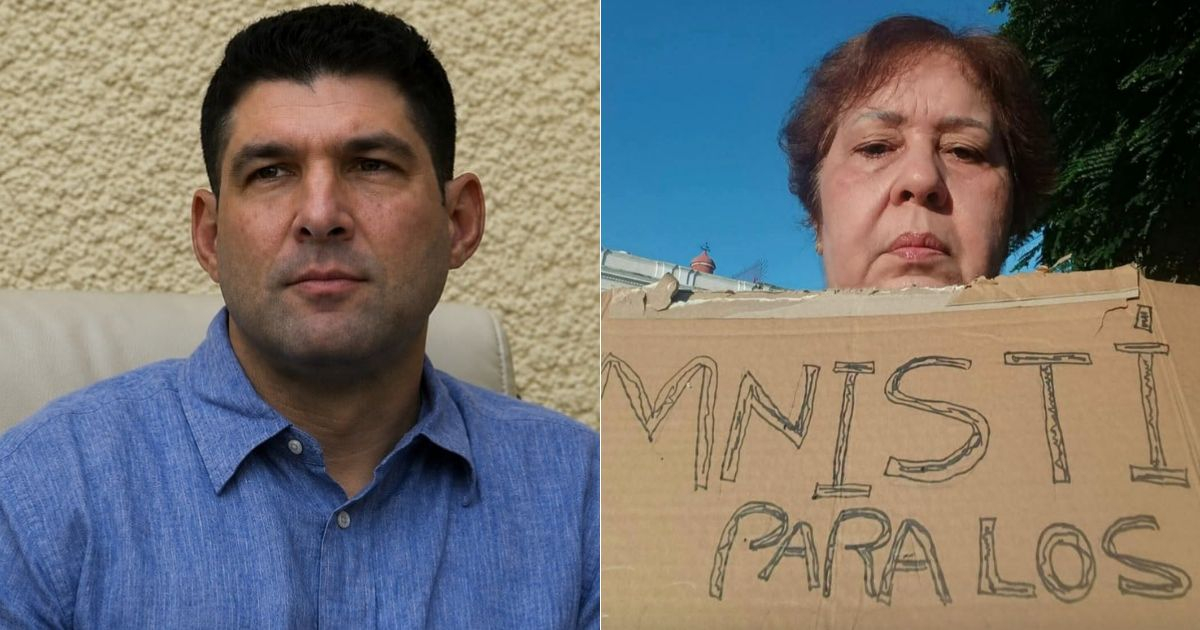
Cuban historian and professor Alina Bárbara López Hernández offered a scathing analysis this Friday of the media campaign surrounding Raúl Guillermo Rodríguez Castro, the grandson of Raúl Castro known as "the Crab," following a profile published by USA Today on July 6th.
In her piece on CubaxCuba, López Hernández argues that the USA Today article is not crafted for the Cuban audience but rather aims to shape international perceptions—particularly targeting President Donald Trump—about the man the regime is trying to position as the potential face of a future Cuba.
López Hernández identifies several claims in the profile that she sees as part of a deliberate narrative: that Raúl Guillermo wields considerable influence, authority, and political weight; that he is poised to negotiate his country's future; and that he serves as a bridge to U.S. negotiators. According to López Hernández, the article concludes with an implausible pitch: portraying the Crab as a beacon of hope not only for the political class he represents but also for the Cuban people.
USA Today ends its profile with what López Hernández describes as a propagandistic image: "Whether or not Rodríguez Castro ascends to the top of formal power on the island, he already commands authority. In meetings with top Cuban officials, everyone defers to him. When he walks down a hallway, people stand. And on the street, Cubans stop to watch him pass."
López Hernández suggests the profile is a "commissioned work" designed to appeal to Trump: Raúl's grandson is no traditional politician, enjoys luxury and private parties, and his favorite baseball team is the New York Yankees, just like the U.S. president's.
The Urgency Behind the New Face of Cuban Politics
To understand why the regime feels the need to hastily construct this new interlocutor, the analyst examines the state of Castro's succession. At 95, Raúl Castro's advanced age coincides with the terminal crisis of the model he built. None of his natural successors survived or proved viable: his son-in-law Luis Alberto Rodríguez López-Calleja, head of GAESA, died in July 2022 at 62; Commander Ramiro Valdés passed away on June 21, 2026, at 94; and Fidel Castro Díaz-Balart, Fidel's son, took his own life in February 2018.
Among Raúl's children, Alejandro Castro Espín was involved in negotiations with Obama from 2013 to 2014, which stalled at partial reforms. Mariela Castro is a staunch critic of imperialism and Trump among international leftist circles, making any pivot toward Washington unfeasible. Thus, according to López Hernández, "only Raúl Guillermo remains," who transitioned from merely guarding his grandfather to overseeing classified reports from three ministries, acting as a liaison between GAESA and Raúl Castro, and making 23 trips to Panama last year seeking investment opportunities.
Constructing a New Political Narrative
When recently asked about Raúl Guillermo, Cuba's ambassador to Uruguay offered a nervous smile and replied, "a guardian of his grandfather." This response illustrates, according to López Hernández, how recent and rapid this "express construction of the character" has been, initiated only after events in Venezuela and Trump's ultimatum to the Cuban regime.
López Hernández also criticizes Raúl Guillermo's own contradictions. In his USA Today interview, Raúl's grandson stated, "It pains me greatly that people can't live like I do. My greatest sorrow is that people struggle." Yet, this same figure expressed a wish for Cubans to be able to "buy foie gras in supermarkets," in a country where 89% lived in extreme poverty by 2025, and more than 11,000 protests shook the island that year.
The activist concludes with a warning that transcends the individual: "It's not about Raúl Castro's grandson being the sole representative of Cuban national interests at a negotiation table with the United States; it's about legitimizing, before Washington, an inexperienced scion from the power group, albeit open to capitalist development, over any institution, so that when the 'historical generation' soon disappears, the political exclusion system they created remains unchanged."
López Hernández writes from house arrest, a situation she has been under since June 18, 2024, while her trial in Matanzas remains indefinitely postponed.
Understanding Cuba's Political Landscape
Who is Raúl Guillermo Rodríguez Castro?
Raúl Guillermo Rodríguez Castro is the grandson of Raúl Castro, known for his influence within Cuba's political landscape. He is being portrayed by some as a potential future leader of Cuba.
Why is Raúl Guillermo being promoted internationally?
The regime seeks to shape international perceptions, particularly in the United States, by positioning Raúl Guillermo as a potential face of Cuba's future amid a transition of power.
What challenges face the Cuban succession plan?
Cuban succession faces challenges such as the advanced age of Raúl Castro, the deaths of potential successors, and the regime's need to establish a credible new face for the future.