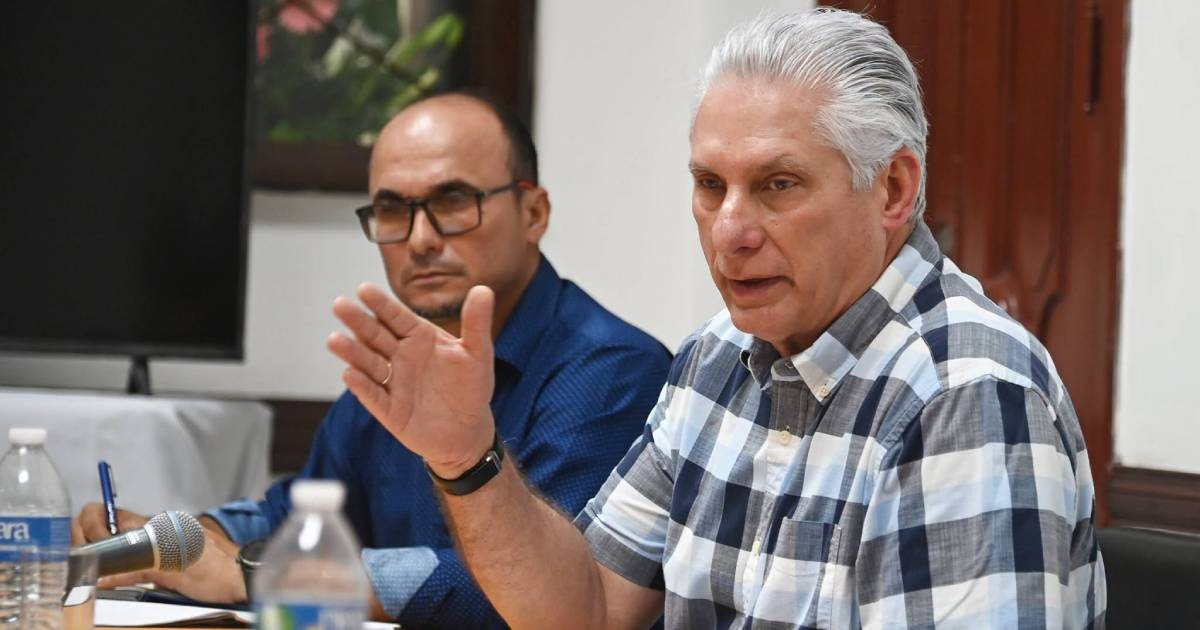
In the midst of a severe electrical crisis, the likes of which Cuba has not seen in decades, Miguel Díaz-Canel visited the Havana municipalities of Centro Habana and Plaza de la Revolución on Wednesday. During his visit, he urged local authorities to "better organize the scheduling of blackouts," as reported by the official website of the Presidency.
Instead of focusing on increasing power generation, the leader's primary directive was to manage power outages more efficiently. Among the proposed measures were a review of the so-called prioritized circuits—18 lines that supply hospitals, water pumping systems, tourist facilities, and some thermoelectric plants—and the promotion of renewable energy sources in social centers, economic entities, and homes.
The official report acknowledged the crisis's impact, admitting that "long hours of blackout" complicate water supply and food preparation, a daily hardship for thousands of Cubans. In Havana, power cuts average about 15 hours per day, while provinces like Matanzas have experienced outages lasting up to 87 consecutive hours.
Díaz-Canel's visit came just three days after the third nationwide blackout of 2026, marking the seventh total collapse of the National Electric System in the past 18 months. The shutdown of Unit No. 6 at the Nuevitas thermoelectric plant in Camagüey triggered a cascading disconnection that left nearly the entire island without electricity.
Although the Electric Union managed to technically restore the system by early Wednesday morning, the generation deficit continued to worsen. That same day, the country recorded a new historic high in electrical deficits: 2,341 megawatts, surpassing the previous record of 2,208 MW set in late June.
The magnitude of the issue underscores the structural deterioration of Cuba's energy system. While demand hovers around 3,100 MW, available generation barely reaches 1,000 MW, necessitating prolonged scheduled outages across much of the country.
Compounding the problem is the aging infrastructure of the thermoelectric plants, many of which haven't received major maintenance in over a decade. The Antonio Guiteras Thermoelectric Plant, the country's largest generator, has been offline 17 times in 2026 alone.
The crisis is also exacerbated by a fuel shortage. Cuba requires about 110,000 barrels of oil daily but produces only around 40,000. In recent months, external crude supplies have also diminished, complicating efforts to sustain electricity generation.
The Cuban government blames the U.S. embargo and difficulties in accessing fuel, while various economists and specialists point to years of underinvestment, infrastructure decay, and a lack of modernization in the electrical system. Estimates suggest that an investment between $8 billion and $10 billion is needed to revitalize the national energy grid.
The president's visit is part of a broader tour of Havana's municipalities to oversee the implementation of 176 economic and social transformations approved by the government in June. This package includes changes to the operation of micro, small, and medium enterprises (MSMEs), the banking system, and tax policies.
Following the meeting in Centro Habana, Díaz-Canel spoke with residents gathered in the area about the country's "tense energy situation." However, he did not announce any new measures to boost power generation nor provided a timeline for when the prolonged blackouts affecting millions of Cubans might decrease.
Understanding Cuba's Energy Crisis
What is the main cause of Cuba's energy crisis?
The crisis is primarily due to the structural deterioration of the energy system, lack of modernization, underinvestment, and fuel shortages.
How has the government responded to the energy crisis?
The government has focused on better managing blackouts rather than increasing power generation and has blamed the U.S. embargo for the situation.
What steps are being taken to address Cuba's energy issues?
Proposed measures include reviewing prioritized circuits and promoting renewable energy sources, though significant investment is required to revitalize the grid.