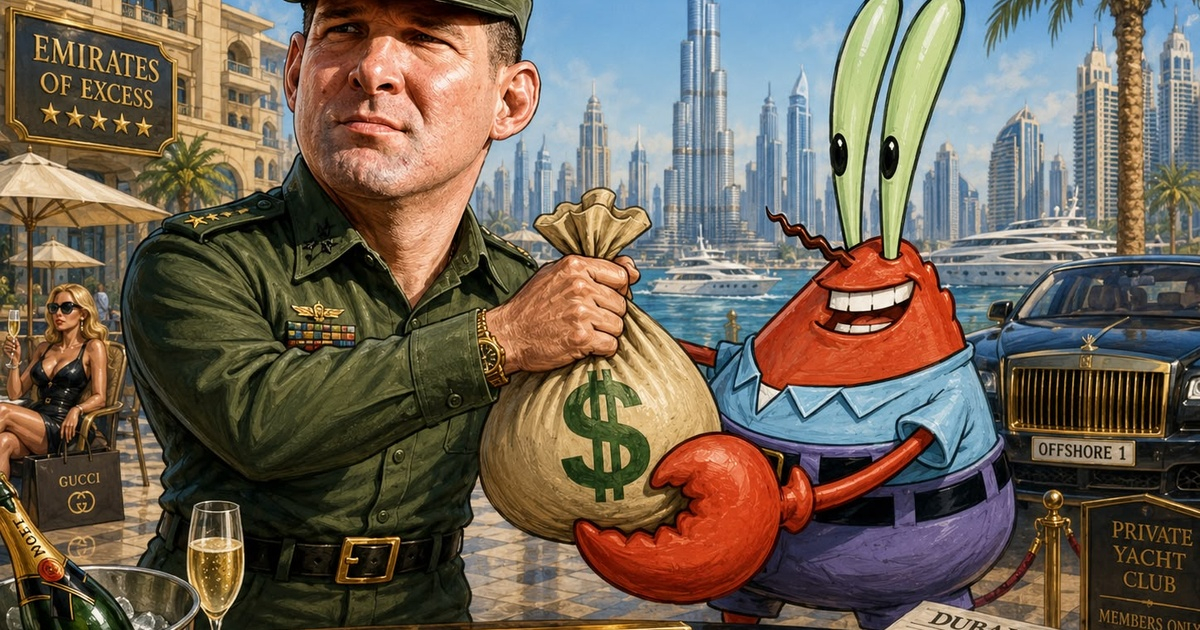
Until recently, Raúl Guillermo Rodríguez Castro, known as "El Cangrejo," was more notorious for his lavish and hedonistic lifestyle than for any political acumen. As the grandson of Raúl Castro and part of the elite that took over Cuba in the name of the poor, he appeared on social media more often indulging in Cuban urban subculture, drinking, dancing, and nightlife than addressing the dire issues facing a nation devastated by his family.
There are videos of him intoxicated, dancing, enjoying a life of privilege that starkly contrasts with the hunger, power outages, and despair of the Cuban people.
From Party Animal to Political Player?
Suddenly, as if this Crustacean had been plucked from the depths of the sea to the shadowy halls of Castro's power, El Cangrejo has reemerged as a "negotiator." No longer just the pampered heir of a family accustomed to living above the rest of the Cubans, he now postures as the Castro family's dolphin and a potential interlocutor with the United States. All this, of course, without any official position, popular mandate, election, or legitimacy—his only credential being his last name.
The situation would be laughable if it weren't so tragic. Cuba is sinking amidst blackouts, hunger, crumbling hospitals, pitiful wages, political repression, and prisons crowded with prisoners of conscience. The population increasingly protests against the lack of freedom and basic necessities. Amidst this crisis, enters the Crustacean, reeking of alcohol and scandals, posing as a statesman concerned for his people.
An Inevitable Comparison
It’s hard not to liken him to Mr. Krabs, Eugene H. Krabs from SpongeBob SquarePants, who is obsessed with money. The tropical Crab of the Castro dynasty seems to have shifted his obsession from bohemian life to political ambition.
Dancing to urban beats is no longer enough; now he aspires to dance over the destiny of millions of Cubans, as Fidel Castro did and his grandfather still does. He is not satisfied with his luxurious life; he wants the throne and the continuation of Castroism. He dreams of becoming Cuba's Kim Jong-un, the youthful face of an old and criminal family tyranny.
Growing Dissent Among Supporters
The rejection from the vast majority of Cubans is clear. No more Castros in power. Interestingly, the discontent isn't just from opposition and oppressed citizens. Even voices from typically compliant sectors have spoken out.
Israel Rojas of Buena Fe, long associated with the regime's cultural defense, reacted with unusual criticism, calling the situation "indecent, unjust, indecorous" and refusing to justify such actions with his loyalty. Similarly, María del Carmen Hernández Carús directly questioned why no one brings this "boy" down from his high horse. Photographer Kaloian Santos highlighted the deep delegitimization caused by seeing a privileged heir occupy spaces meant for institutions, officials, and the people.
Even Cuba's ambassador to Uruguay, Lissett Pérez, while not directly criticizing the character, downplayed him to a mere bodyguard of Raúl Castro, not as a statesman, negotiator, or political figure.
The Crumbling Facade of Castroism
If traditionally obedient voices are critical, what are the old generals thinking? What about the colonels, high-ranking officials, Manuel Marrero Cruz, Bruno Rodríguez Parrilla, Roberto Morales Ojeda, ministers, and party bureaucrats? Most notably, what is Miguel Díaz-Canel, the "president," feeling as he increasingly seems like a secondary actor reading a script written by others?
El Cangrejo exposes the institutional farce of Castroism. It reveals that behind the president, the Parliament, the Party, and the Ministry of Foreign Affairs, the family still rules. But it also shows that this family no longer commands the same reverential fear. The throne is shaking, the court is murmuring, the people are protesting, and even some palace musicians are off-key.
Everything is aligning against the Castrocommunist dynasty, and the Cuban people are increasingly understanding that the solution to this grave tragedy does not lie in minor economic reforms or an "enchanted crab," but in achieving freedom, democratizing Cuba, and casting the Castro family and all who thrived by enslaving the nation into the dustbin of history.
Understanding Cuba's Current Political Climate
Who is Raúl Guillermo Rodríguez Castro?
Raúl Guillermo Rodríguez Castro, nicknamed "El Cangrejo," is the grandson of Raúl Castro and part of the Cuban elite. He has recently emerged as a controversial figure attempting to position himself as a negotiator with the United States, despite lacking any formal credentials or position.
What has been the public reaction to El Cangrejo's rise?
The public reaction has been largely negative, with many Cubans rejecting the idea of another Castro in power. Criticism has also emerged from typically pro-regime figures, highlighting a growing discontent with the current leadership.
How does El Cangrejo's lifestyle contrast with the situation in Cuba?
El Cangrejo's lavish lifestyle, often displayed on social media, starkly contrasts with the dire conditions many Cubans face, including hunger, power outages, and political repression.