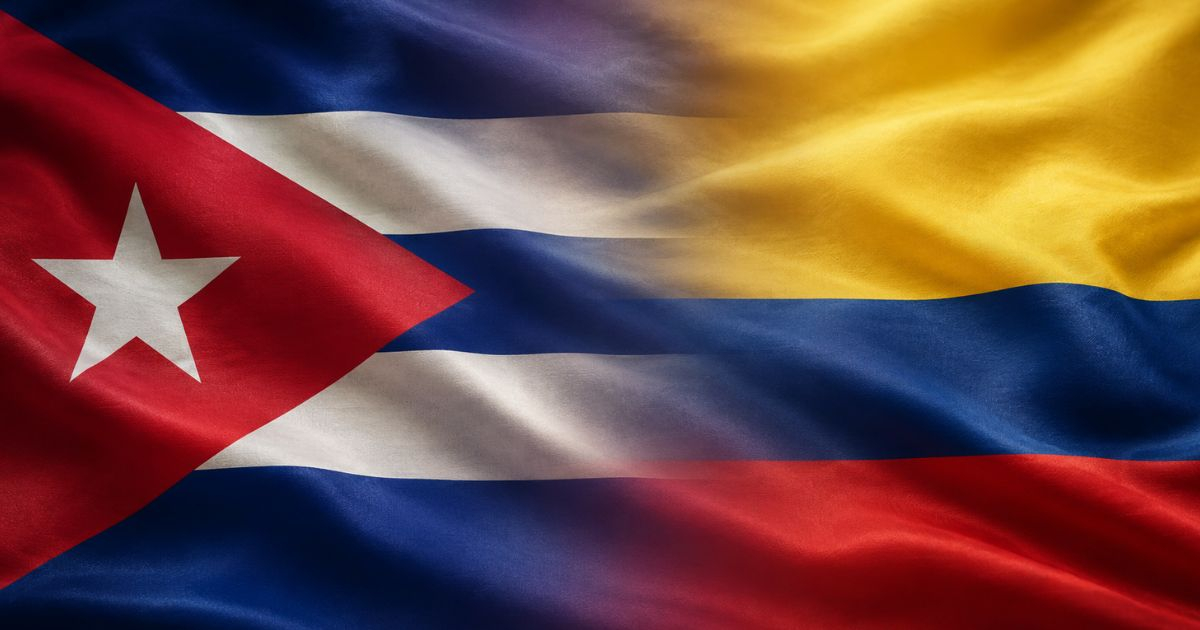
Colombia's appointed Foreign Minister, Omar Bula, declared on Thursday that the incoming administration of President-elect Abelardo de la Espriella will not establish embassies in Cuba or Nicaragua. This marks a dramatic shift in Colombia's foreign policy stance toward these two authoritarian regimes.
Bula was unequivocal in explaining the decision: "We will not legitimize regimes by placing an embassy."
The diplomat referred to Cuba and Nicaragua as "long-term dictatorships" and ruled out granting them full diplomatic recognition under the new Colombian leadership.
However, the designated foreign minister clarified that Colombia will not sever ties with these nations entirely.
To maintain minimal communication channels, the government might resort to appointing chargé d'affaires, albeit without full diplomatic representation.
This action represents a significant departure from the policies of outgoing President Gustavo Petro, who had maintained close relations with Havana and Managua.
Under Petro's leadership, Cuba served as the venue for peace negotiations with the ELN, and both countries were pivotal allies in the "total peace" process.
De la Espriella, who secured the presidency in the June 21 runoff with nearly 13 million votes, will assume office on August 7, 2026.
During his campaign, he described Cuba as "the head of the serpent of communism in Latin America" and suggested that the island should become a U.S. Free Associated State, akin to Puerto Rico.
Colombia thus joins a regional trend of diplomatic isolation of the Cuban regime.
In March 2026, Ecuador, led by President Daniel Noboa, expelled all Cuban diplomatic personnel and forced the closure of the Cuban embassy in Quito.
In stark contrast to the approach towards Cuba and Nicaragua, Bula adopted a notably different stance towards Venezuela.
"With Venezuela, we will be very close. It is a gigantic opportunity... it is in a process with three very clear stages: stabilization, recovery, and transition," he stated, emphasizing that Colombia will support this process with an eye toward eventual democratization.
Among the new administration's immediate priorities is the restoration of relations with the United States and Israel, a nation with which Petro severed ties in May 2024.
Bula confirmed that the decrees to normalize these relations are already being drafted and will be signed on August 7, the day of the presidential inauguration.
"We had been the preferred allies of the United States for a long time," recalled the appointed foreign minister, who also announced that the three pillars of his administration will be modernization, professionalization, and austerity.
Washington's support for the new Colombian government was evident from the campaign: Donald Trump celebrated the end of the Petro era and promised a "powerful relationship" with De la Espriella, while Secretary of State Marco Rubio offered cooperation in regional security.
Bula emphasized that the decision regarding Cuba and Nicaragua is not driven by ordinary ideological differences but by a matter of principle: "These are countries that are definitely on a different course, but not so much because of the political current, it’s not about ideology, [but] about long-term dictatorships, and I don't think it's our role to legitimize them in any way."
Colombia's Foreign Policy Shift and Its Implications
Why is Colombia closing its embassy in Cuba?
The new Colombian government under President-elect Abelardo de la Espriella has decided to close its embassy in Cuba as part of a radical shift in foreign policy, aiming not to legitimize long-term dictatorships.
Will Colombia cut all diplomatic ties with Cuba and Nicaragua?
No, Colombia will not completely sever diplomatic ties. Instead, it will maintain minimal communication channels, possibly through chargé d'affaires, without full diplomatic representation.
How does Colombia's approach to Venezuela differ from its stance on Cuba and Nicaragua?
Colombia plans to maintain a close relationship with Venezuela, seeing it as an opportunity for stabilization, recovery, and transition towards democratization, contrasting with its isolating stance on Cuba and Nicaragua.