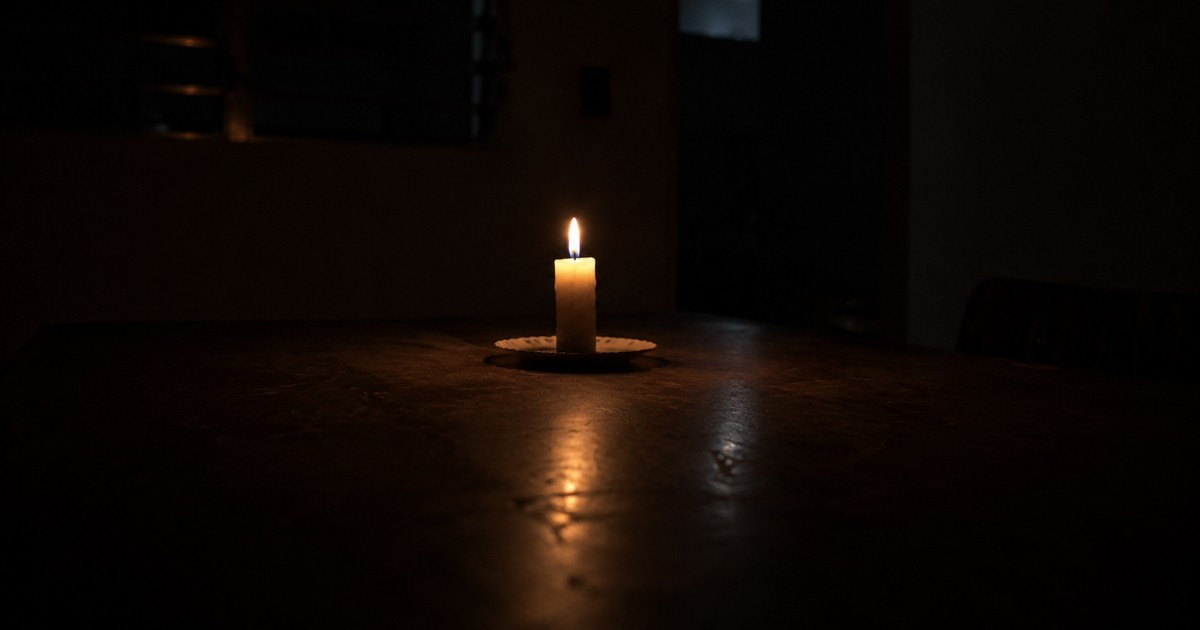
On Wednesday, July 8, Cuba experienced the largest power generation shortfall in its history, with a peak impact of over 2,341 megawatts (MW) during nighttime hours, according to the latest report released by the Unión Eléctrica (UNE) on Thursday.
This deficit left nearly 73% of the island's population without electricity at the same time, setting new records that surpassed those from previous months.
The record-breaking event was not an isolated incident. Just a few days earlier, on July 3, the power deficit reached 2,206 MW following the 17th shutdown of the year at the Antonio Guiteras thermoelectric plant. On July 5, the forecast was for 2,230 MW; by the next day, it had climbed to 2,245 MW.
The situation has become a relentless sequence of escalating power failures.
Another Day of Challenges Ahead
The UNE has warned of another critical day this Thursday, predicting an estimated 1,650 MW shortfall by midday and 2,260 MW during the peak evening hours, with only 935 MW of generation available against a maximum expected demand of 3,100 MW.
The immediate context only worsens the scenario. On Monday, July 6, Cuba endured its third total blackout of the year and the seventh in 18 months, when an unexpected outage of the Nuevitas plant's unit No. 6 left about 9.6 million people in the dark at 12:17 pm.
The UNE managed to technically reconnect the National Electroenergetic System (SEN) early on Wednesday, July 8, at 1:10 am, yet the underlying deficit remained above 2,000 MW.
Underlying Structural Problems
A UNE report on Monday highlighted the extent of the crisis: six thermoelectric units were out of service due to failures at plants like Máximo Gómez, Ernesto Guevara, Antonio Guiteras, Diez de Octubre, and Lidio Ramón Pérez, alongside 106 distributed generation centers halted due to fuel shortages, adding up to 890 MW of unavailable power.
The country's 54 solar photovoltaic parks generated 4,240 MW/hour with a peak capacity of 792 MW that day, but this contribution is insufficient to offset the massive nighttime shortfall. The regime touts solar panel production as a solution, though experts warn that without a comprehensive overhaul of the thermoelectric grid, blackouts will persist.
The increase is staggering when compared to historical records: in the summer of 2024, deficit peaks ranged from 1,500 to 1,900 MW; in May this year, a record of 2,174 MW was set; it rose to 2,208 MW in June; and now, July has reached 2,341 MW in just a few weeks.
The Root of the Crisis
The causes are deep-rooted: thermoelectric plants operating for over 40 years without major maintenance—like the Antonio Guiteras plant, the country's most powerful, which hasn't had a full overhaul since 2010—critical fuel shortages, and a backlog of failures that the regime has been unable to resolve.
It is estimated that Cubans have endured over 44,300 hours without electricity since the onset of the current crisis.
The Guiteras plant, which contributes nearly 10% of the SEN's capacity, was scheduled to reconnect to the grid this Thursday after its 17th shutdown of the year, although its history of repeated failures offers little assurance of stability.
Understanding Cuba's Power Crisis
What caused the recent power outage in Cuba?
The recent outage was due to a significant shortfall in power generation, with the UNE reporting a peak impact of 2,341 MW. Structural issues with outdated thermoelectric plants and a lack of fuel have compounded the problem.
How has the Cuban government responded to the power crisis?
The Cuban government has been promoting solar energy as a solution, but experts argue that without significant upgrades to the thermoelectric grid, the blackouts will continue.
What are the future implications of this power crisis for Cuba?
Without addressing the aging infrastructure and fuel shortages, Cuba could face ongoing power disruptions, affecting millions of its citizens and hindering economic activities.