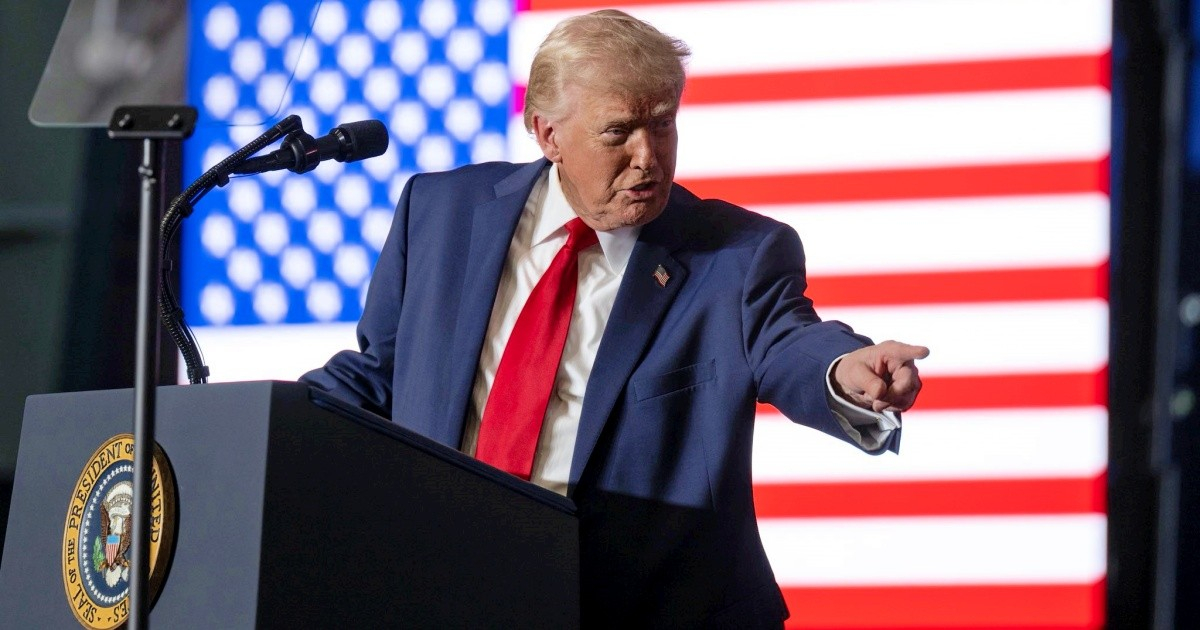
Former President Donald Trump declared on Wednesday his intention to swiftly petition the United States Supreme Court for a rehearing regarding birthright citizenship, following a recent ruling against his stance by the high court.
"I will immediately request a rehearing before the United States Supreme Court. This judicial blunder will devastate America if they don't overturn their utterly insane decision," Trump expressed on Truth Social, where he also criticized the ruling as "absolute madness."
The decision Trump aims to overturn was made on June 30 in the case of Trump v. Barbara, with a 6-3 vote affirming that the 14th Amendment grants citizenship to anyone born on U.S. soil, regardless of their parents' immigration status.
Chief Justice John Roberts penned the majority opinion, which garnered support from both conservative and liberal justices.
The Uncommon Path of Requesting a Rehearing
The motion for a new hearing is an exceptionally rare approach in the modern Supreme Court landscape. To succeed, it would require the backing of five out of the nine justices, a challenging threshold given the original majority was six votes. Additionally, the appeal must be filed within 25 days of the ruling, creating a tight deadline for Trump's team.
Conservative Rift Fuels Trump's Efforts
Despite losing the case, Trump finds political leverage in the conservative bloc's division. Dissenting votes came from Justices Clarence Thomas, Samuel Alito, and Neil Gorsuch. Alito called the ruling a "mistake" and argued it "upholds a strong incentive to enter or remain illegally in this country."
Thomas crafted a 91-page dissenting opinion, insisting that the decision "cheapens" citizenship as understood by the 14th Amendment's framers. Although Justice Brett Kavanaugh sided with the majority, his reasoning was rooted in violations of immigration laws from 1940 and 1952, not the Constitution, leaving a legislative avenue open.
This ruling marks Trump's third significant judicial defeat at the Supreme Court in recent months, following a February 2026 decision that nullified his tariffs and another preventing him from firing Lisa Cook from the Federal Reserve.
Legislative Hurdles and Trump's Ambitions
Simultaneously, Trump is pushing for congressional action to abolish birthright citizenship through ordinary legislation. "A lengthy and complicated constitutional amendment isn't necessary. Congress should start TODAY to end costly and unfair birthright citizenship!" he stated on Truth Social.
However, legal experts caution that altering the 14th Amendment would necessitate a constitutional amendment and 60 Senate votes, a highly unlikely scenario in the current Congress. House Speaker Mike Johnson voiced support but acknowledged the challenges: "It's certainly time to do everything possible. I'm just not sure what that is," he told CNN.
The Birth Tourism Debate
Trump justified his campaign by highlighting billboards in southern Texas advertising childbirth packages for around $4,000, labeling it a "scam." "AMERICAN CITIZENSHIP IS NOT FOR SALE!" he declared.
In response, Texas Governor Greg Abbott ordered an investigation into the Mission Regional Medical Center for allegedly profiting from this practice. Nonetheless, the Pew Research Center notes that birth tourism is statistically negligible, with only 80,500 cases between 2016 and 2024, representing 0.24% of total births during that period.
The administration is also considering banning the entry of pregnant foreign women as an additional measure, though experts warn of significant constitutional challenges to this approach.
Cuban-American Congresswoman María Elvira Salazar distanced herself from Trump and supported the ruling: "The Constitution is clear, and we must always respect the rule of law," she wrote on X.
Understanding Trump's Legal and Legislative Challenges
What is Trump's main argument against birthright citizenship?
Trump argues that birthright citizenship provides a strong incentive for illegal immigration, and he believes it cheapens American citizenship. He also points to what he calls "birth tourism" as a significant issue.
How likely is it for Trump to succeed in his Supreme Court petition?
It's quite unlikely, as Trump would need the support of five justices to grant a rehearing, a challenging feat given the original decision was 6-3 against his position.
What are the legal hurdles to abolishing birthright citizenship through Congress?
Modifying the 14th Amendment would require a constitutional amendment and 60 Senate votes, a daunting task in the current political climate.