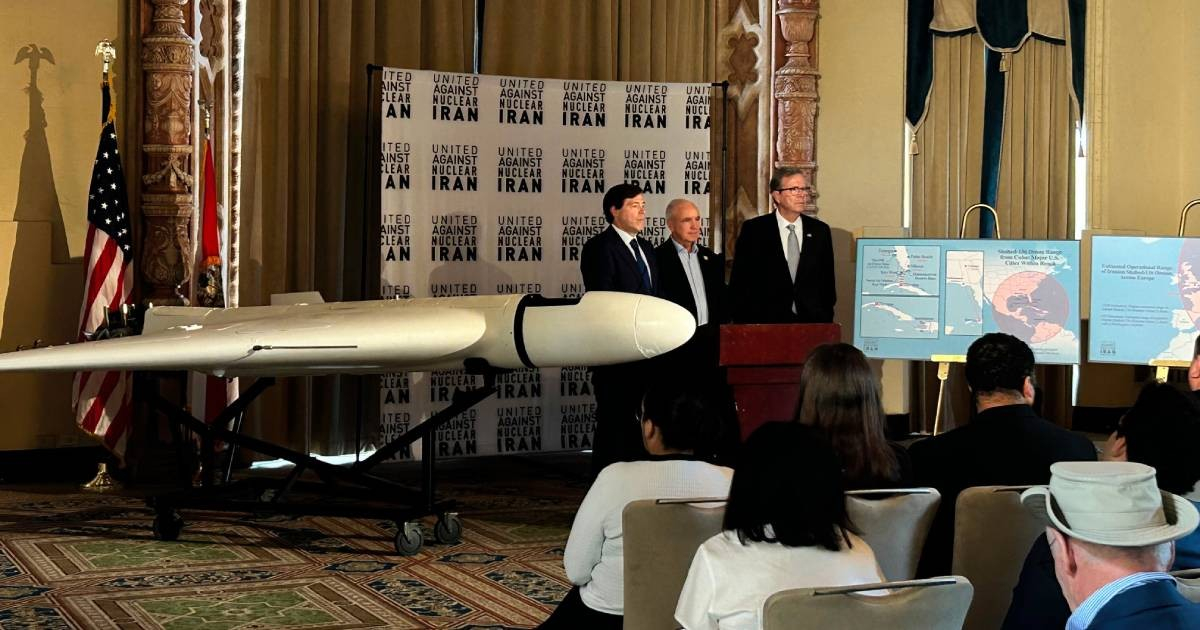
A mock-up of the Iranian Shahed-136 drone was showcased on Wednesday at the Biltmore Hotel in Coral Gables, Miami. The event, orchestrated by the bipartisan group United Against Nuclear Iran (UANI), aimed to highlight intelligence reports suggesting that the Cuban regime has procured over 300 of these drones from Russia and Iran since 2023.
The gathering featured former Florida Governor Jeb Bush, who serves as the president of UANI, Republican Congressman Carlos Giménez, and Ambassador Mark Wallace, the organization's CEO. They collectively warned that this alleged military cooperation between Havana and Tehran poses a threat to U.S. security.
"Miami, Florida, is within striking distance of Iranian drones collaborating with the Cuban regime," Wallace stated during his presentation.
The former ambassador emphasized that the alliance between the two nations is not new and that Iran's growing presence in Cuba, given its proximity to strategic U.S. locations in the Caribbean, is concerning.
Carlos Giménez provided a more detailed account of the Shahed-136's reach. "They have a range of about 2,500 kilometers, which means they can reach New York from Cuba," he said, standing next to the displayed aircraft.
The congressman labeled the drone as an offensive weapon, asserting that if intelligence reports are accurate, the situation is indeed severe. "If Cuba possesses 300 of these drones, it's undoubtedly a threat to the United States," he stated, as reported by Local 10 News.
Later, Giménez reinforced this message on social media. "The dictatorship is a real threat with these Iranian drones just 90 miles from our shores!" he wrote on X.
Jeb Bush also voiced his concerns, noting that the same drone model has been utilized by Russia in its war against Ukraine. "Reports of 300 drones in Cuba are a risk that should alarm us. While we have the capability to defend our homeland, Cuba remains a risk to our country, and Iran is its ally," he declared.
The Alarm's Origins
The concerns raised by UANI are based on a report published by Axios in May, which cited U.S. intelligence sources. According to the report, Cuban officials allegedly discussed plans to use Shahed-136 drones against targets such as the Guantanamo Naval Base, U.S. military vessels, and even Key West.
The Cuban regime has neither confirmed nor denied the alleged acquisition of these drones. In response to the publication, they stated that Cuba has the sovereign right to equip itself with necessary defense means.
This revelation has spurred intense diplomatic and military activity. On May 14, the CIA director made an unannounced visit to Havana to meet with top Cuban officials. Two weeks later, the head of the U.S. Southern Command held talks with Cuban military personnel near the Guantanamo Naval Base, marking an unusual interaction between the two sides.
A Less Alarming Perspective
Not everyone at the event shared the same level of concern. Political analyst Andy Gómez of Local 10 News pointed out that while the existence of these drones warrants attention, it is unlikely that Cuba would directly use them against U.S. soil.
"I'm not overly worried about Cuba launching a drone against the United States because the consequences for them would be chaotic," Gómez stated.
He also rejected the idea of military intervention as a solution, advocating instead for maintaining political and diplomatic pressure on Havana.
During the event, Gómez expressed his perception of potential internal deterioration within the Cuban regime. "All the signs I'm seeing from inside Cuba indicate a possible internal collapse," he noted.
Gómez also referenced a recent comment by Secretary of State Marco Rubio, who remarked that "with or without drones, a failed state 90 miles south of the United States poses a threat to national security."
The Shahed-136 exhibition occurred just three days before the fifth anniversary of the July 11, 2021, protests, a date several participants highlighted as particularly significant for monitoring the political situation in Cuba.
Understanding the Implications of Cuban-Iranian Military Cooperation
Why is the Shahed-136 drone considered a threat to the United States?
The Shahed-136 drone is viewed as a threat because it has a range of approximately 2,500 kilometers, allowing it to reach significant U.S. locations from Cuba. Its presence in Cuba suggests potential military cooperation between Cuba and Iran that could threaten U.S. security.
What actions have been taken in response to the reports of drones in Cuba?
In response to the reports, there has been increased diplomatic and military engagement, including an unannounced visit by the CIA director to Havana and discussions between the U.S. Southern Command and Cuban military officials near the Guantanamo Naval Base.
How has the Cuban government responded to allegations of drone acquisition?
The Cuban government has not confirmed or denied the acquisition of the drones but has asserted its sovereign right to equip itself with the necessary means for defense.