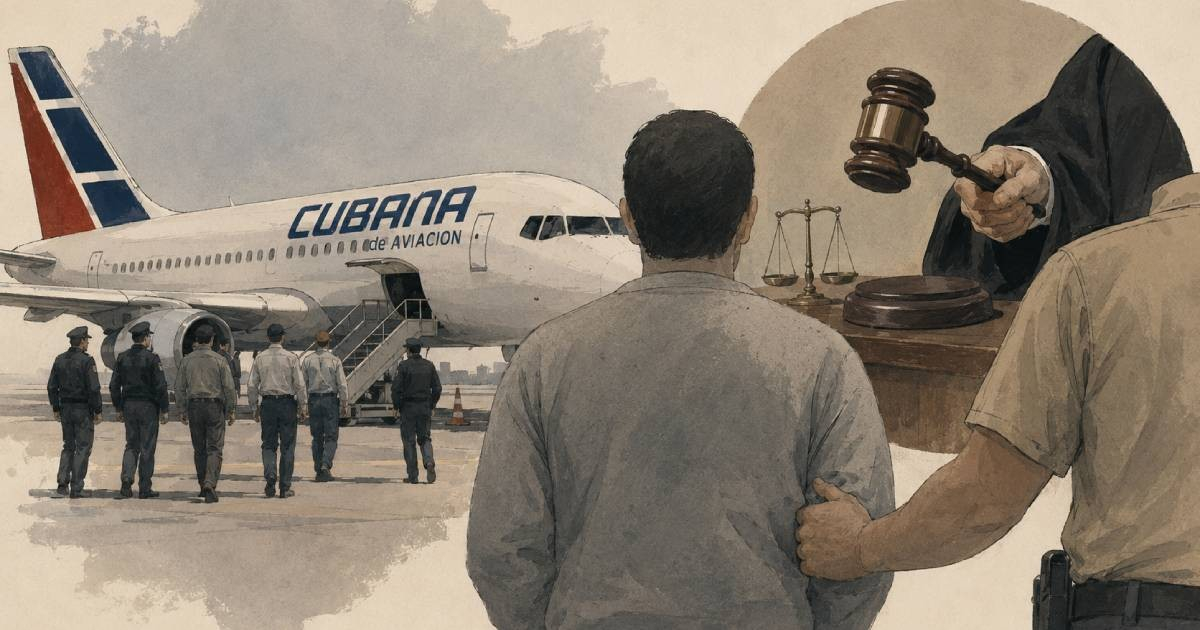
A federal judge in the United States has mandated the immediate release of Maikel Guerra Morales, one of the Cuban nationals involved in the 2003 hijacking of a plane from the Isle of Youth that was forced to land in Key West. The judge concluded that the government failed to prove that his deportation could be carried out within a reasonable timeframe.
Judge John E. Steele of the U.S. District Court for the Middle District of Florida granted Guerra Morales' habeas corpus petition, instructing Immigration and Customs Enforcement (ICE) to release him within 24 hours. The order also ensures that Guerra Morales has phone access to inform his attorney and family about his release.
Legal Precedents and Detention Limits
The ruling draws on the Supreme Court precedent from Zadvydas v. Davis (2001), which sets limits on the detention of immigrants with deportation orders when their removal cannot be executed.
According to this precedent, it is reasonable to detain a foreign national for the first six months following a final deportation order. Beyond that period, the government must demonstrate that removal is feasible in the near future.
Guerra Morales had been in ICE custody since December 30, 2025, following his arrest on the basis that he would be deported to Mexico. However, the judge found that immigration authorities had not provided evidence that Mexico had agreed to accept him or that any travel documents had been processed for his deportation to Mexico or any other country.
"The law is clear on this matter. The government cannot indefinitely detain individuals as an alternative solution to stalled deportation processes," Steele wrote in his decision.
Background on the Hijacking Incident
Guerra Morales' case dates back to March 19, 2003, when he and at least eleven other Cubans hijacked a DC-3 Aerotaxi plane shortly after it took off from Nueva Gerona in the Isle of Youth.
Investigations revealed that the hijackers assaulted the crew and forced the pilot to divert the flight to Key West, Florida. On board were 31 passengers, five crew members, and a security escort. U.S. authorities identified Alexis Norniella Morales, Guerra Morales' brother, as the leader of the group.
Following trial in a federal court in Key West, Guerra Morales was sentenced to 264 months in prison for air piracy and interference with a flight crew, a sentence he has fully served.
Protection from Deportation to Cuba
After completing his sentence, an immigration judge ordered his deportation but granted him protection under the Convention Against Torture in May 2022, recognizing the likelihood of torture or inhumane treatment if returned to Cuba.
Subsequently, on March 1, 2023, ICE released him under an order of supervision, which, according to court records, he complied with until his re-detention in late 2025.
While the judge has ordered his release, Guerra Morales remains subject to immigration controls.
The ruling upholds the supervision order imposed by ICE and warns that the agency may detain him again if a suitable destination for his deportation is identified and can be executed legally.
This case arises amid a tightening of U.S. immigration policy towards Cuban nationals. During Donald Trump's second administration, the U.S. increased deportations to third countries, including Mexico, for migrants who cannot be directly returned to Cuba. However, the ruling underscores that merely intending to deport a foreign national does not justify indefinite detention when there is no concrete plan for removal.
Frequently Asked Questions about Maikel Guerra Morales' Case
Why was Maikel Guerra Morales released from detention?
A federal judge ordered his release because the government could not demonstrate that his deportation could occur within a reasonable time frame, as required by legal precedent.
What is the significance of the Zadvydas v. Davis precedent?
The Zadvydas v. Davis case limits detention of deportable immigrants, stating they cannot be held indefinitely if their removal is not feasible within a reasonable period.
What happened during the 2003 plane hijacking?
In 2003, Maikel Guerra Morales and others hijacked a DC-3 plane, forcing it to land in Key West, Florida. The hijackers assaulted the crew, and the incident involved 31 passengers and several crew members.