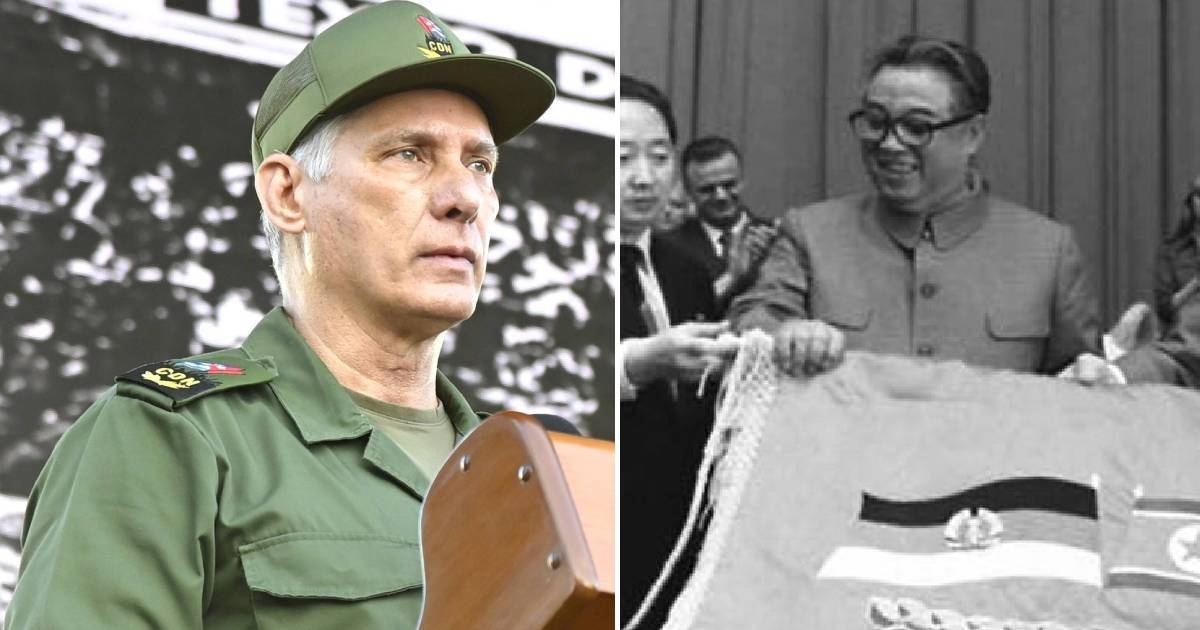
On Wednesday, Miguel Díaz-Canel sparked a wave of criticism by posting a tribute on social media to Kim Il-sung, the founder of North Korea, on the 32nd anniversary of his death. Many Cubans condemned the gesture as a celebration of one of the 20th century's most brutal dictators.
In a Facebook post, the Cuban leader wrote, "32 years ago, the Great Leader Comrade Kim Il-sung, a great friend of #Fidel and our country, passed away. We will always remember his contribution to the historical and solid bonds of friendship and cooperation between the Democratic People's Republic of Korea and #Cuba."
Accompanying the message was a vintage photograph, likely from the 1980s or 1990s, showing two men at an official event with their hands raised in unity: one in a decorated military uniform and the other in a dark formal suit.
The Cuban public quickly responded on social media, pointing out the irony of a leader from a nation mired in a severe humanitarian crisis paying homage to someone who established one of the deadliest totalitarian regimes in modern history.
Kim Il-sung, who died on July 8, 1994, ruled North Korea with an iron fist from 1948. His regime initiated the Korean War in 1950 by invading the south, leading to famines that, according to international estimates, claimed the lives of between 600,000 and 3.5 million people.
He also set up concentration camps and the Songbun system, a hereditary social stratification that subjected entire generations to discrimination. After his death, he was declared the "Eternal President of the Republic."
Historic Ties and Modern Tensions
Relations between Havana and Pyongyang date back to August 29, 1960, just a year after the Cuban Revolution's triumph, forming one of the longest-standing communist alliances of the Cold War. Díaz-Canel has eagerly fostered this relationship; in November 2018, he visited Pyongyang, where nearly a million North Koreans welcomed him, and he met with Kim Jong-un. It was during this visit that the first official portrait of Kim Jong-un with Díaz-Canel was released.
In April, Díaz-Canel congratulated Kim Jong-un on his reelection as president of the State Affairs Commission, reaffirming Cuba's solidarity with North Korea.
However, the relationship has been strained since Cuba restored diplomatic ties with South Korea in February 2024 and opened its embassy in Seoul in June 2025, after six decades without relations. This move deeply angered Kim Jong-un's government: a senior North Korean diplomat stationed in Cuba defected to South Korea in 2024, on a mission specifically aimed at preventing this rapprochement.
Enduring Alliances Amidst National Struggle
Despite these tensions, Wednesday's tribute underscores that the Cuban regime has no plans to distance itself from the memory of North Korea's founder. For many Cubans enduring power outages, food shortages, and an unparalleled crisis, Díaz-Canel's enthusiasm for celebrating allied dictators is both revealing and infuriating.
Understanding Cuba's Diplomatic Relations
Why did Miguel Díaz-Canel's tribute to Kim Il-sung cause controversy?
Díaz-Canel's tribute was controversial because many Cubans view Kim Il-sung as one of the most brutal dictators of the 20th century, making the gesture appear as an endorsement of his oppressive regime.
How have Cuba's relations with North and South Korea evolved?
Cuba historically maintained strong ties with North Korea since 1960. However, relations have been strained since Cuba reestablished diplomatic ties with South Korea in 2024, leading to diplomatic tensions with Pyongyang.
What was the significance of Díaz-Canel's visit to North Korea in 2018?
Díaz-Canel's 2018 visit to North Korea symbolized the strengthening of ties between the two nations, marked by a warm welcome from nearly a million North Koreans and meetings with Kim Jong-un.