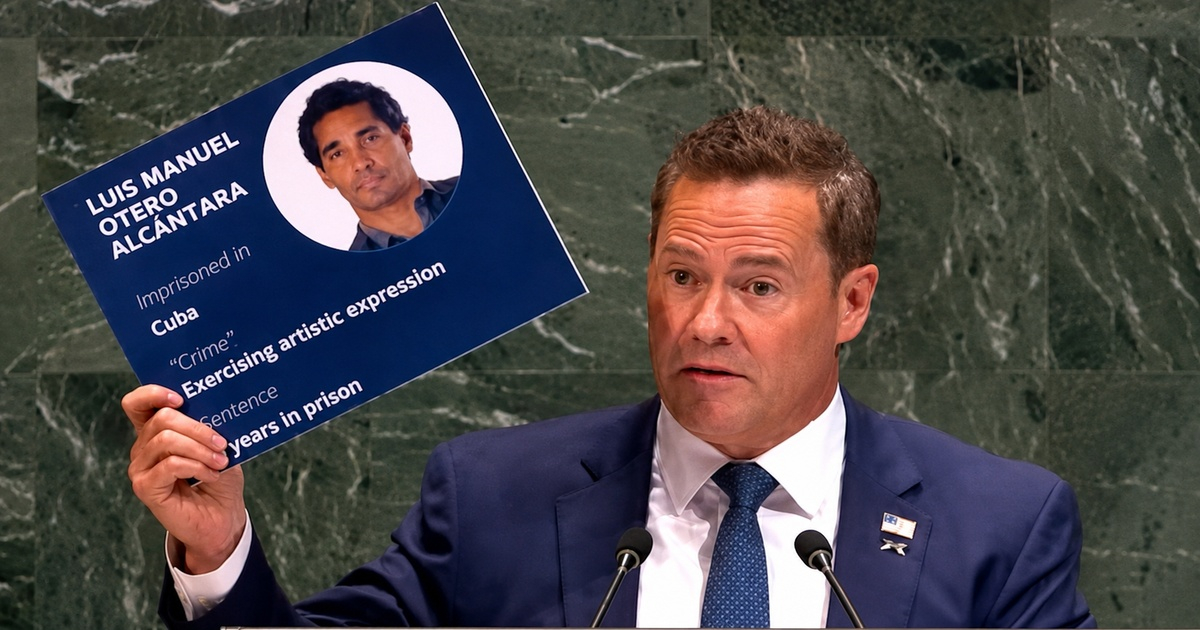
In a mere 20 minutes, U.S. representatives at the United Nations, Mike Waltz and Jeffrey Bartos, dismantled the long-standing facade of lies and justifications perpetuated by the Castro regime to rationalize the oppression and poverty imposed on the Cuban people.
Waltz remarked, "Blaming the United States is the only economic strategy left for Havana. The true embargo is the guillotine the regime holds over its own citizens' heads." He emphasized that the genuine blockade is the one the regime enforces against its citizens, suppressing free speech, faith, entrepreneurship, dissent, political rights, hope, and even electricity.
When the U.S. ambassador referenced July 11, 2021, the regime's representatives attempted to interrupt him. This date remains a source of fear for Cuba's communist elite even years later. Unfazed, Waltz continued, "You can keep pounding the table, my friend. This is not Havana. This is the United States of America. This is the United Nations. We will raise our voices, we will be heard, and we will not be silenced as you do with your own people. So, keep pounding the table."
A powerful moment came when the American representative mentioned several Cuban political prisoners, displaying their photos: "Luis Manuel Otero Alcántara. Do you know what his crime was? He's in a maximum-security prison—temporarily moved to a 'government facility' until his release in three days, according to Spain's El País. His crime, according to the regime, is artistic expression. His crime is being an artist, Mr. President." He continued listing five other emblematic political prisoners.
Misguided Focus on the Embargo
Being more concerned about the U.S. embargo against the Castro regime than the systemic blockade that the tyrannical regime imposes on the Cuban people's fundamental rights and freedoms is akin to opposing chemotherapy for its side effects while allowing a destructive cancer to continue unchecked. Unlike clinical cancer, this political affliction is more contagious than COVID-19.
The regime that has held Cuba in its grip for 67 years has decimated institutions, the economy, and society, crushing the liberty of millions. It is a cancer that represses, imprisons, tortures, exiles, and impoverishes. It holds political prisoners in inhumane conditions, bans freedom of expression, association, assembly, and peaceful protest. It restricts the people's right to choose their leaders, controlling the economy to the point of extreme poverty, chronic scarcity, and dependency, as the elite grows obscenely rich.
In the face of this cancer, the U.S. embargo acts as necessary chemotherapy or radiotherapy. It is not the root of the problem; it is a response—imperfect but tangible—to a dictatorship that has, for decades, exported subversion, aligned with hostile powers, and clung to power with a manic obsession.
The Reality Behind the UN Resolutions
To claim that the embargo is the main cause of Cuba's troubles is to perpetuate a propagandistic lie repeated ad nauseam. The embargo is part of the treatment to contain and eventually eradicate the issue, and if it hasn't achieved the desired outcome, it's due to those who continue to feed the cancer and attack the cure.
Every year, the UN General Assembly passes a resolution condemning the U.S. embargo. It's debated, voted on with solemnity, and the regime presents the outcome as a great victory for the "Revolution" and a defeat for "imperialism." Meanwhile, the people, hungry and in darkness, fearing repression, feel betrayed by the world, including the European Union, which claims to defend Cuban rights and is allied with the United States.
Every year, they denounce the "chemotherapy" but there's no equivalent resolution, widely approved, against the cancer, against the severe human rights violations in Cuba. That's neither fair nor neutrality. "The darkest places in hell are reserved for those who maintain their neutrality in times of moral crisis." It is hypocrisy of the worst kind, turning a blind eye as the cancer spreads and pretending the real problem is the medicine trying to fight it.
Yet, the Cuban people do not give up. Every day, they rise with more determination and courage amid harsh repression. Dictatorships have expiration dates, and Cuba's time is running out. The United States, along with the few true friends we have around the world, will continue to be a key factor in bringing freedom sooner than many expect. When that day comes, we'll remember who stood with us in our darkest hours, who remained "neutral," and who sided with the dictatorship.
Understanding the Cuban Embargo and Its Impact
What is the primary reason for the U.S. embargo on Cuba?
The U.S. embargo on Cuba is primarily a response to the country's long-standing human rights violations and its alignment with hostile powers. It serves as a measure to pressure the regime to improve its human rights record and political freedoms.
How does the embargo affect the Cuban people?
While the embargo targets the regime, its effects are often felt by the Cuban populace due to the government's control over the economy and distribution of resources. It is a complex issue where the regime blames the embargo for economic hardships, while critics argue that the regime's policies are the root cause of the country's suffering.
Why is the UN resolution against the embargo controversial?
The UN resolution condemning the embargo is controversial because it does not address the Cuban regime's human rights abuses. Critics argue that focusing solely on the embargo without condemning the regime's actions is hypocritical and ignores the broader issue of the regime's oppression.