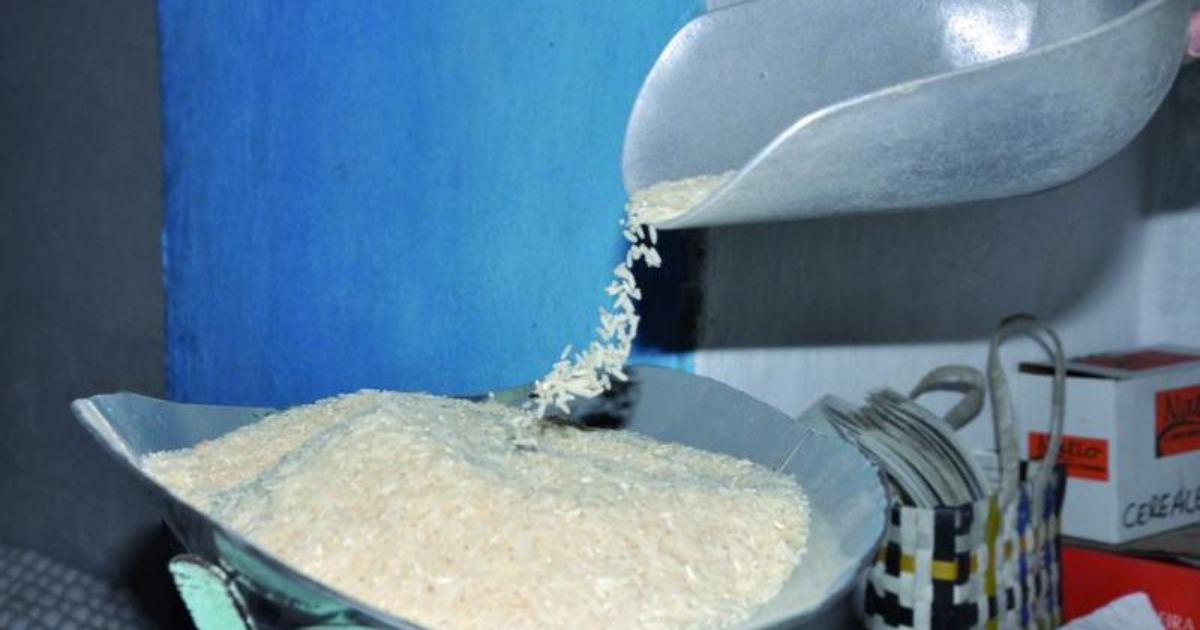
The Ministry of Domestic Trade recently announced on its Facebook page that consumers in Santiago de Cuba would receive a distribution of five pounds of rice per person. This allotment is part of a donation from the People's Republic of China, along with ten ounces of beans, ten ounces of peas, and children's compotes for the month of May.
Camilo Ernesto Machado, the Provincial Director of Merchandise Sales at GECI Santiago, delivered the announcement. However, the post quickly sparked a wave of complaints from Cubans across nearly all provinces, expressing that they had either not received anything or had been given smaller quantities than promised.
Residents from Matanzas, Holguín, Las Tunas, Camagüey, Pinar del Río, Ciego de Ávila, Villa Clara, Guantánamo, Granma, Artemisa, Mayabeque, and Quivicán echoed the same grievance in the official publication: the Chinese rice hasn't arrived, or it was delayed and insufficient.
Deisy Vázquez Díaz from Pilón, Granma, noted, "We haven't seen rice since December 2025," and pointed out that cigarettes, a state resource, are sold at 600 pesos in that municipality.
The situation was even more irregular in Colón, Matanzas: "Here they gave two pounds per card at the Frank País neighborhood’s store, and they charged 170 pesos. I didn't get any," narrated Josefa Mendoza Romero, highlighting not only the reduced quantity but also the charge for what was supposed to be a free donation.
In Sagua la Grande, Villa Clara, only four pounds were reported instead of five.
In Mayabeque, a local described the ration book as "a decorative figure," while in Ciego de Ávila, Carmen Campos reported that products are "put in a warehouse to wait," and an oil announced two months ago has yet to appear.
The delay in distribution also drew criticism. "This will be for next year, as the donation arrived three months late. There's never any transportation, and the freight train seems to have vanished too," wrote Fajardo Ramírez.
The rice being distributed is part of an aid package approved by Xi Jinping in January 2026: 60,000 tons of rice and 80 million dollars in financial assistance.
The first batch of 15,600 tons arrived at the port of Havana on March 26, 2026, aboard the ship Loyalty Hong.
The regime claims that these initial 15,000 tons were distributed between March and April across all provinces, benefiting 9.6 million consumers.
However, citizens' accounts contradict this narrative: several provinces have yet to receive the product by July, months after the official distribution was claimed to be completed.
The logistical crisis is deep-rooted: lack of fuel for transport, collapse of freight train services, and concentration of goods in provincial capitals without reaching the municipalities.
"September will come, and some stores in the province won’t even know what those products taste like. Everything stops at the provincial capital," warned Jose Enrique Rizo De Los Santos.
The backdrop is an unprecedented food emergency in Cuba: domestic rice production plummeted from 304,000 tons in 2018 to just between 80,000 and 111,000 tons in the past two years, meeting less than 20% of the internal demand.
According to the Food Monitor Program, 96.91% of the population lacks adequate food access, and 33.9% of households had at least one member who went to bed hungry in the last 30 days.
Anay Aday summed up the widespread frustration with a rationing system that has promised to ensure basic nutrition since 1962 but now relies on international charity for sustenance: "Why don't they just get rid of the ration book once and for all and avoid so much disrespect?"
Understanding the Cuban Food Distribution Crisis
What was the Chinese donation to Cuba?
The donation from China included 60,000 tons of rice and 80 million dollars in financial assistance, approved by Xi Jinping in January 2026.
Why are Cubans not receiving the donated rice?
The distribution of the rice has been plagued by logistical issues such as fuel shortages, collapsed freight train services, and the concentration of goods in provincial capitals without reaching municipal areas.
How has domestic rice production in Cuba changed?
Cuba's domestic rice production has decreased significantly from 304,000 tons in 2018 to between 80,000 and 111,000 tons in recent years, covering less than 20% of domestic demand.