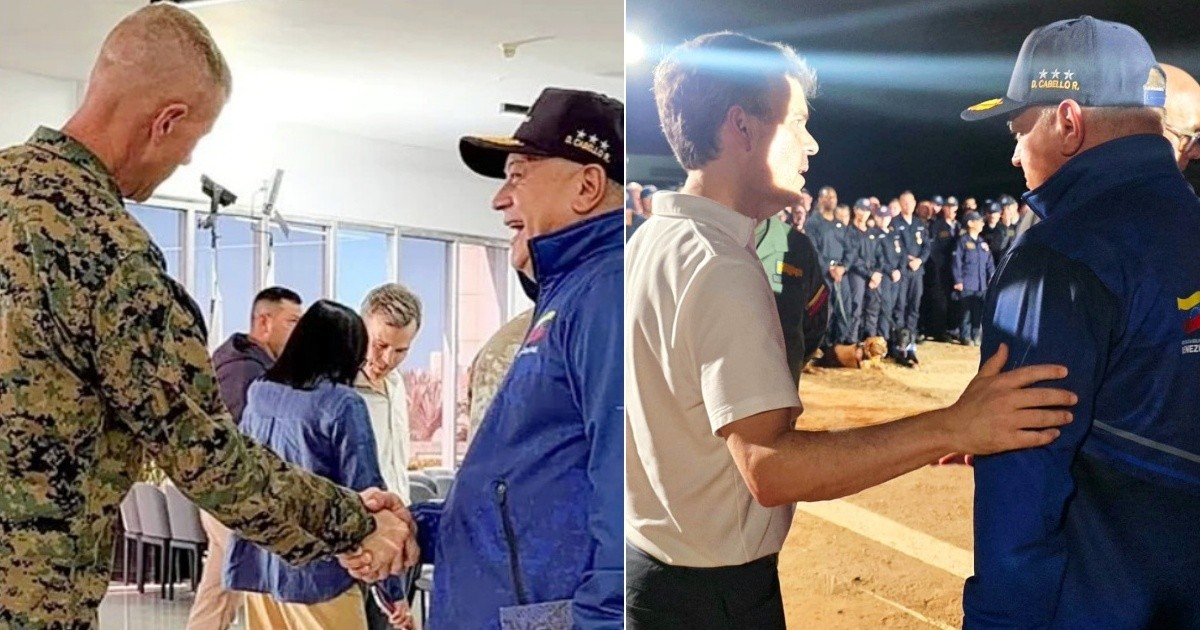
The Chargé d'Affaires of the U.S. Embassy in Caracas, John Barrett, sidestepped inquiries on Tuesday regarding whether the $25 million bounty for the capture of Diosdado Cabello remains active. This follows a controversy sparked by photos showing Cabello alongside Venezuela's Interior Minister during humanitarian operations after the June 24 earthquakes.
During a virtual press conference focused on the humanitarian response to the seismic disaster, journalist Roberto Macedonio from NTN24 asked the diplomat directly, "Does Washington still uphold its policy regarding Diosdado Cabello? Is the reward for his capture still in place, or has the State Department altered its stance on him?"
Barrett neither confirmed nor denied any policy shift, instead redirecting the conversation to humanitarian efforts: "The State Department is fully committed to responding to the devastating earthquake in Venezuela and advancing President Trump's three-phase plan for the country, which remains unchanged. This plan includes stabilization, economic recovery, reconciliation, and democratic transition," Barrett stated.
In the same conference, General Francis Donovan, commander of U.S. Southern Command, also evaded a direct answer when asked about the potential return of opposition leader María Corina Machado to Venezuela.
The Controversial Photographs
The photographs that ignited the controversy depict two separate yet politically symbolic moments. In one image, Barrett is seen with Cabello during a nighttime rescue operation, with the diplomat placing a hand on the Venezuelan minister's arm, suggesting a sense of camaraderie.
In another image, General Donovan—who led "Operation Absolute Resolution" that resulted in Nicolás Maduro's capture on January 3, 2026—is shown engaging in a relaxed conversation with Cabello, who is recognizable by his cap bearing the initials "D. CABELLO R." and three stars.
These photos were taken during the farewell of over 350 U.S. officials and rescuers involved in post-earthquake efforts, as reported by Venezuelan journalist Noelia Belén Izarza on July 5: "A picture is worth a thousand words, and these images speak volumes. For millions of Venezuelans, this scene is hard to reconcile."
Cabello's Legal Standing in the U.S.
To the United States, Cabello is not just another Venezuelan official. The Treasury Department sanctioned him in 2018 for corruption and drug trafficking, and in 2020, he was formally charged with narcoterrorism alongside Maduro.
The Southern District of New York's Prosecutor's Office accuses him of narcoterrorism, conspiracy to import cocaine, and firearms possession. He is also alleged to be the leader of the "Cartel of the Suns," an organization of high-ranking Venezuelan military officials involved in drug trafficking.
The bounty for his capture was increased from $15 million to $25 million in January 2025 by the Biden administration, and Secretary of State Marco Rubio reaffirmed it on May 5, 2026: "We continue to view Diosdado Cabello as a narcoterrorist," the U.S. diplomat declared just two months before the controversy erupted.
Political Reactions and Opposition Stance
Republican Congressman Carlos Giménez from Florida reiterated that the bounty on Cabello remains valid, asserting that a humanitarian mission does not change the charges the Venezuelan leader faces.
Fellow Republican Congressman Mario Díaz-Balart emphasized that Cabello must face U.S. justice for drug trafficking and narcoterrorism.
From the Venezuelan opposition, José Amalio Graterol, a political opposition secretary, compared Barrett's photo with Cabello to an image alongside "El Niño Guerrero," highlighting the symbolic gravity of the encounter.
Pragmatic Realities During Emergencies
On June 24, 2026, two earthquakes measuring 7.2 and 7.5 magnitude struck Venezuela, marking the most powerful quakes in over a century. As of July 8, the official toll reached 3,685 dead, with the UN estimating up to 50,000 missing.
The United States spearheaded international aid with 37 aircraft and more than $310 million in assistance. In this context, Cabello, who controls the nation's security structures as Interior Minister, became a necessary operative interlocutor for coordinating access to affected areas.
Reports from January 2026 indicate that the U.S. held secret talks with Cabello months before Maduro's capture, demanding he avoid deploying militias or security forces against the opposition. Cabello was not detained during the operation and remained in his position under Delcy Rodríguez's interim government.
Officially, the $25 million bounty remains active, the charges in New York have not been dropped, and the Treasury Department's sanctions are still in place. The lingering question is how long Washington can maintain this official stance while its diplomats and generals appear in photos with the man they offer a substantial reward to capture.
Frequently Asked Questions About Diosdado Cabello and U.S. Policy
What is the current status of the bounty on Diosdado Cabello?
The $25 million bounty for Diosdado Cabello's capture remains officially in effect, according to U.S. policy, despite recent controversies.
Why was Diosdado Cabello sanctioned by the U.S. Treasury Department?
Diosdado Cabello was sanctioned for his involvement in corruption and drug trafficking. Additionally, he faces charges of narcoterrorism and is alleged to be a leader in the "Cartel of the Suns."
How did the U.S. respond to the earthquakes in Venezuela?
The United States led the international relief efforts, providing 37 aircraft and over $310 million in aid to support Venezuela after the devastating earthquakes.