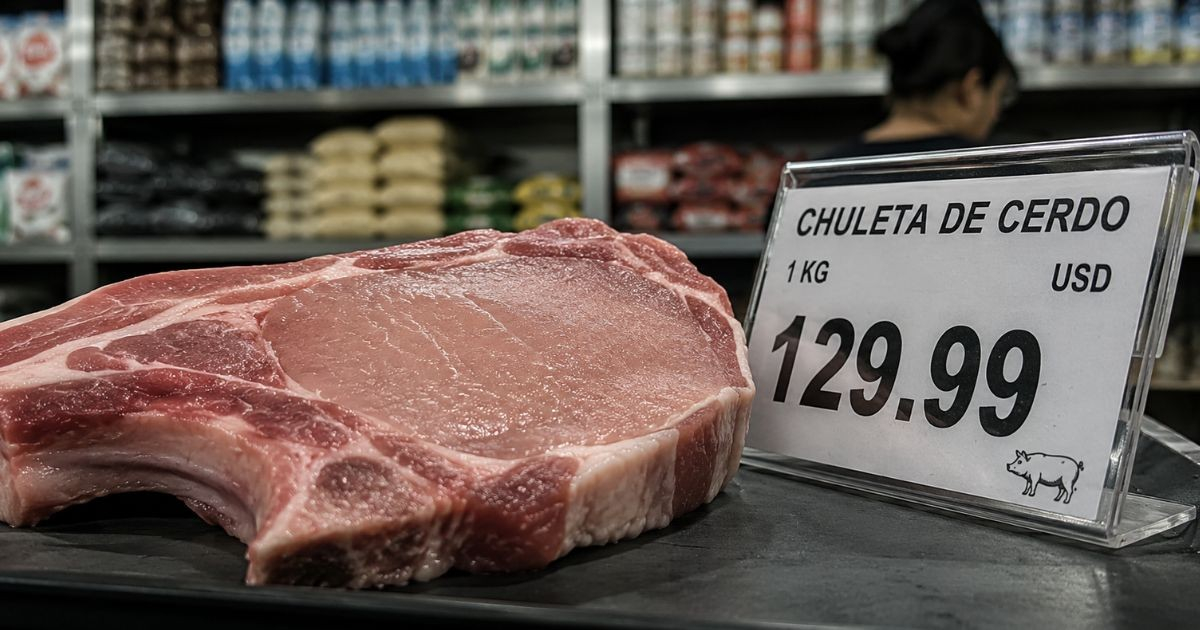
A new dollar-based store has opened in the Comodoro Hotel's gallery in Havana, offering products at prices far beyond what most Cubans can afford. A pork chop is priced at nearly $130, beef cheeks at $100, and a veal chop at $65, as reported by the independent outlet 14ymedio.
Operating under the brand Supermix, the store was announced on social media by the Caracol group, linked to the Ministry of Tourism, without mentioning the Supermix name. Behind this venture are Cimex, a subsidiary of the military conglomerate Gaesa, and Inversiones Pucara S.A. (Ipsa), a company with Spanish shareholders registered in Panama and operating in Cuba since 1997.
The store's opening was marred by technical issues: cash registers malfunctioned, card payments were impossible, and the butcher section had no change. Customers were greeted by an employee at the entrance saying, "The IT team is working to fix the problem."
Faced with a shortage of coins, a butcher counter worker asked customers, "Do you have a loose dollar? I would appreciate it."
Extravagant Prices and Limited Accessibility
Notwithstanding the first day's technical setbacks, the hallmark of this store is its extravagant pricing. Norwegian smoked salmon exceeds $100 for a 1.5-kilogram package; peeled prawn tails cost $18 for 400 grams; and Brazilian chicken breast is sold at $8 per kilogram.
Basic goods like powdered milk are priced over $10 per kilo, compared to about $8 in other foreign currency stores. A liter of oil is $3.50, against the usual $2.35 or $2.50, and deodorant sells for four dollars when it generally costs just over a dollar elsewhere.
One customer remarked, "The meat is top-tier, no minced meat or hot dogs, and there are seafood options. This store caters to a different, more VIP demographic," as quoted by 14ymedio.
A retiree from Central Havana with a daughter in Spain lamented, "Powdered milk is more expensive here than in other stores, costing over $10 per kilo."
Economic Reality and Security Measures
The stark contrast with the economic reality of most Cubans is apparent. The average salary on the island ranges from $10 to $16 monthly at the informal exchange rate, with the dollar trading at about 700 Cuban pesos.
The store also stands out for its security measures: employees place customers' bags in black fabric bags locked with a padlock during their entire visit. Shopping bags aren't free; they sell for three dollars each.
Regarding payment methods, a sign on the door indicates that when the system is operational, it will accept the Russian Mir card, Chinese Union Pay, the prepaid Clásica, and Cuban national cards. Visa and Mastercard ceased operations in Cuba on June 6, following sanctions imposed by the Trump administration on the processing bank linked to Fincimex.
Supermix had already opened a branch in the Focsa building about a year ago, using the same high-end foreign currency trading model. On the opening day at the Comodoro, only four customers were counted in the morning, one of whom was a foreigner.
Summing up the situation, an elderly man at the store's entrance stated, "It has a different name, but it's all the same. Most of us can't afford it."
Understanding Cuba's Economic Challenges
Why are the prices so high in the new store?
The high prices in the new store are due to its focus on high-end products and a target demographic that can afford luxury goods, which is not reflective of the average Cuban consumer's purchasing power.
What payment methods does the store accept?
Once operational, the store is expected to accept the Russian Mir card, Chinese Union Pay, the prepaid Clásica, and Cuban national cards. Visa and Mastercard are not accepted due to international sanctions affecting their operations in Cuba.
How do the store's prices compare with average Cuban salaries?
The store's prices far exceed what an average Cuban earns, with the typical monthly salary ranging from $10 to $16, making the store's offerings inaccessible to the majority of the population.