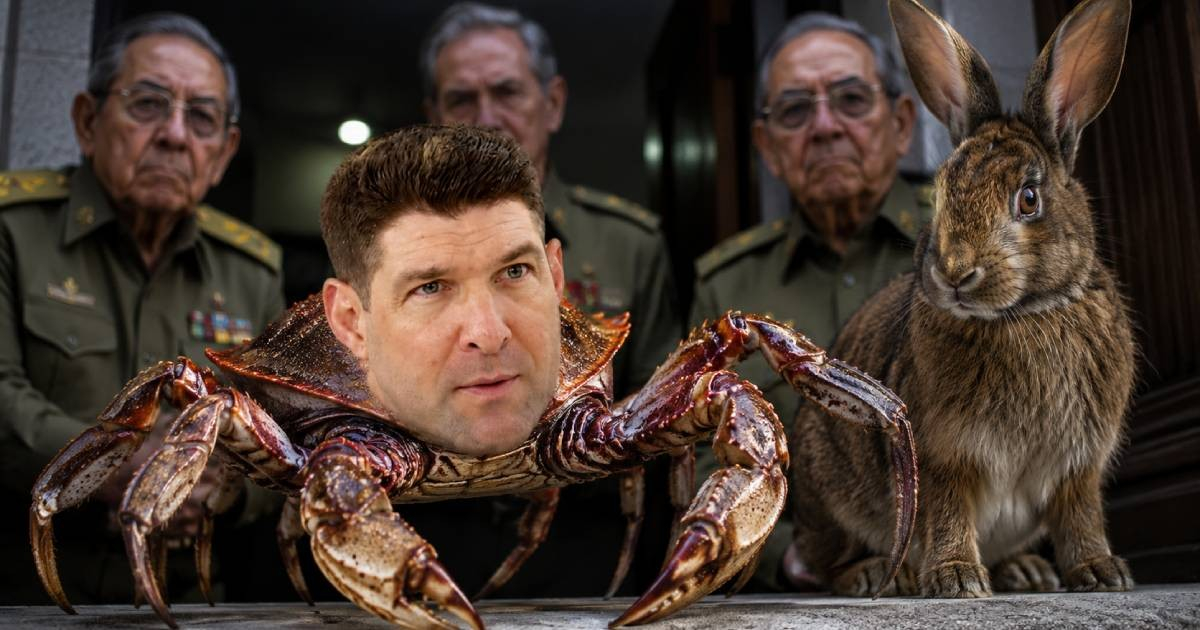
On Monday, Cuban playwright Irán Capote shared a lengthy critique regarding an interview given by Raúl Guillermo Rodríguez Castro, famously known as "El Cangrejo" or "The Crab," to USA Today. Capote questioned the content of Rodríguez Castro's statements as well as his role within the Cuban power structure.
Capote's post, which gained significant traction on social media, coincided with the third complete failure of the National Electric System (SEN) this year. He used this occurrence to highlight the stark contrast between official discourse and the everyday realities faced by millions of Cubans.
The writer claims he approached the interview objectively but ended up finding it riddled with contradictions he couldn't overlook. He was particularly struck by Rodríguez Castro's statement that he had no interest in politics, despite presenting himself as someone capable of negotiating directly with U.S. President Donald Trump and influencing the nation's future.
"He says it so nonchalantly, not realizing he's part of the very political image that's led us to this chaos," Capote wrote.
Questioning Legitimacy and Power
Capote also questioned the legitimacy by which the grandson of the former leader is portrayed as a key figure in Cuba's future.
"The Crab, who was not elected by any constituency, municipal assembly, provincial assembly, National Assembly, or any assembly for that matter, holds the future of our country in his hands," he asserted.
The playwright described this situation as a "silent monarchy," where power and privilege are passed down through familial connections rather than public choice.
The Image of Privilege
Capote also mocked the image Rodríguez Castro projects in the interview, where he appears dressed in designer clothing and shoes, flaunting a gold chain adorned with the initials of Fidel and Raúl Castro.
"The Crab, who claims his right to control the country's future due to his silent monarchy lineage, emerges from the shadows he's lived in to confirm, with his striking blue eyes, Hermès sneakers, and designer attire, that this nation is meant to enrich a select few," Capote remarked.
This image of a privileged heir to power sparked numerous reactions on social media. Among the notable responses was from comedian Ulises Toirac, who challenged Rodríguez Castro's use of the term "Revolution" to justify any potential political role.
"What kind of Revolution decides who should step forward and who should step back?" Toirac wrote.
Thousands of users also commented on the interview, expressing social discontent with messages like, "Let him live a month like we do."
Capote, who was barred by the UNEAC of Pinar del Río from taking a teaching position in 2022 for what he termed ideological reasons, concluded his reflection with a phrase that became the most widely shared: "Don't be surprised when we're fooled by 'The Crab'."
He sarcastically added, "So that all children can have Hermès sneakers."
Understanding the Role of "The Crab" in Cuban Politics
Who is Raúl Guillermo Rodríguez Castro?
Raúl Guillermo Rodríguez Castro, also known as "El Cangrejo" or "The Crab," is the grandson of Raúl Castro and has been portrayed as a significant figure in Cuban politics despite not holding an elected position.
What was the main critique of Rodríguez Castro's interview?
Playwright Irán Capote criticized the contradictions in Rodríguez Castro's statements, particularly his claim of disinterest in politics while being involved in significant political negotiations and decisions.
How did social media react to the interview?
The interview sparked numerous reactions on social media, with users expressing discontent and questioning the legitimacy and privilege of Rodríguez Castro's position.