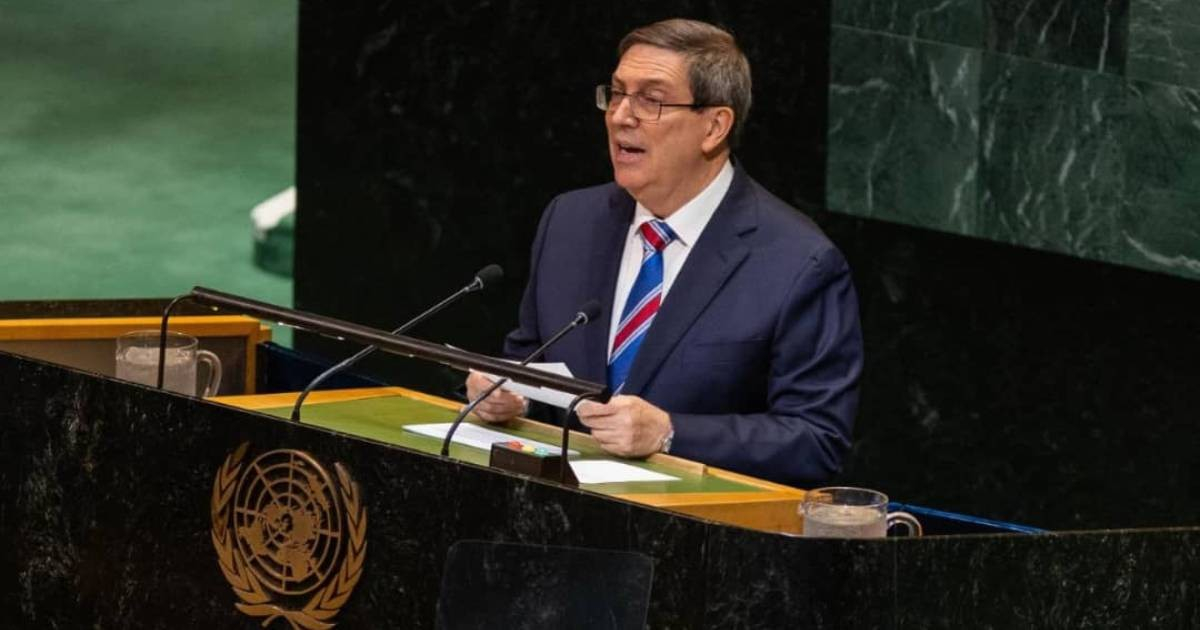
The Cuban government heralded the approval of an extraordinary debate on the U.S. embargo at the United Nations General Assembly this Tuesday as a "victory." However, they glossed over a critical detail: 30 countries abstained from the vote, more than doubling the number from the last vote on the issue in October 2025.
Both Miguel Díaz-Canel and Foreign Minister Bruno Rodríguez Parrilla took to social media to highlight the 136 votes in favor and nine against, neglecting to mention the significant number of abstentions.
Rodríguez Parrilla even shared an infographic boldly declaring a "Victory for Cuba" with "136 in favor" prominently displayed, while Díaz-Canel expressed gratitude for international support, claiming each vote was an act of "justice and courage" against what he called the "blatant lies" from the U.S. representative.
The final tally stood at 136 supporting votes, nine opposing, and 30 abstentions.
Despite the approval of the debate, the support Havana received was less robust than in the annual embargo resolution passed in October 2025, which saw Cuba garnering 165 favorable votes, seven against, and 12 abstentions.
The rise in abstentions—from 12 to 30—signals a declining willingness among many countries to unconditionally back the Cuban regime's stance in the UN.
It's important to note that this Tuesday's vote does not alter or lift the U.S. embargo. It merely authorizes an extraordinary debate under agenda item 38 of the General Assembly, a mechanism Cuba is using for the first time, distinct from the annual resolution introduced since 1992.
Opposition to the Debate
Nine countries voted against the debate: the United States, Argentina, Costa Rica, Israel, Morocco, the Czech Republic, North Macedonia, Paraguay, and Ukraine.
During the session, U.S. Ambassador to the UN Mike Waltz argued that the real embargo burdening the Cuban people is imposed by their own government. He condemned the existence of political prisoners, nationwide blackouts, and economic control by the military conglomerate GAESA.
Bruno Rodríguez attempted to interrupt the U.S. diplomat's speech twice with procedural motions, but both attempts were overruled by the Assembly's president.
An Unfavorable International Context
The session took place in a less favorable international climate for Havana than in previous years.
In recent months, several Western governments have intensified their criticism of the Cuban regime due to its close ties with Russia, its voting record at the UN concerning the war in Ukraine, and allegations of recruiting Cuban citizens to fight alongside the Russian army.
Days before the debate, The Nation magazine unveiled a diplomatic cable signed by Secretary of State Marco Rubio, instructing U.S. embassies to dissuade other governments from supporting Cuba's initiative.
Although the Cuban government managed to secure the Assembly's approval for the debate, the vote underscored a more fragmented international support than in previous years—a reality that Cuban authorities chose to ignore in their official celebrations.
Understanding the UN Vote on the Cuban Embargo
What was the outcome of the UN vote on the Cuban embargo debate?
The UN vote resulted in 136 countries supporting the debate, nine opposing, and 30 abstentions.
Why is the increased number of abstentions significant?
The increase in abstentions, from 12 to 30, indicates a reduced willingness among many nations to fully support the Cuban regime's position at the UN.
Does the UN vote change the U.S. embargo on Cuba?
No, the vote does not alter or lift the U.S. embargo. It only authorizes a special debate under the UN General Assembly's agenda.
Which countries voted against the debate?
The countries that opposed the debate were the United States, Argentina, Costa Rica, Israel, Morocco, the Czech Republic, North Macedonia, Paraguay, and Ukraine.