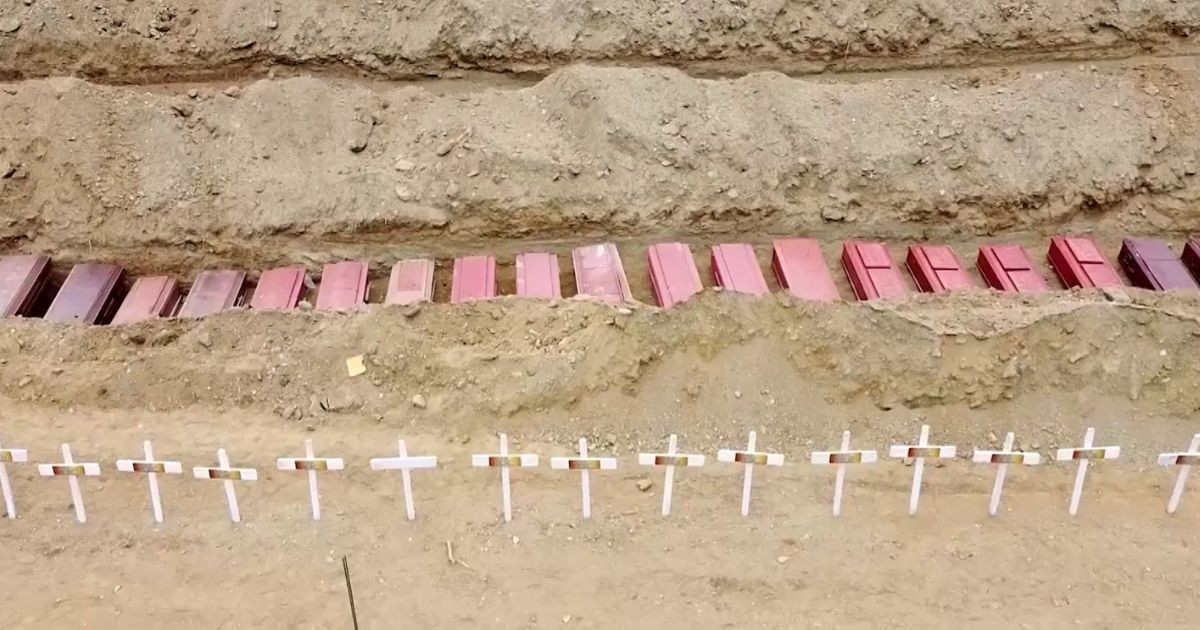
Venezuela presents heart-wrenching scenes to the world as it grapples with the aftermath of recent earthquakes. In a secluded hillside outside La Guaira, an emergency cemetery expands daily. For over ten days, excavators and trucks have been tirelessly digging trenches to lay to rest hundreds of victims from the June 24 earthquakes, which rocked the nation with magnitudes of 7.2 and 7.5.
This site, known as La Esperanza Cemetery, is located in the Catia La Mar municipality, about an hour's drive from the hardest-hit areas. According to a report by El País, by Monday morning, 253 individuals had already been buried here, with 159 remaining unidentified.
Though the graves are not completely anonymous, each trench is marked with white stones, a wooden cross, and a code linking to a file containing photographic records and burial documentation. Some crosses bear names, while others are labeled "special identification," awaiting family claims.
"This is not chaos. We are not treating them like animals or garbage. Each person has a dignified resting place," stated Elis Zabala, the municipal official overseeing the operation. Zabala noted that the trenches could accommodate an additional 2,000 to 3,000 coffins, with plans to expand further if necessary.
According to testimonies gathered by El País, the bodies at La Esperanza belong to the poorest individuals or those whose family members reside abroad. Venezuela's diaspora, numbering around eight million, complicates the process of identifying victims whose relatives are overseas.
Families able to identify their loved ones and afford funeral services have opted for traditional burials or cremations. Those who could not were left with no choice but to send their loved ones in refrigerated trucks to these emergency graves.
The management of these bodies has been a significant challenge and a source of ongoing criticism. Initially, hundreds of corpses decomposed under the Caribbean sun in an open-air parking lot, many of them either naked or partially clothed. The stench prompted locals to demand a transfer, leading to their relocation to the port, where they continued to lay exposed to the elements.
Interim President Delcy Rodríguez claimed she ordered the prevention of unnamed mass burials from the start, stating, "I initially said: no one will go to a mass grave." However, foreign correspondents questioned her about the slow and uncoordinated efforts during the first 72 hours, when survivors reported a lack of equipment and even basic supplies like paper and pens to mark bodies extracted from the rubble by neighbors.
Rodríguez dismissed the critiques as a "media laboratory" and defended the increase in deployment from 4,000 personnel initially to 29,567 currently. The official death toll as of Monday stands at 3,535, with 16,740 injured.
This figure starkly contrasts with estimates from the UN and the International Rescue Committee, which place the number of missing between 50,000 and 68,000. The U.S. Geological Survey’s Red Alert projects a probable death toll ranging from 10,000 to 100,000.
Amidst rows of identical crosses, one grave is distinct, marked with a photograph. Yonathan Calderón, a 13-year-old boy, smiles in a picture affixed to a unique dark wooden cross. He passed away on July 3, nine days after the earthquake.
Key Facts about the Earthquake Aftermath in Venezuela
How many unidentified victims have been buried in La Esperanza Cemetery?
As of Monday morning, 159 out of 253 individuals buried at La Esperanza Cemetery remain unidentified.
What challenges has Venezuela faced in managing the earthquake aftermath?
Venezuela has struggled with the management of decomposing bodies, initially stored in an open-air parking lot, and logistical issues in identifying victims due to a large diaspora and lack of resources.
What are the estimated death toll and missing persons figures according to international organizations?
The UN and International Rescue Committee estimate between 50,000 and 68,000 missing, while the US Geological Survey’s Red Alert projects a death toll ranging from 10,000 to 100,000.