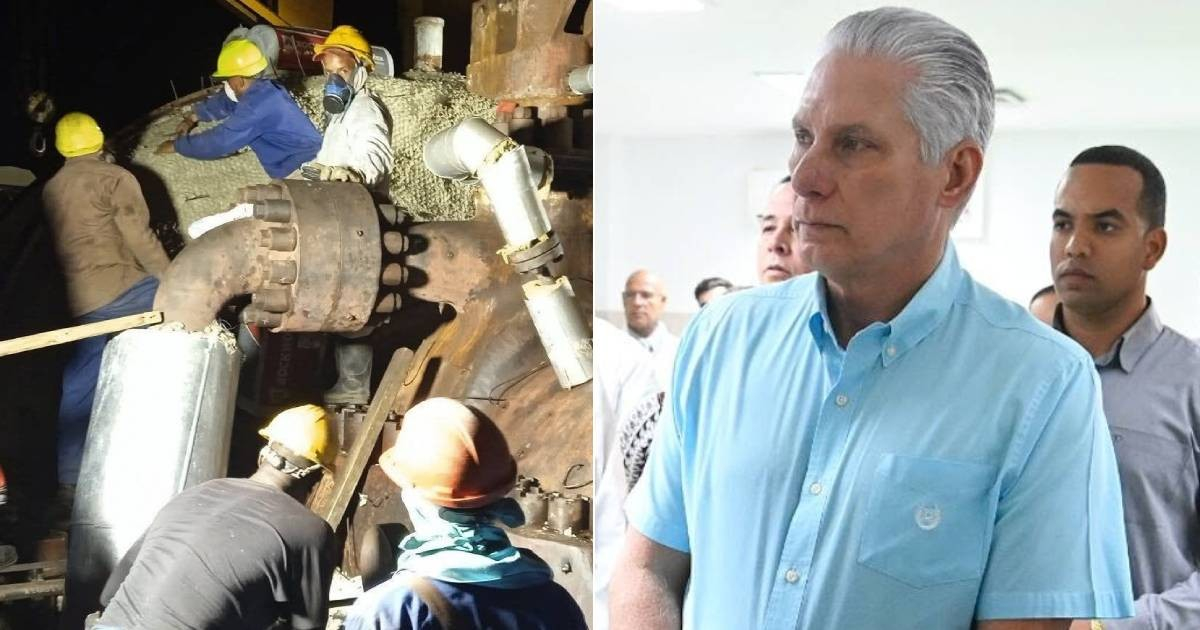
As Cuba endures its seventh complete collapse of the National Electric System (SEN) within the last year and a half, Cuban leader Miguel Díaz-Canel praised the efforts of the Unión Eléctrica (UNE) workers on Monday while once again pointing fingers at the United States for the ongoing energy crisis.
"What the electrical workers are doing is heroic amidst a genocidal energy blockade," he wrote on his X account, alleging that Washington aims to provoke social unrest by suffocating Cuba through fuel blockades.
His remarks accompanied a post from the Minister of Energy and Mines, Vicente de la O Levy, who announced that protocols were in place to restore the system, and that micro-systems were operational in various regions to maintain essential services.
The SEN experienced a collapse this Monday following the shutdown of Unit No. 6 at the Nuevitas thermoelectric plant in Camagüey, triggering a cascading disconnection that left much of the nation without power.
This marks the third nationwide blackout in 2026 and the seventh since late 2024. Prior to the collapse, the UNE had forecasted a generation shortfall of up to 2,230 megawatts, with availability hovering around 1,000 MW compared to an estimated demand of 3,100 MW. Additionally, 106 distributed generation plants were out of service due to fuel shortages, and multiple thermoelectric units remained inactive due to malfunctions.
Díaz-Canel's statements sparked widespread reactions on social media. Many users criticized his singular focus on U.S. sanctions, reminding that the electrical system had faced numerous breakdowns even before Donald Trump's presidency.
"The SEN failed five times before Trump took office... you have driven the country to ruin. Own up to your incompetence," wrote independent journalist and activist Magdiel Jorge Castro in response to the leader's post.
Experts have long emphasized that Cuba's electric crisis stems from a combination of factors, including the aging thermoelectric facilities, decades of poor maintenance, a lack of investment, and challenges in securing fuel supplies.
These challenges are compounded by import restrictions on oil. Cuba requires several shipments monthly to sustain power generation, but the Trump administration's sanctions on companies and countries supplying fuel to the island have further hindered this supply.
This is not the first time Díaz-Canel has come to the defense of the electrical sector workers amid an energy crisis. Earlier this year, on Electric Worker Day, he hailed them as "titans," a message that also drew heavy criticism from citizens enduring prolonged power outages.
While the government emphasized recovery efforts on Monday and promoted hashtags like #CubaNoSeRinde, millions of Cubans remained without electricity, underscoring the severe energy crisis gripping the island.
Understanding Cuba's Energy Crisis
What are the main causes of Cuba's energy crisis?
Cuba's energy crisis is attributed to a mix of factors, including aging thermoelectric facilities, insufficient maintenance over decades, lack of investment, and fuel supply issues exacerbated by U.S. sanctions.
How has the U.S. impacted Cuba's energy situation?
The U.S. has imposed sanctions that restrict companies and countries from supplying fuel to Cuba, complicating the island's ability to import the necessary oil for power generation, thereby worsening the energy crisis.
How did the latest blackout occur in Cuba?
The latest blackout happened when the shutdown of Unit No. 6 at the Nuevitas thermoelectric plant led to a cascading disconnection, causing a significant portion of Cuba to lose power.