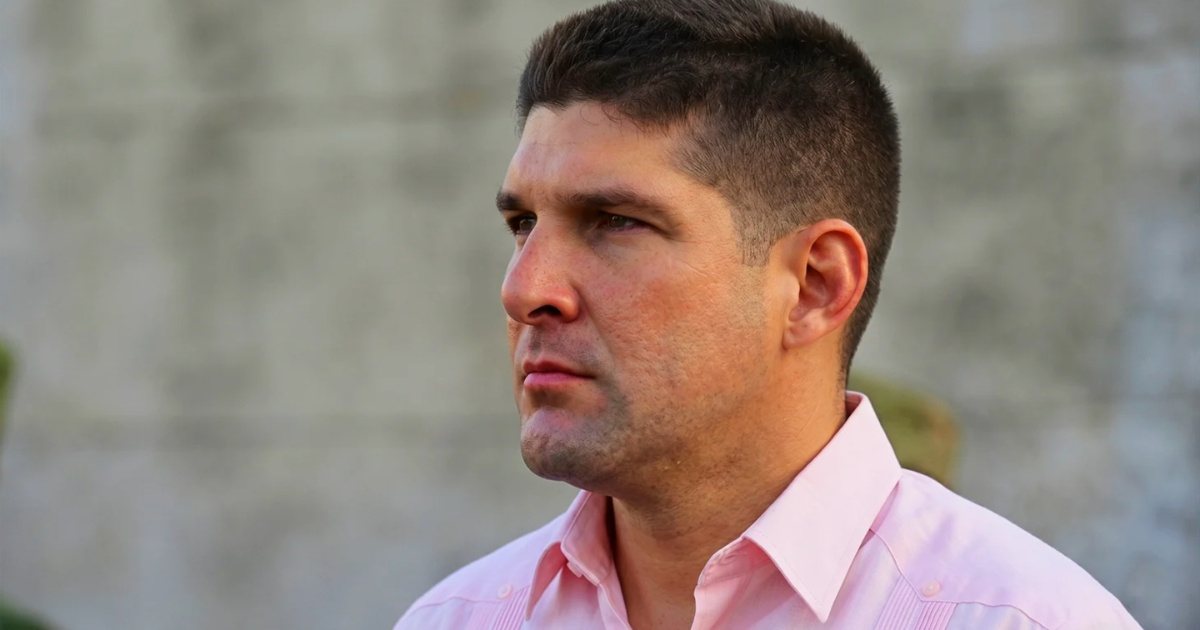
Sporting fitted jeans, a Hugo Boss t-shirt, and Hermès sneakers, Raúl Guillermo Rodríguez Castro—affectionately dubbed "El Cangrejo"—gave his inaugural interview to a U.S. outlet, featured in USA Today this Monday. The 42-year-old grandson of Raúl Castro positioned himself as the man ready to engage directly with Donald Trump regarding Cuba's future.
"I'm open to negotiating with anyone appointed by the U.S., including Trump if given the chance," he expressed during two days of talks in June in Havana, seated in the office once occupied by his grandfather at the Convention Center, home to the Cuban parliament.
With his towering and robust physique, light green eyes, and closely shaved head, Rodríguez Castro's appearance starkly contrasts with the revolutionary leaders before him—notwithstanding the luxurious lifestyle he leads, reflected in his attire and footwear.
Legacy and Influence
He dons a gold chain with a medallion engraved with the initials "FCR" and "RCR"—Fidel Castro Ruz and Raúl Castro Ruz. "If there's anything I believe in, it's these two men," he stated, displaying the medallion.
Despite not holding an official government post, Rodríguez Castro is a colonel in the Ministry of the Interior and serves as the chief unofficial liaison between the regime's upper echelons and Washington.
His nickname is rooted in a physical trait: he was born with six fingers on his right hand, undergoing three surgeries before turning eight.
A Unique Position
The son of the late General Luis Alberto Rodríguez López-Calleja, who led GAESA—the military conglomerate controlling a significant segment of Cuba's economy—until his death in 2022, Rodríguez Castro has been involved in state meetings since his teenage years, including discussions between Fidel and Raúl Castro, earning him another moniker: "Raulito."
"He's the favored grandson. Raúl Castro trusted his father, and he's the grandson Raúl cherished most," commented Frank Mora, a professor of politics and international relations at Florida International University.
His emergence on the public stage occurs under intense pressure. Trump's administration sanctions have slashed Cuba's energy imports by 80-90%, leading to blackouts lasting up to 25 hours daily in over 55% of the territory and a projected GDP contraction of -6.5% by 2026.
Political Maneuvering and Challenges
Rodríguez Castro boasts connections with Washington unmatched by any other Cuban official: he conversed with Marco Rubio in January following the U.S. military operation in Caracas resulting in the deaths of 32 Cuban soldiers guarding Nicolás Maduro; he met with Rubio in St. Kitts in February; and was present during the CIA director's visit to Havana in May.
Remarkably, he has not been sanctioned by Washington.
"This administration has inadvertently elevated Raulito's status. He's gained consensus among various Cuban state factions favoring market openness. Yet, it's insufficient for those around Rubio, seeking political rather than mere economic change," stated Ricardo Herrero, executive director of the Cuba Study Group.
His lifestyle openly contradicts the narrative he champions. A joint investigation by La Prensa, Armando.Info, Transparencia Venezuela en el Exilio, and the Centro Latinoamericano de Investigación Periodística revealed at least 23 private jet trips to Panama between 2024 and late 2025 for luxury shopping.
Nevertheless, he insisted, "It pains me that many cannot live as I do. I'm burdened by people's struggles and work daily to alter that situation."
In April, he sent Trump a secret letter with proposals for economic cooperation, intercepted by a Customs agent at Miami airport; its bearer, businessman Roberto Carlos Chamizo, was returned to Havana.
The regime unveiled a package of over 170 measures on June 18 to privatize part of its socialist economy, reforms spearheaded by Rodríguez Castro. Washington dismissed them as "superficial smoke signals," with Rubio responding by imposing new sanctions on GAESA entities, including the Banco Financiero Internacional.
Regarding political prisoners, Rodríguez Castro mentioned that Cuba is ready to release "those deemed political prisoners" under appropriate conditions, adding, "Truth is not absolute."
Questions About Raul Castro's Grandson and Cuba's Future
Who is Raúl Guillermo Rodríguez Castro?
Raúl Guillermo Rodríguez Castro, often called "El Cangrejo," is the grandson of Raúl Castro. He is a colonel in the Ministry of the Interior and serves as an informal liaison between Cuba's leadership and the United States.
What role does Rodríguez Castro play in negotiating with the U.S.?
Rodríguez Castro has positioned himself as a key figure willing to engage directly with U.S. leaders, including Donald Trump, to discuss the future of Cuba. He has established connections with U.S. officials and has been involved in significant political discussions.
What is the significance of Rodríguez Castro's lifestyle?
His luxurious lifestyle, characterized by high-end fashion and private jet trips, contrasts with the socialist rhetoric he promotes. This discrepancy has drawn criticism and skepticism regarding his intentions and authenticity.
What measures has Rodríguez Castro supported in Cuba?
Rodríguez Castro has advocated for over 170 measures to privatize parts of Cuba's socialist economy. These reforms aim to open up the market, although they have been met with skepticism by U.S. officials.