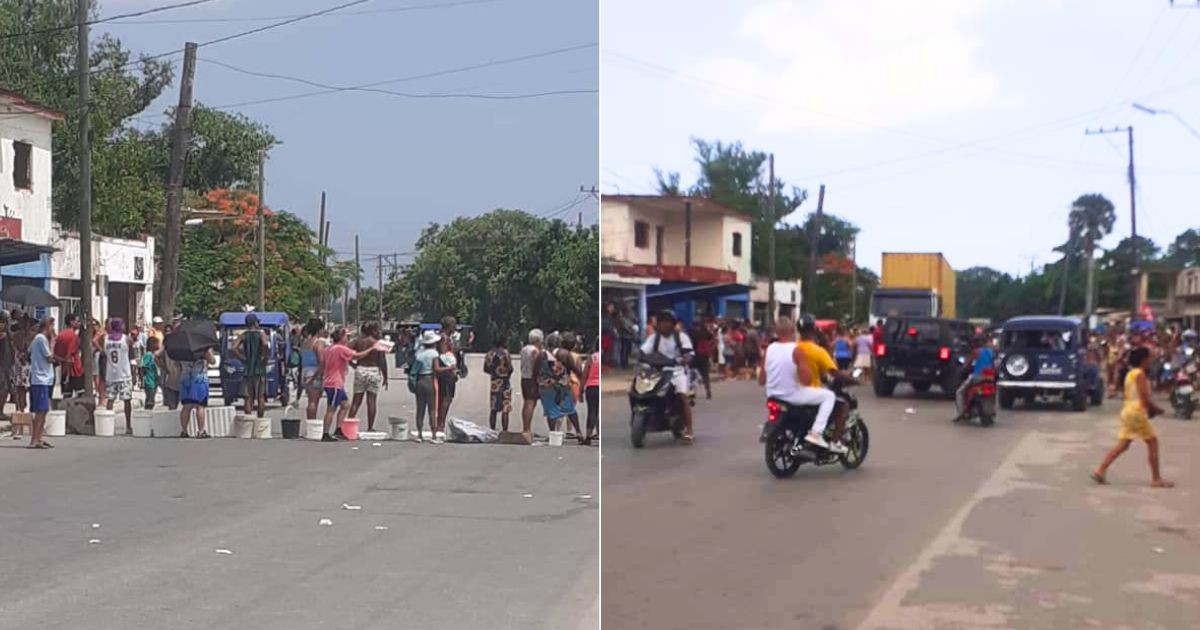
Residents of Mantilla, a neighborhood in the Arroyo Naranjo district of Havana, took to the streets this Sunday, blocking the Calzada de Managua to demand access to potable water. The community has been suffering without a regular water supply for over two months, amidst soaring temperatures exceeding 30°C.
The protest gained visibility through the Facebook community group “Somos Mantilla (Grupo Oficial),” where Radimir Galán Rodríguez shared the news. Gretel Lobelle, a former resident and teacher from the area, elaborated on the dire situation: “Temperatures at 88°F. It’s been over two months since Mantilla received water. A small tank of well water costs 2,500 pesos; a full tanker, 40,000,” she posted.
Lobelle vividly described the survival tactics locals have adopted: “People often ask how they manage. They rely on water thieves, meters of hoses from areas with water, and carrying from those with wells. Everyone has adjusted to saving every drop for when it might be available.”
The Struggles of a Neglected Community
Mantilla, a neighborhood long plagued by deficits, is populated by humble, working-class citizens. “This is a peripheral community, I lived it myself,” Lobelle recalled. In 2000, Mantilla had a water aqueduct and drainage network, infrastructure that has since deteriorated without replacement.
This Sunday’s demonstration was not an isolated incident. On June 7, after a week without water, residents rushed to fill any container when a tanker finally arrived. Earlier, on April 2, a resident reported a leak on Progreso Street, where water mixed with piled trash, ignored by the state-run Aguas de La Habana. And on March 12, the community had already engaged in street blockades and pot-banging protests amid extended blackouts.
Temporary Solutions and Lingering Issues
Following Sunday’s roadblock on the Calzada de Managua, local authorities reportedly dispatched two or three tankers to Mantilla. However, residents argue that such measures fail to address the root of the problem. Lobelle empathized with the protesters: “It’s likely they’ll provide a bit of water. A protest doesn’t really move the government, but at least for a moment, these people can express their humanity and escape survival mode.”
Mantilla’s plight mirrors a broader water crisis affecting the Cuban capital. Over 376,000 people in Havana endure irregular access to water, while nationwide, around 2.7 million face shortages with many receiving water sporadically. The reliance on the electrical grid for 87% of water supply means that blackouts lasting up to 22 hours render water pumps useless across the island.
In the black market, private tankers and illegal pumps command exorbitant prices. Tankers holding 8,000 to 10,000 liters are priced at 18,000 to 26,000 Cuban pesos in Havana, with illegal “water thieves” costing up to 36,000 pesos. In Mantilla, as Lobelle notes, a tanker costs a staggering 40,000 pesos, highlighting the severity of the crisis in this district.
Widespread Discontent Across Havana
Since March 2026, more than a dozen Havana municipalities have experienced similar protests with roadblocks, pot-banging, and barricades. Areas like El Cerro, Guanabacoa, Regla, Marianao, Playa, Luyanó, Diez de Octubre, Alamar, Boyeros, San Miguel del Padrón, and Centro Habana have all witnessed unrest. The organization Cubalex reported at least 14 arrests related to these demonstrations. The regime’s response has consistently been to deliver tankers under public pressure, without addressing the systemic failures of the collapsing water infrastructure.
Understanding Cuba's Water Crisis
What prompted the recent protest in Mantilla?
The protest in Mantilla was sparked by a prolonged water shortage, with the community going over two months without regular access to potable water amidst high temperatures.
How are Mantilla residents coping with the water crisis?
Residents have resorted to using illegal pumps and hoses from areas with water, relying on community wells, and storing any available water to manage the shortage.
What has been the government's response to the protests?
The government's typical response has been to send water tankers to affected areas temporarily, without addressing the underlying infrastructure issues causing the water crisis.