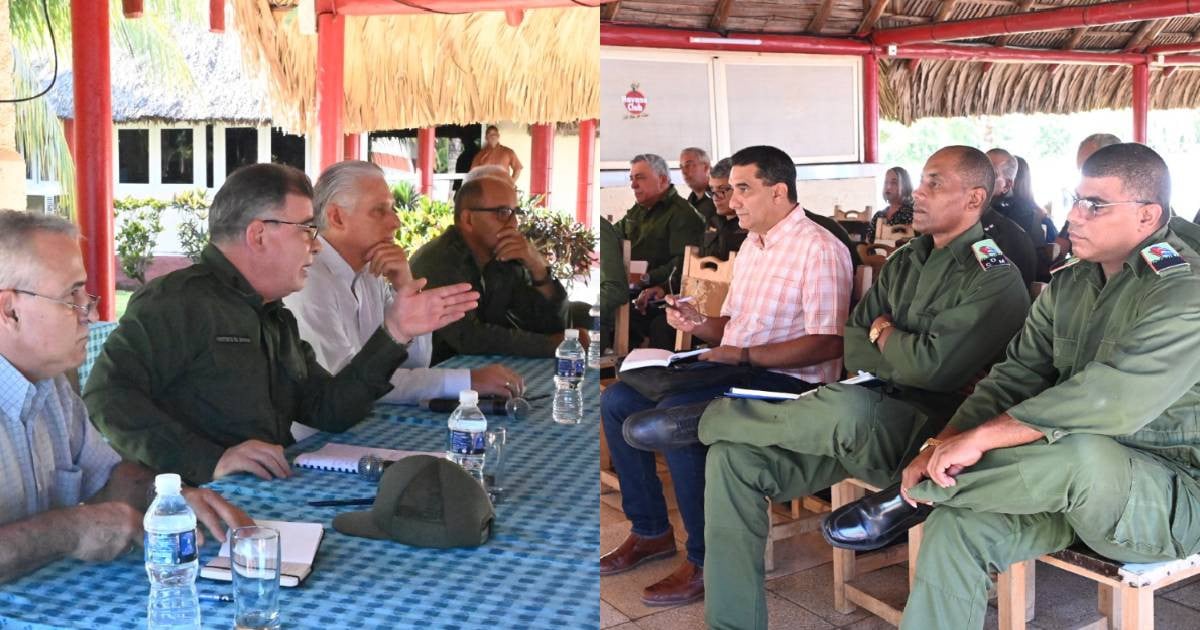
On Saturday, President Miguel Díaz-Canel visited the Wajay Defense Zone in Havana's Boyeros municipality to assess the role of Interior Order Groups within Cuba's territorial defense framework. The regime has portrayed this integration as a crucial step to "prevent and confront exceptional situations."
Leading the visit as the head of the National Defense Council, Díaz-Canel was joined by three members of the Political Bureau: Army Corps General Lázaro Alberto Álvarez Casas, the Minister of the Interior; Army Corps General Roberto Legrá Sotolongo, First Deputy Minister of the Revolutionary Armed Forces and Chief of the General Staff; and Division General José Amado Ricardo Guerra, Secretary of the Council of Ministers. This was highlighted in a report by the Presidential Office on Sunday.
The Interior Order Groups are specialized units under the Ministry of the Interior (Minint) that combine regular troops, Territorial Troop Militias, Production and Defense Brigades, and Minint forces with civilian participation. Their mission encompasses interior order, security, and defense under a unified plan.
Strengthening Defense Zones
Díaz-Canel praised these groups for providing a "coherent, precise, firm, creative response" and indicated that their integration into defense zones—territorially equivalent to popular councils—could enhance cohesion and functionality in local areas.
The president also noted that "organizational reserves are not lacking, and there will always be room for tailored solutions based on the specific characteristics of each location."
This visit is part of the Defense Preparation Year for 2026, declared by the regime and inaugurated on January 12 with ceremonies in the three territorial armies. Saturdays have been designated as regular military training days for civilians.
Broader Control Initiatives
The latest meeting with Cuban military leaders adds to a series of territorial control measures launched in recent months. These include the "Mi Barrio por la Patria" program, formally introduced in May and covering over 12,000 districts; the Community Youth Network launched in April; and the strengthening of the Committees for the Defense of the Revolution (CDR) as "defense and combat" structures in each neighborhood.
The regime claims these actions are a response to alleged threats from President Donald Trump's administration, which have intensified following the apprehension of former Venezuelan President Nicolás Maduro by U.S. forces in January.
Reality vs. Official Narrative
However, the real situation diverges considerably from the official narrative. According to a May report by Cubalex, Cuba is experiencing a "de facto state of exception," with 31 documented security, defense, and repression incidents in March alone, marking a 240% increase from February. Sixty-one percent of these incidents involved repression or direct control over the population.
All this is happening while the island endures power outages exceeding 20 hours a day, chronic shortages of food and medicine, and a 23% GDP contraction since 2019. The regime's militaristic apparatus cannot conceal these harsh realities with territorial defense exercises.
Cubalex concludes that the regime is effectively implementing measures typical of a state of emergency "without formal declaration or legal oversight," representing the most significant territorial control deployment since the regime's revival of war rhetoric in early 2026.
FAQs on Cuba's Territorial Defense Strategy
What are the Interior Order Groups in Cuba?
The Interior Order Groups are units within Cuba's Ministry of the Interior that integrate regular troops, militias, and civilian forces to maintain interior order, security, and defense under a unified command.
Why has the Cuban government emphasized territorial defense?
The regime claims territorial defense is necessary to counter perceived threats from the U.S. government, especially after the capture of former Venezuelan President Nicolás Maduro. However, this is seen as part of broader efforts to maintain control over the population.
What challenges is Cuba facing amid these defense preparations?
Cuba is grappling with severe power outages, food and medicine shortages, and a significant economic downturn, with a 23% GDP contraction since 2019, which the regime's defense initiatives cannot mask.