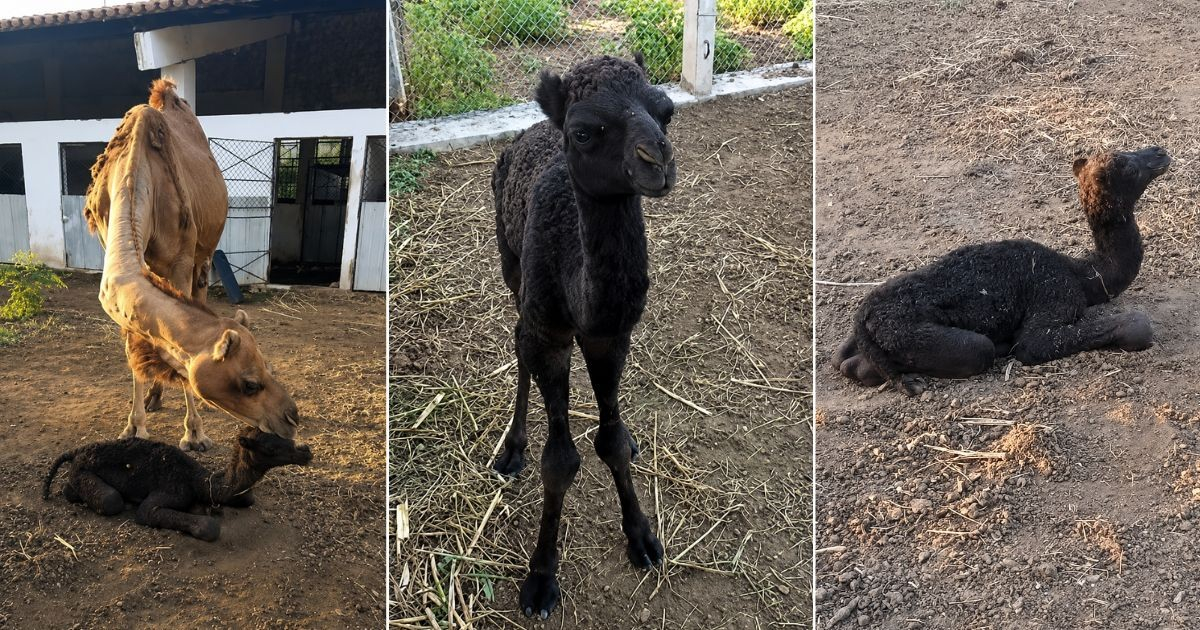
This July, the National Zoo of Cuba celebrated a rare event: the birth of a dromedary calf (Camelus dromedarius), marking the first such occurrence in nearly 30 years. This joyful news was shared by the Cuban Zoo Company on their official Facebook page.
"After 30 years, a Dromedary (Camelus dromedarius) has been born at the National Zoo of Cuba. The newborn is in excellent health, under the watchful eyes of its mother and the dedicated area technicians," the institution proudly announced in their statement.
The accompanying photographs highlight the calf's strikingly dark black coat, an uncommon feature in a species typically seen in shades of beige, light brown, or sandy colors.
These images also capture the tender moment of the mother tending to her newborn, performing the essential post-birth care, while the dromedary calf rests comfortably on the straw-covered ground.
This birth is a significant milestone for the zoo, considering the challenges of breeding dromedaries in captivity. Their pregnancy lasts between 13 and 15 months, each birth usually results in a single calf, and the mother remains closely bonded with the newborn during its first week.
Interestingly, dromedaries have been extinct in the wild for around 2,000 to 3,000 years, with all current populations being either domesticated or maintained in controlled environments.
From birth, these calves are capable of standing on their first day, and their nursing period can span one to two years.
Located in Calabazar, Boyeros municipality, Havana, the zoo opened in March 1984. It spans 340 hectares, housing over a hundred species including native Cuban wildlife and exotic animals.
In recent years, the facility has been the site of other notable births of species that are difficult to breed in captivity. In March 2021, four Bengal tigers were born naturally, followed by the arrival of a male white rhinoceros calf in June 2022 and another Bengal tiger in August of the same year.
The arrival of the dromedary calf adds to this trend of reproductive successes, reinforcing the park's status as one of the most active ex situ conservation centers in the Caribbean.
Frequently Asked Questions About Dromedary Birth at the National Zoo of Cuba
How long is the gestation period for dromedaries?
The gestation period for dromedaries ranges from 13 to 15 months.
Why is the birth of a dromedary significant for the National Zoo of Cuba?
The birth is significant because it is the first dromedary born at the zoo in nearly 30 years, highlighting the challenges and successes of breeding this species in captivity.
What makes the calf's coat color unusual?
The calf has a rare dark black coat, which is unusual for the species that typically has beige, light brown, or sandy-colored coats.