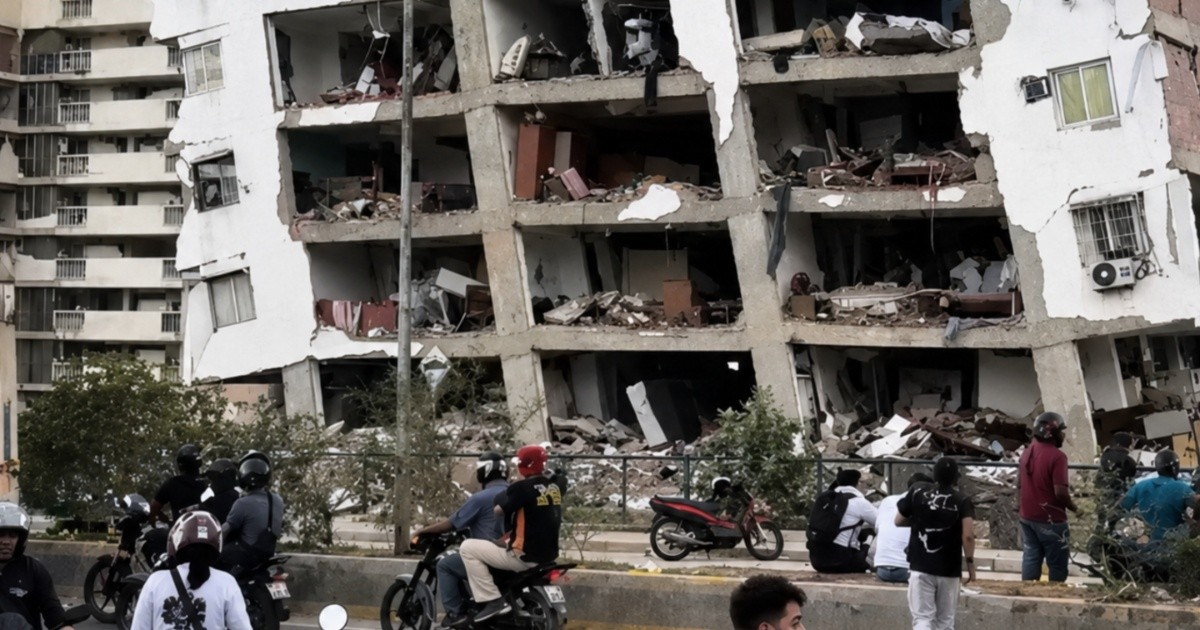
Following the catastrophic dual earthquakes that shook Venezuela on June 24, with magnitudes of 7.2 and 7.5 occurring just 39 seconds apart, alarming alerts began to circulate on Cuban social media. These warnings predicted imminent seismic activity in the Bartlett Deep, the southern part of eastern Cuba, and the Caribbean Sea.
However, according to Juventud Técnica, experts from Cuba's National Seismological Service have dismissed any direct connection between these Venezuelan events and the seismic activity on the island.
Enrique Diego Arango Arias, head of the National Seismological Service at the National Center for Seismological Research (CENAIS), was unequivocal: "None of these alerts or earthquake warnings have been issued by any scientific institution dedicated to studying or researching the seismicity of Cuba or the Caribbean."
The credibility of those spreading these predictions was also questioned by the specialist: "To my knowledge, none of those who issue these alarms are seismologists. No reputable name with published articles on earthquake prediction has surfaced."
Geological Context and Theoretical Possibilities
Geologically speaking, the situation is straightforward: Cuba lies on the North American plate, in contact with the Gonave microplate to the south, whereas the Venezuelan earthquakes occurred along the boundary between the Caribbean plate and the South American plate.
"There should be no direct influence, as the North American plate, where Cuba is located, is not in contact with the Caribbean plate, but rather with the Gonave microplate, situated south of Cuba," explained Arango Arias.
Nonetheless, the expert admitted a theoretical possibility: a strong earthquake could potentially trigger events in areas already on the verge of releasing accumulated tensions, through the vibrations it generates in the Earth.
He illustrated this with a common analogy: "I always use the example of what happens when you shake a fruit tree: the ripe fruits, which were going to fall sooner or later, drop."
Cuba's Seismic Activity in 2026
Despite the lack of direct influence from Venezuelan earthquakes, Cuba's seismic context in 2026 has been notably active.
A magnitude 6.2 earthquake that struck western Cuba on June 8, with its epicenter in Pinar del Río, surprised experts as it occurred in a historically inactive area and was felt as far as Miami and Cancún.
Earlier, on March 17, a magnitude 6.0 earthquake hit Imías in Guantánamo, producing over 900 aftershocks within the first 24 hours.
The southeastern region of the country remains the most seismically dangerous area.
The Oriente fault, which runs along the southern part of Cuba, has been accumulating energy since the 1932 earthquake in Santiago de Cuba, which had a magnitude of 6.75 and an intensity of eight degrees on the MSK scale. It might produce a similar event in the future.
Structural Vulnerability and Risk Management
Seismologist Dr. Fernando Guasch Hechavarría, an expert in Disaster Risk Management, has emphasized that the greatest risk to Cuba comes not from Venezuelan earthquakes, but from the region's accumulated structural vulnerability. "The increase in seismic risk in the Caribbean region is a reality and is generating potentially critical disaster scenarios," he warned.
Guasch pointed out that public policies regarding territorial planning in the Greater Antilles are not aligned with the estimated danger levels, thus exponentially increasing the risk in the face of any significant seismic event.
Arango Arias reiterated that in the event of any imminent danger, the competent institution would be the first to alert the public: "If an imminent hazard related to seismicity were known, the first to inform the population would be CENAIS and the National Civil Defense."
Understanding Seismic Risks in Cuba
How do the Venezuelan earthquakes affect Cuba?
Experts have concluded that there is no direct influence of the Venezuelan earthquakes on Cuba due to the different tectonic plates involved.
What is the Oriente fault?
The Oriente fault is a geological fault that runs along the southern part of Cuba, known for accumulating significant seismic energy, with potential to cause future earthquakes.
What is the main seismic risk for Cuba?
The primary risk for Cuba is its structural vulnerability and inadequate public policies in relation to territorial planning, rather than direct effects from Venezuelan seismic activity.