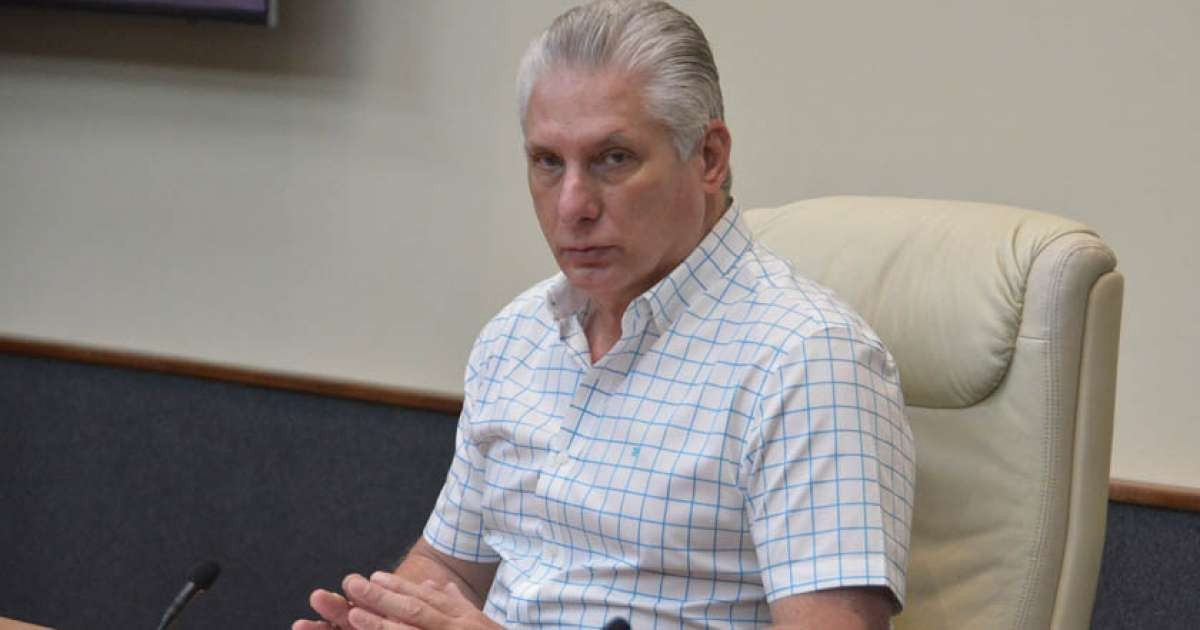
Miguel Díaz-Canel sparked outrage on social media with his response to the pot-banging protests echoing across Cuba. In a remark that epitomizes the regime's narrative, he advised, "Bang your pots at the northern neighbors, they're the ones who have us in this blackout," during an interview with the Puerto Rican weekly CLARIDAD, known for its historical support of Castroism.
The comment emerged when a journalist from the weekly, who claimed to have lived in Cuba for five years, noted that he observed nightly pot-banging in his neighborhood due to dissatisfaction with the power outages.
Rather than accepting any responsibility, Díaz-Canel sought to redirect the pot-banging as propaganda against Washington, ignoring the regime's mismanagement as a cause of the crisis.
Diverse Reactions from Cubans
Cubans' reactions on social media were swift and vehement, ranging from sarcasm to open indignation. "Well then, the order is given: bang the pots," one user wrote, taking the leader's suggestion literally. Another was more explicit: "We need to bang harder so it can be heard."
Many pointed out the blatant cynicism in Díaz-Canel's statements. "The height of cynicism," one commenter summarized. "That's a blatant mockery of the people," added another. "Washing his hands," a third person concluded.
A particular phrase gained traction among the comments: "Full pots don't make noise; their clatter is for hunger and freedom."
Historical Fatigue with Official Rhetoric
Others highlighted the historical fatigue with the official discourse: "Seventy years and the same speech," one user wrote. "These communists make it easy for me to oppose them," another quipped.
Some warned of the implications of the leader's own statement: "Later, he shouldn't arrest people if he himself authorized it." Others were more forthright: "A blackmailer; down with the dictatorship, long live a free Cuba."
Ignoring Internal Failings
In the interview, Díaz-Canel acknowledged the extent of the collapse: "There's a shortage of transportation, food, medicine, and prolonged blackouts of more than twenty hours. That causes dissatisfaction, no one can be happy, the people are suffering."
Nevertheless, he attributed the entirety of the issues to the U.S. embargo: "The main obstacle to our development is the prolonged blockade and its tightening," outright dismissing any personal responsibility.
The reality on the ground starkly contradicts the official narrative. The electric generation deficit hit a historic high of 2,208 MW on June 25, leaving nearly 70% of the country without power, and by Saturday, it was still at 2,050 MW, with 11 thermoelectric units out of service.
The regime's response to the pot-banging was to militarize neighborhoods: black berets armed with long rifles, police operations, and Internet shutdowns. Cubalex documented at least 38 arrests in June, including six minors.
Residents of Zamora, in Marianao, protested on Tuesday after more than 24 hours without electricity, shouting "Freedom!" and "Down with the dictatorship!" Resident Zea Gisselle aptly summarized the situation: "They have fuel to patrol the neighborhood and repress, but not to ensure the country's basic services."
The Cuban Conflict Observatory recorded 107 street protests in June, a historic record, nearly double the previous high.
Díaz-Canel concluded the interview with his typical rhetoric of resilience: "I am convinced that we will overcome, we will move forward, we will prevail, and we will not give up. We will not surrender."
On Cuba's streets, however, the pots continue to resound—and not necessarily to be heard in Washington.
Understanding the Cuban Crisis and Reactions
What prompted Díaz-Canel's controversial suggestion?
Díaz-Canel made the suggestion to bang pots at the "northern neighbors" during an interview, attempting to blame the U.S. for Cuba's power outages, despite the regime's mismanagement being a significant factor.
How did Cubans react to Díaz-Canel's statement?
Cubans expressed their anger and irony on social media, with many criticizing the cynicism of Díaz-Canel's statements and highlighting the regime's failure to address the crisis.
What actions has the Cuban regime taken in response to the protests?
The regime has militarized neighborhoods, conducted police operations, and implemented internet shutdowns to suppress the protests, resulting in multiple arrests.