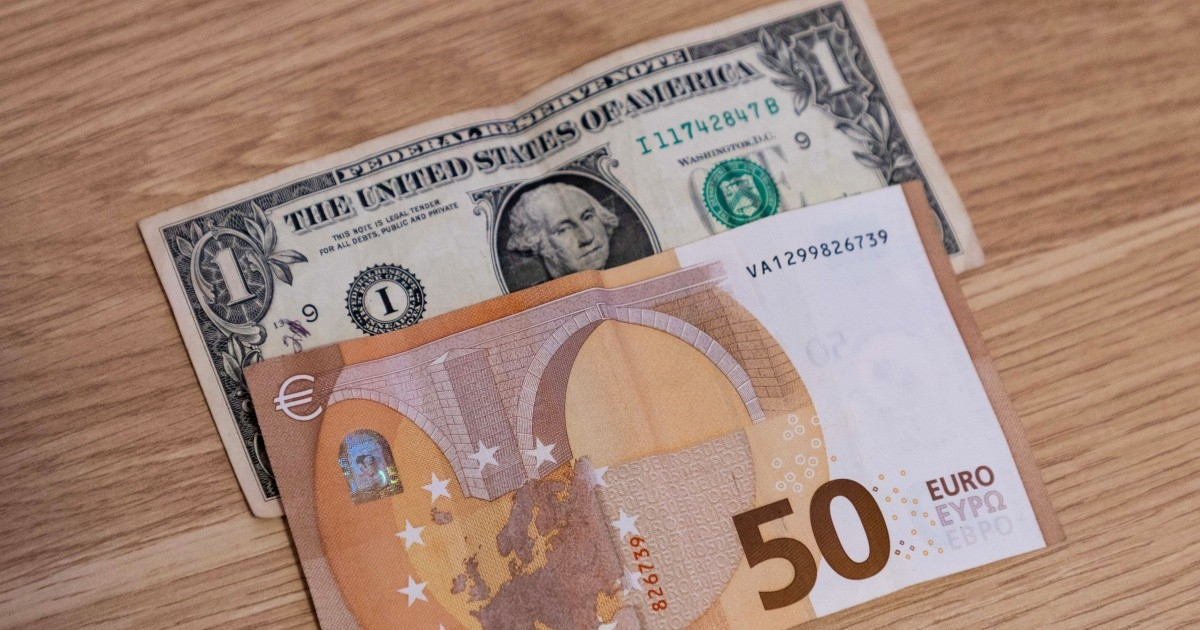
On Sunday morning, the Cuban black market signaled a clear trend: both the dollar and the euro are climbing once more, indicating that the correction seen in late June is now a thing of the past, and the upward momentum that began on July 1 is gaining strength.
This Sunday, the dollar is being sold at an average of 660 Cuban pesos (CUP), marking a 15 CUP increase from Saturday's rate of 645 CUP.
The euro, however, saw the most significant leap of the day, skyrocketing by 30 CUP to reach 750 CUP.
Conversely, the Freely Convertible Currency (MLC) is declining, now priced at 490 CUP.
The Dollar's Consistent Climb
This Sunday’s rise in the dollar is not an isolated event. The currency has been on an upward trend for five consecutive days, rebounding from a recent low of 605 CUP recorded on June 30.
The progression of this recovery is telling: from 610 CUP on July 1, moving to 620 CUP on July 2, fluctuating between 630 and 640 CUP on July 3, hitting 645 CUP on Saturday, and reaching 660 CUP this Sunday.
Meanwhile, the euro, which had stabilized at 720 CUP on Saturday, has surged by 30 units, edging closer to its levels before the June correction.
Historic Peaks and the Correction That Followed
To grasp the extent of these movements, one must look back. On June 21, the dollar hit its all-time high of 695 CUP in the informal market, while the euro reached its own record of 800 CUP.
This spike was directly tied to the announcement of a package of 176 economic measures approved by the National Assembly on June 19. This package included, for the first time since 1959, the authorization of private banking and a digital currency exchange market.
Following that peak, both currencies underwent a significant correction, with the dollar dropping to 605 CUP by June 30—a 90 CUP decrease in just nine days.
The recovery since July 1 has been steady.
The Currency Overshooting Phenomenon
Analysts at elTOQUE describe this pattern as an "overshooting" or foreign exchange overreaction, a recurring occurrence in the Cuban economy since 2022.
"When expectations change—be it due to an economic policy announcement, a rumor, or a crisis of confidence—the price of foreign currency surges beyond what the actual economic fundamentals justify," explains elTOQUE's analysis of the phenomenon.
Once the market comprehends the true scale of the change, it corrects itself. However, this correction is never complete: "The new baseline remains higher than the previous one," they caution.
The so-called "herd effect" also fuels these increases: "People buy foreign currency not because they have rationally evaluated the context, but because they see others buying, and the fear of being left behind drives the surge," they add.
Skepticism from Independent Economists
Critical voices are not in short supply. Economist Pedro Monreal González labeled the 176-measure package as a "monster" or "deformed hybrid" on June 26, warning that "the numbers don't add up."
Pavel Vidal from the Observatorio de Monedas y Finanzas (OMFi) noted that "Cuban currency markets sometimes move exuberantly based on certain waves of optimism or pessimism," adding that "restoring confidence, certainty, and hope will be challenging."
elTOQUE shares the structural diagnosis: "As long as conditions remain unchanged—real scarcity of foreign currency, triple-digit inflation, fiscal deficit, and distrust in the Cuban peso—the rate will eventually climb again."
An Unchecked Historical Devaluation
Long-term figures highlight the crisis's gravity. In 2020, the dollar was trading at just 42 CUP in the informal market. By January 2026, it had reached 435 CUP, and on June 21, it peaked at 695 CUP.
In just six years, the Cuban peso has lost more than 95% of its value against the dollar, a hemorrhage that no package of measures has managed to stop.
At Sunday's rates, 100 dollars are equivalent to 66,000 CUP, and 100 euros to 75,000 CUP, starkly illustrating the chasm between purchasing power in foreign currencies and the salaries in pesos received by the majority of Cubans.
Understanding Cuba's Currency Market Dynamics
Why is the Cuban peso losing value so rapidly?
The Cuban peso has been devalued significantly due to factors such as scarcity of foreign currency, high inflation, fiscal deficits, and a general lack of confidence in the Cuban peso itself.
What caused the recent spike in the dollar and euro in Cuba's black market?
The recent spike in the dollar and euro is linked to the announcement of a package of 176 economic measures, including the introduction of private banking and a digital currency market, which has sparked both optimism and speculation in the currency market.