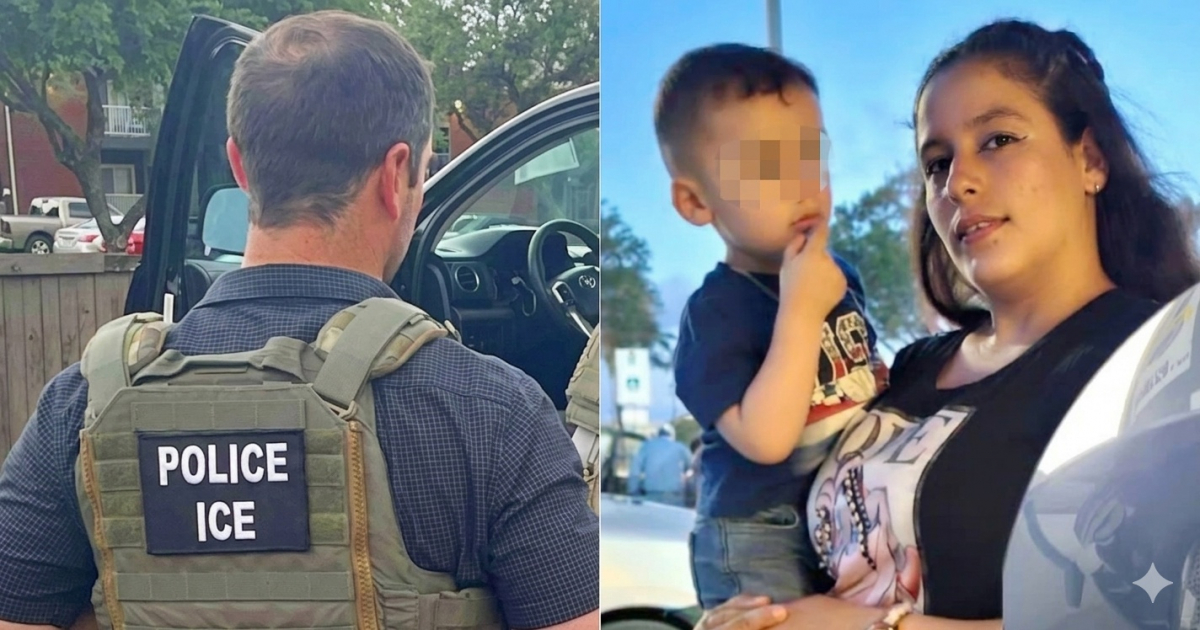
Tania Romero Naranjo, a 24-year-old Cuban woman originally from the Isle of Youth, was taken into custody by the U.S. Immigration and Customs Enforcement (ICE) on June 26 during a routine check-in appointment.
According to a recent report by Univision journalist Javier Díaz, Romero Naranjo has been residing in Portland, Texas, for four years. She entered the United States using the I-220A form, a document known for not providing a definitive legal status nor equivalent to a parole, thus leaving its holders in a perpetual state of immigration uncertainty.
A Mother's Separation from Her Child
This case has struck a chord with many due to its deeply human element: Romero Naranjo is the mother of a three-year-old American citizen who has been under his father's care since her detention.
Díaz described the husband as "desperate in the face of this family crisis," emphasizing that during her time in the U.S., Tania had no criminal record and worked in a high-risk job. She applied fireproofing materials in oil refineries, a task that, according to Díaz, "not all women would dare to undertake."
Family Pleads Against Deportation
The family is urging that Tania not be deported to Cuba or, at the very least, that she be permitted to await the outcome of her immigration proceedings while free. "The family needs to be heard and not have Tania deported to Cuba, as it would separate her from her American son," Díaz concluded.
Díaz's publication unleashed a wave of reactions filled with solidarity. "Deport those who commit crimes, but not hardworking people without criminal records," one user commented, a sentiment echoed by many others.
Some pointed out the systemic issue: "The problem is that many were processed incorrectly, leaving them in a very difficult legal limbo."
The I-220A Limbo: A Widespread Issue for Cuban Immigrants
The I-220A form is a Notice of Release on Recognizance issued by ICE, allowing migrants to remain out of custody while their case progresses. However, it does not provide a pathway to the Cuban Adjustment Act of 1966, which offers permanent residency after a year and a day in the U.S.
It is estimated that between 400,000 and 500,000 Cubans face this predicament nationwide, caught in a category that offers no real protection against deportation.
Since the Trump administration's return in January 2025, arrests during routine check-ins have become a documented pattern. ICE detentions of Cubans surged by 463% between late 2024 and early 2026, with the agency surpassing 10,000 detentions in just five days at the beginning of this month.
Political Pressure and Similar Cases
Tania's situation is not unique. In May, ICE detained two Cuban pastors in Harlingen, Texas, also during a routine check-in. Republican Congresswoman María Elvira Salazar sent a formal letter on June 18 to Secretary of Homeland Security Markwayne Mullin, demanding parole-in-place for Cubans with I-220A who have no criminal records.
"I-220A should not mean legal limbo. For years, thousands of Cuban families have lived in uncertainty because the government handled similar cases differently. That is not justice, and I will continue fighting until these families receive the fair treatment they deserve under the law," Salazar stated.
The 11th Circuit Court of Appeals in Atlanta held a hearing in December 2025 regarding the legal status of the I-220A, but has yet to issue a definitive ruling, leaving hundreds of thousands of Cuban families awaiting a decision that could alter their fate.
As of the closure of this article, no further information is available regarding the case.
Understanding the I-220A and Its Impact on Cuban Immigrants
What is the I-220A form?
The I-220A is a Notice of Release on Recognizance issued by ICE, allowing migrants to stay out of custody while their case is processed. However, it does not grant a legal status or a pathway to permanent residency under the Cuban Adjustment Act.
How many Cubans are affected by the I-220A status?
It is estimated that between 400,000 and 500,000 Cubans are affected by the I-220A status, leaving them in a legal limbo without protection against deportation.
What has been the political response to the I-220A issue?
Republican Congresswoman María Elvira Salazar has been vocal about the issue, advocating for parole-in-place for Cubans with I-220A forms who lack criminal records. She argues that the current system is unjust and has promised to fight for fair treatment for affected families.