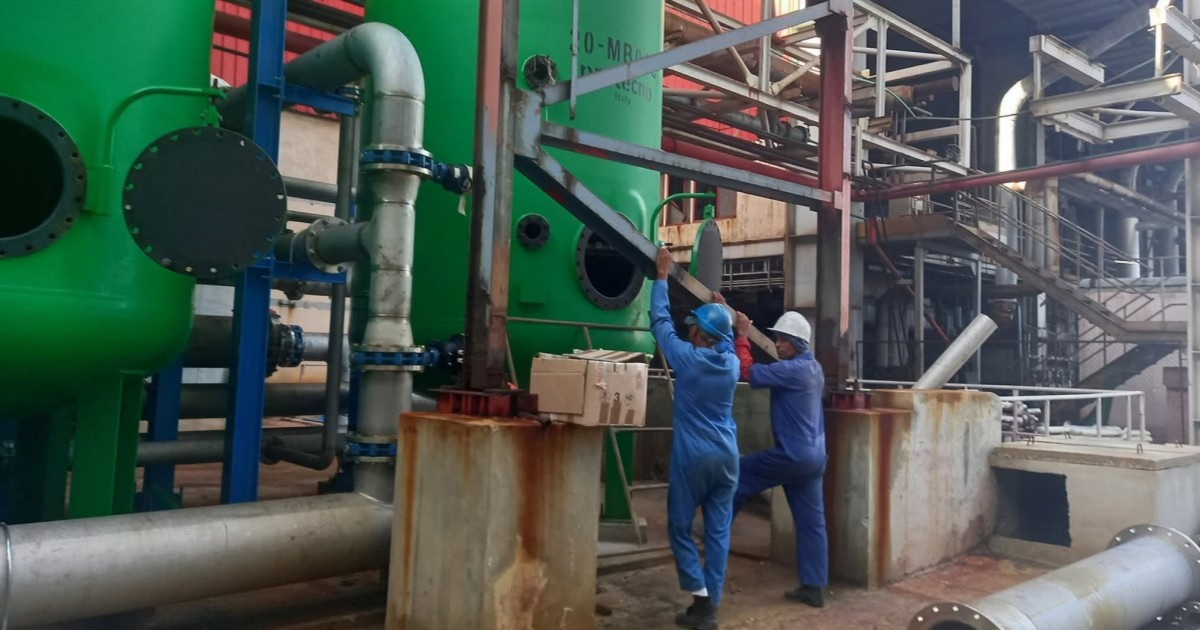
Cuba is set to face a severe power crisis this Saturday as eleven thermoelectric units remain out of commission. Of these, six are undergoing repairs while five are under maintenance. As a result, the Electric Union forecasts a significant shortfall of 2,050 MW during the night, with only 1,050 MW available to meet an expected demand of 3,100 MW.
Official reports indicate that during peak evening hours, the power deficit will reach 2,080 MW, leaving millions of Cubans enduring long periods without electricity. By midday, this shortfall is projected to be around 1,550 MW.
The affected units include numbers 6 and 8 at the Máximo Gómez power plant in Mariel; the Antonio Guiteras plant in Matanzas; unit 6 of Diez de Octubre in Nuevitas; unit 2 of Lidio Ramón Pérez in Felton; and unit 3 of Antonio Maceo in Renté.
Units currently undergoing maintenance are block 5 of the Máximo Gómez plant; unit 3 of Ernesto Guevara in Santa Cruz; units 5 and 6 of Antonio Maceo; and unit 5 of Diez de Octubre.
Additional Power Generation Challenges
Exacerbating the situation, 106 distributed power generation plants remain inactive due to fuel shortages, along with the Regla and Melones barges, and the Mariel and Moa Fuel Centers.
On Friday, the entire nation experienced a 24-hour power outage, including overnight hours, with a peak shortfall of 2,221 MW at 8:00 pm.
Capital and Provincial Power Disruptions
Havana was not spared from these disruptions, with the Electric Company of Havana reporting a maximum shortfall of 586 MW. By the end of their report, 407 MW had yet to be restored, with no estimated recovery time.
Friday night was also marked by a malfunction at the Victoria de Girón Substation in Havana, causing significant system oscillation at 8:08 pm and the sudden shutdown of Renté 3 and Felton 1 units.
Granma province was completely disconnected as a protective measure due to a sharp frequency drop, which led to its isolation to prevent a collapse of the National Electric System.
Long-standing Energy Issues
The ongoing issues are not merely circumstantial. The Antonio Guiteras plant, the largest in the country, has experienced 17 outages this year and hasn't undergone major maintenance since 2010.
Román Pérez Castañeda, director of the UNE, acknowledged the urgent need for intervention but admitted that the country's current situation doesn't allow for it.
Energy and Mines Minister Vicente de la O Levy had promised maintenance by late 2025, postponed it in December, and mentioned it again in April 2026 without setting a firm date. This pattern of unfulfilled promises characterizes the regime's handling of its worst energy crisis.
Escalating Public Unrest
Cuba requires between 90,000 and 110,000 barrels of oil daily for its electric system but only produces 40,000. The cessation of Venezuelan supplies in January 2026 has worsened an already untenable situation.
Since July 1, there have been protests, pot-banging demonstrations, and street blockades in Havana and Santiago de Cuba, with chants evolving from "We want power!" to "Freedom!" and "Down with the dictatorship!" The Cuban Observatory of Conflicts recorded 1,311 protests in May 2026, the highest since July 11, 2021.
Understanding Cuba's Energy Crisis
What is causing the power outages in Cuba?
Cuba's power outages are primarily due to the failure and maintenance of multiple thermoelectric units, coupled with a lack of fuel for distributed generation plants.
How is the Cuban government addressing the energy crisis?
The government has made several promises to conduct essential maintenance by 2025 and 2026, but no concrete actions have been taken yet, contributing to public frustration.
How have Cubans reacted to the ongoing power issues?
Cubans have protested through demonstrations, pot-banging, and street blockades, expressing demands for power and political change.