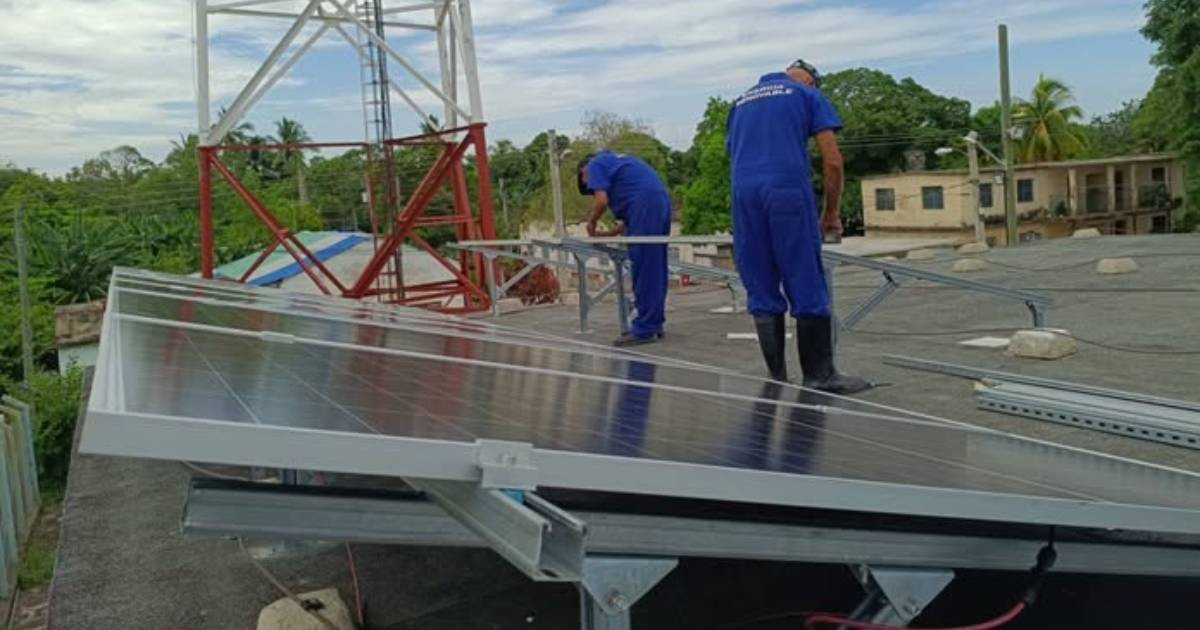
In an effort to maintain communication services during what is arguably the most severe energy crisis Cuba has faced in decades, ETECSA is forging ahead with the installation of solar panel systems across telephone centers in the municipal capitals of Pinar del Río. According to the state-run newspaper Granma, installations have been completed in eight centers, with ongoing work in Viñales, Sandino, and the Hermanos Cruz district in the provincial capital.
The territorial director of ETECSA in the province, Manuel Milián Villar, set a politically charged deadline for the project: having all systems operational by July 26, the date marking the 73rd anniversary of the assaults on the Moncada and Carlos Manuel de Céspedes barracks. "We have all the necessary equipment to achieve this," stated Milián Villar, as reported by the state media.
Varied Capacity to Meet Technical Needs
The capacity of these systems is tailored to the specific technical demands of each center. "Some systems offer 10 kilowatts (kW), others 30, 50, and one even provides 100 kW," Milián Villar explained. This enhancement aims to improve landline services for approximately 60% of ETECSA's customers in Vueltabajo—over 50,000 connections—though the impact on mobile services will be more limited.
Investments Highlight Infrastructure Collapse
The scale of this investment underscores the extent of infrastructure collapse in the province. Milián Villar acknowledged that the National Electric System's crisis left nine out of 11 municipal capitals in Pinar del Río disconnected, with only Sandino and the provincial capital remaining operational thanks to generators, as indicated by the source.
This is not the first instance of resorting to solar energy as a stopgap for the electrical disaster. Prior to this new investment, the province had received a Chinese donation of 18 solar systems of two kW each, distributed across four municipalities. In November 2025, China donated 5,000 solar systems valued at over $114 million, of which 240 units were allocated to ETECSA nationwide.
Challenges Persist Despite Solar Solutions
What the official report fails to mention is the limited autonomy of these systems, which falls short of the extended power outages experienced in Pinar del Río, sometimes exceeding 30 hours. These blackouts have compelled ETECSA to deploy emergency solar panels in various provinces, though this has not resolved the underlying issue. Furthermore, regulations from the National Office for Rational Energy Use prevent recharging batteries from the conventional grid, leaving them solely reliant on solar radiation.
ETECSA has conceded that power outages disrupt phone services: nationally, around 47.5% of mobile radio bases and 56.5% of telecommunication cabinets are rendered inoperative by power cuts. Gustavo López Cruz, head of ETECSA's commercial department in Sancti Spíritus, candidly admitted, "The reality is that this technology cannot function for more than 24 hours without grid power."
Theft and Community Response
The structural fragility is compounded by the theft of solar panels. At least three thefts targeting ETECSA's infrastructure occurred in Santiago de Cuba between May and June 2026, leaving hundreds of users without service. An engineer from the company expressed frustration on social media: "Once again, the so-called honorable thieves have struck, taking away the hard work and sacrifice of us workers who rise early every day for the good of the people."
The official report also highlights community efforts, with residents from the 10 de Octubre neighborhood in Pinar del Río and the Calderón community in San Juan y Martínez organizing to acquire and donate backup solar systems for local cabinets, indicating a shift of responsibility onto citizens.
The Communist Party's Political Bureau designated Pinar del Río as the central site for the July 26 celebration on June 27, citing progress in renewable energy, a move that sparked outrage among Cubans who report power outages lasting over 20 to 30 hours in the same province. Meanwhile, Cuba ranks last in internet speed in Latin America, according to recent Speedtest Global Index data.
Cuba's Energy Crisis and Solar Panel Use
Why is ETECSA installing solar panels in Pinar del Río?
ETECSA is installing solar panels to keep communication services running during severe energy shortages affecting Cuba.
What challenges do solar systems face in Pinar del Río?
The main challenges include limited system autonomy during prolonged outages and regulations that prevent battery recharging from the conventional grid, making them dependent on sunlight.
How has the community responded to the energy crisis?
Communities in Pinar del Río have organized to purchase and donate solar systems for local telecommunication cabinets, showing a proactive approach to addressing the crisis.