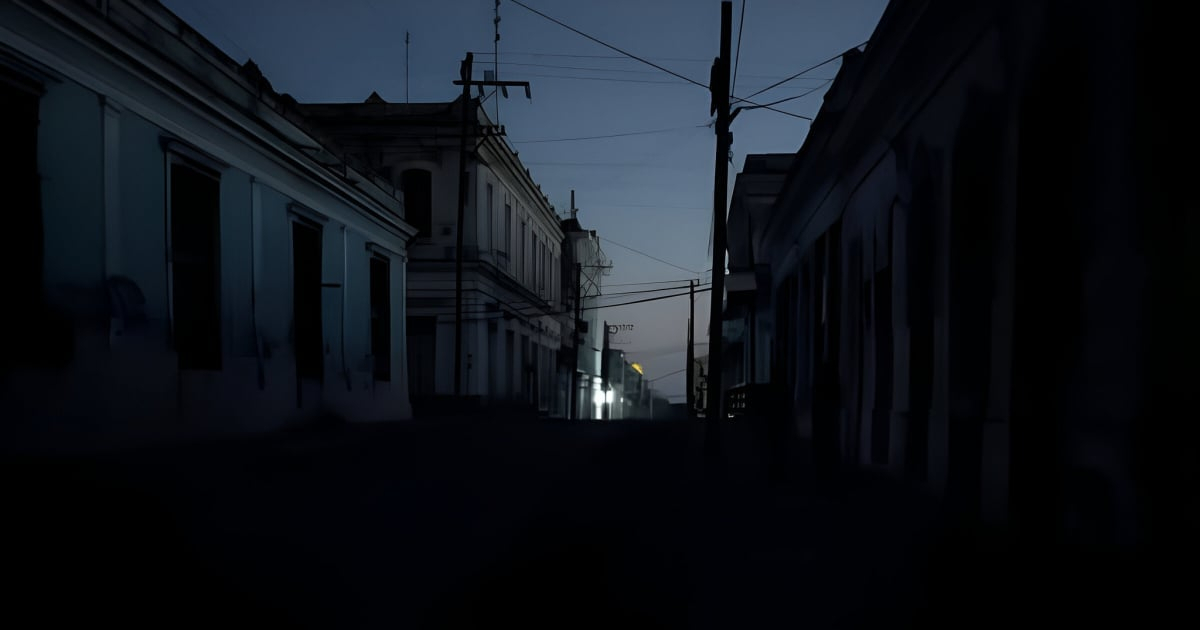
A malfunction at the Victoria de Girón Substation in Havana triggered another crisis within Cuba's National Electric System (SEN) on Friday. The Cuban Electric Union (UNE) reported on Facebook that the incident occurred at 8:08 PM, causing significant fluctuations that led to the unexpected shutdown of the Renté 3 and Felton 1 units.
The state-run entity admitted that the SEN was left with "low generation capacity availability," resulting in "severe disruptions nationwide." Although Felton reconnected with a meager 50 MW while increasing loads, and ENERGAS units joined the core generation, the situation remained dire.
Regions Plunged into Darkness
The most immediate impact was felt in Granma, which was completely cut off from the SEN around 8:40 PM. The province's Electric Company explained that the disconnection occurred because the Lidio Ramón Pérez (Felton) Power Plant was synchronizing with the system when a sudden frequency drop occurred, forcing Granma to disconnect to prevent a total collapse of the National Electric System.
This setback unfolds amid the worst energy crisis in Cuba's recent history. The projected deficit for Friday reached an unprecedented 2,206 MW, with only 944 MW of generation capacity available to meet a demand of 3,150 MW. The situation was worsened by the 17th outage of the Antonio Guiteras Power Plant on the same day.
Struggling Infrastructure and Public Outcry
Adding to the woes, 106 distributed generation plants remain offline due to fuel shortages, accounting for 890 MW of unavailable capacity. Additionally, Unit 2 of the Felton Power Plant, which has an installed capacity of 330 MW, had already been out of service since the previous day.
Granma faces particular hardships. On June 23, the province lost power due to a failure in the 110 kV transmission line between Renté and Santiago de Cuba. Some circuits have experienced outages of up to 72 consecutive hours, prompting public demands for at least three hours of daily electricity.
In the past 18 months, the SEN has endured at least five total collapses. The longest occurred on March 16, 2026, resulting in a nationwide blackout lasting 29 hours and 29 minutes. In May, a deficit of 2,174 MW left 70% of the island simultaneously in the dark. On February 4, a disruption at the Holguín 220 kV substation plunged four eastern provinces into darkness.
Public Sentiment and Government Response
Citizen reactions on social media have ranged from exhaustion to irony and indignation. One user captured the collective sentiment: "It's now normal for something to happen with the SEN every weekend... and we're just starting summer... may God have mercy on us." Another highlighted systemic inequality: "From my rooftop, I see Varadero all lit up, never going dark, working like a charm, 24/7. Those things don't happen in Olympus." A third voice warned of worse to come: "At this hour and with that message, they're telling us we'll be without power for days."
The crisis stems from decades of neglect of Cuba's thermoelectric facilities, compounded by the suspension of Venezuelan oil shipments following Nicolás Maduro's capture on January 3. The UNE announced plans to reintegrate 400 MW through maintenance on six thermoelectric plants by July but acknowledged that this would not meet national demand, as Cubans face the beginning of summer with power outages exceeding 40 consecutive hours in some areas.
Understanding Cuba's Energy Crisis
What caused the recent power crisis in Cuba?
The crisis was triggered by a malfunction at the Victoria de Girón Substation, leading to severe fluctuations and power unit shutdowns. The situation is compounded by a lack of adequate generation capacity and outdated infrastructure.
How are citizens reacting to the power outages?
Citizens are expressing exhaustion and frustration on social media, highlighting systemic inequalities and fearing prolonged outages as summer approaches.
What steps is the Cuban government taking to address the energy crisis?
The Cuban Electric Union plans to reintegrate 400 MW through maintenance on thermoelectric plants by July, though this will not fully meet the national demand.