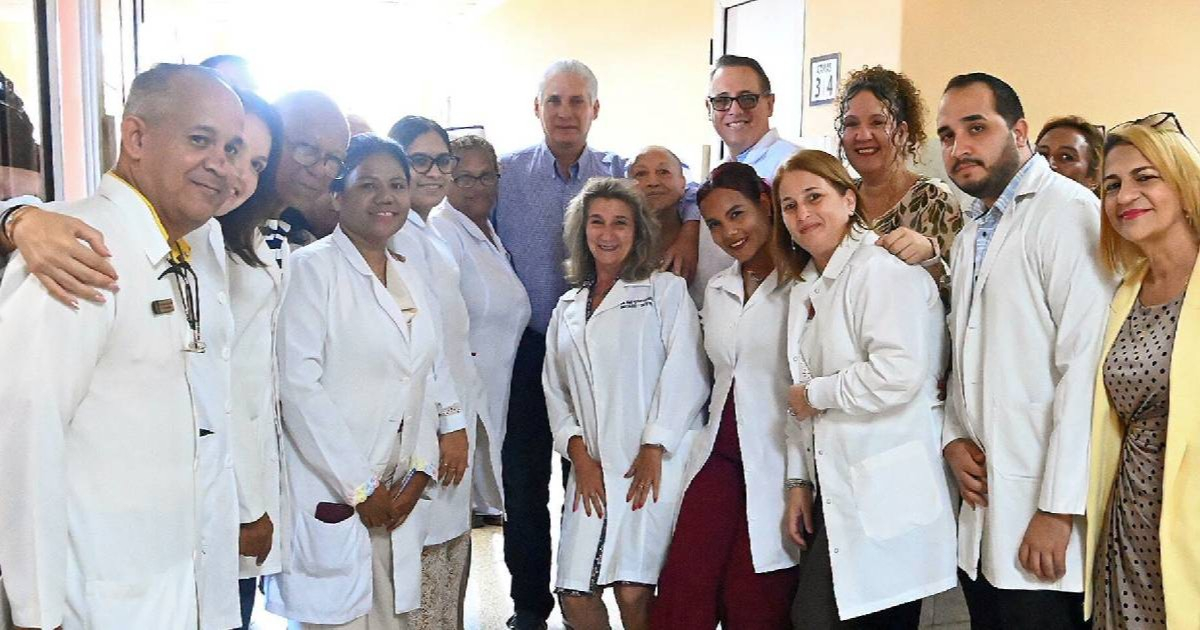
On Friday, Miguel Díaz-Canel paid a visit to the University Gynecological and Obstetric Hospital "Ramón González Coro" in Havana. His subsequent social media post triggered a wave of outrage among Cubans, who dismissed his visit as mere propaganda, detached from the harsh realities of the country's healthcare system.
In his post on X, Díaz-Canel stated, "I visited the 'Ramón González Coro' hospital, where heroism becomes commonplace. Despite the severe shortages imposed on us by the hostile policies of the United States government, life continues to find its way here. It was an uplifting encounter."
The post received a mere 123 likes and 12 comments, largely critical. Many Cubans pointed out that the González Coro is among the best-equipped facilities in the island's healthcare system, arguing that choosing it as the site for an official visit paints a misleading picture of the conditions faced by most hospitals across the nation.
Contrasting Realities in Cuban Healthcare
While Díaz-Canel posed with the medical staff, reports from other Cuban healthcare facilities highlighted dire conditions such as collapsed ceilings, sewage water beneath beds, power outages lasting up to 20 hours, and a lack of basic medications.
During the tour, Díaz-Canel himself acknowledged alarming statistics reflecting the crisis: over 67,000 newborns without special medications, 34,000 pregnant women without full care, and more than 100,000 cancer patients — including 1,200 children — receiving limited treatments. The national surgical waiting list exceeds 96,500 patients, including 12,000 minors.
"Creative Resistance" Amid Crisis
He coined the term "creative resistance" to describe the efforts of doctors who walk to work, often before dawn due to a lack of transportation, and who work without consistent electricity or sufficient supplies. "There is no blackout that extinguishes hope, and no scarcity that breaks the will," he claimed.
Concluding his visit, he quoted Fidel Castro: "These are tough times, but Fidel always said that in crises, we must find opportunities to grow, develop, and improve, and sooner rather than later, we will overcome this situation."
Public Backlash and Deteriorating Health Statistics
The public reaction was swift. Cubans took to social media to point out that this was Díaz-Canel's eighth visit to healthcare facilities in 2026, all to reference hospitals or those undergoing rehabilitation, with each visit following the same pattern: official triumphant images amidst reports of systemic collapse elsewhere.
The backdrop of this visit is grim. The infant mortality rate closed 2025 at 9.9 per 1,000 live births, the highest in over two decades, compared to 4.0 in 2018, marking a 148% deterioration over seven years. In Havana, that figure reached 14 per 1,000 in the first two months of 2026.
The scrutiny of the maternal-infant crisis extends to maternal mortality, which hit 44.1 per 100,000 in 2025, nearly double the rate in 2023. In February 2026, Health Minister José Ángel Portal Miranda admitted the system is "on the brink of collapse," with the basic medication list covering only 30% of national demand, leaving 461 of 651 essential drugs absent from state pharmacies.
Díaz-Canel blamed all shortages on the U.S. embargo and Washington's "maximum pressure" policy, a narrative the regime consistently repeats when faced with evidence of decline. Meanwhile, economists and the Cuban populace attribute the collapse primarily to decades of internal mismanagement.
Understanding the Cuban Healthcare Crisis
What triggered the public outrage against Díaz-Canel's hospital visit?
The public was outraged because Díaz-Canel's visit to a well-equipped hospital was seen as propaganda, ignoring the severe conditions in most other healthcare facilities in Cuba.
How does the Cuban government explain the healthcare crisis?
The Cuban government attributes the healthcare crisis to the U.S. embargo and Washington's policies, though many believe internal governance issues are the main cause.
What are the current statistics related to Cuban healthcare challenges?
Cuba's infant mortality rate hit 9.9 per 1,000 live births in 2025, with maternal mortality at 44.1 per 100,000. The healthcare system is struggling with a severe drug shortage and long surgical waiting lists.