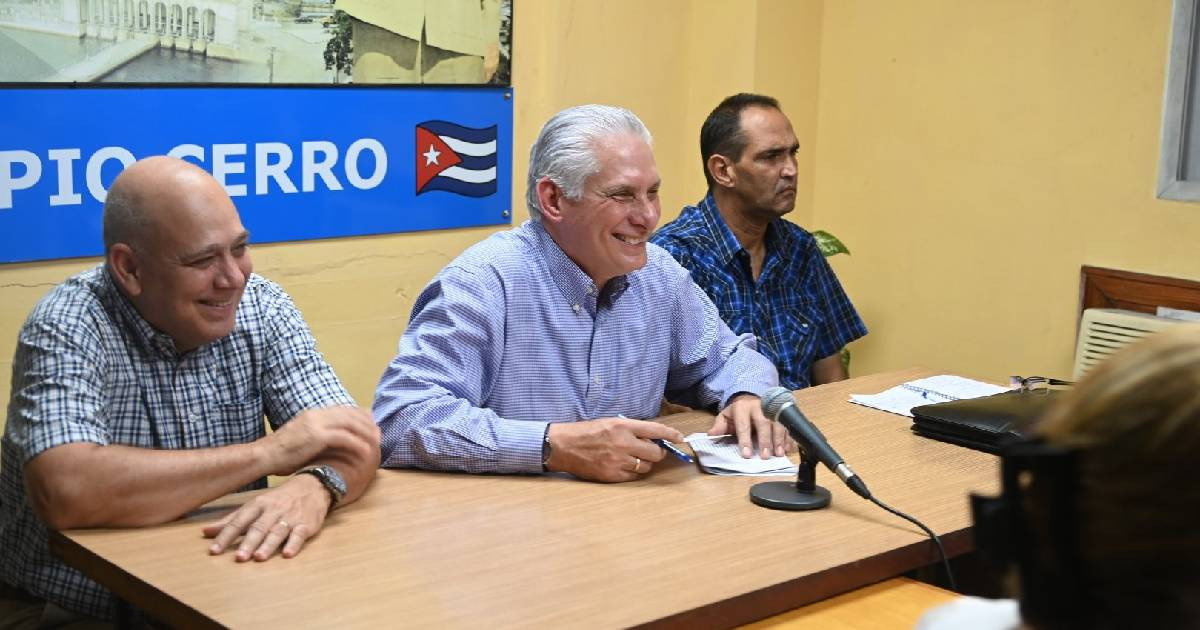
On Friday, Cuban leader Miguel Díaz-Canel visited the Havana municipalities of Cerro and Marianao to meet with the Municipal Defense Councils, urging them to take advantage of the newly approved economic reforms. The official website of the Presidency described this as a discussion about "responses to the challenging situation the country is facing."
"Municipalities must gear up for autonomy; local businesses should prepare for operational independence. You need to be ready to manage ventures with direct foreign investment, closed currency financing schemes, and opportunities involving Cubans abroad and domestically," the leader emphasized.
This visit coincided with some of the most severe power outages recently experienced in the capital.
On the same day, the Antonio Guiteras thermoelectric plant, Cuba's largest power generator, shut down due to its 17th failure of 2026, exacerbating a deficit that began in July with a shortfall of over 2,100 MW against a 3,200 MW demand.
In Marianao, where Díaz-Canel discussed prosperity, residents of the Zamora neighborhood protested on Tuesday, chanting "Freedom!" after enduring more than 24 hours without electricity and several days without water.
The regime blames the crisis on the U.S. embargo and what it calls a "petroleum blockade." However, the reality in both municipalities also includes inadequate equipment for waste collection, with waste burning normalized in Marianao, and thousands lacking access to safe drinking water.
Díaz-Canel's rhetoric leaned on the 176 economic transformations approved by the Communist Party of Cuba and the National Assembly on June 18 and 19, respectively. These changes are seen as the most significant reform package since 1959.
The initiatives include municipal decentralization with powers to attract foreign currency and investment, private banking, and the removal of employment caps for small and medium-sized enterprises (SMEs).
Nonetheless, implementing these measures requires modifying over 148 legal provisions and enacting 32 new regulations. Economists like Mauricio de Miranda have cautioned that without democratic checks and balances, this opening could lead to a "Russian-style transition" benefiting the PCC elite.
Roberto Morales Ojeda, a member of the Political Bureau and secretary of the Central Committee's Organization, also participated in Friday's meetings. The tours began in the Playa municipality and will extend to other municipalities in Havana, according to sources.
Díaz-Canel concluded his address with a long-term promise: "We aim to reach a point where we unleash all productive forces at the municipal level to improve supply levels for the population, purchasing power, and the wage-price relationship as quickly as possible, guiding us toward prosperity."
The average state salary in Cuba is currently equivalent to about $13 per month.
Understanding the Economic Reforms in Cuba
What is the main focus of Díaz-Canel's recent municipal visits?
Díaz-Canel's visits to the municipalities focused on urging local councils to leverage newly approved economic reforms for greater autonomy and economic development.
What are the key components of the recently approved economic changes?
The economic changes include municipal decentralization, the ability to attract foreign investment, establishment of private banking, and the removal of employment limits for SMEs.
What are some challenges associated with implementing these reforms?
Implementing the reforms requires altering over 148 legal provisions and approving 32 new regulations, posing significant challenges without democratic oversight.