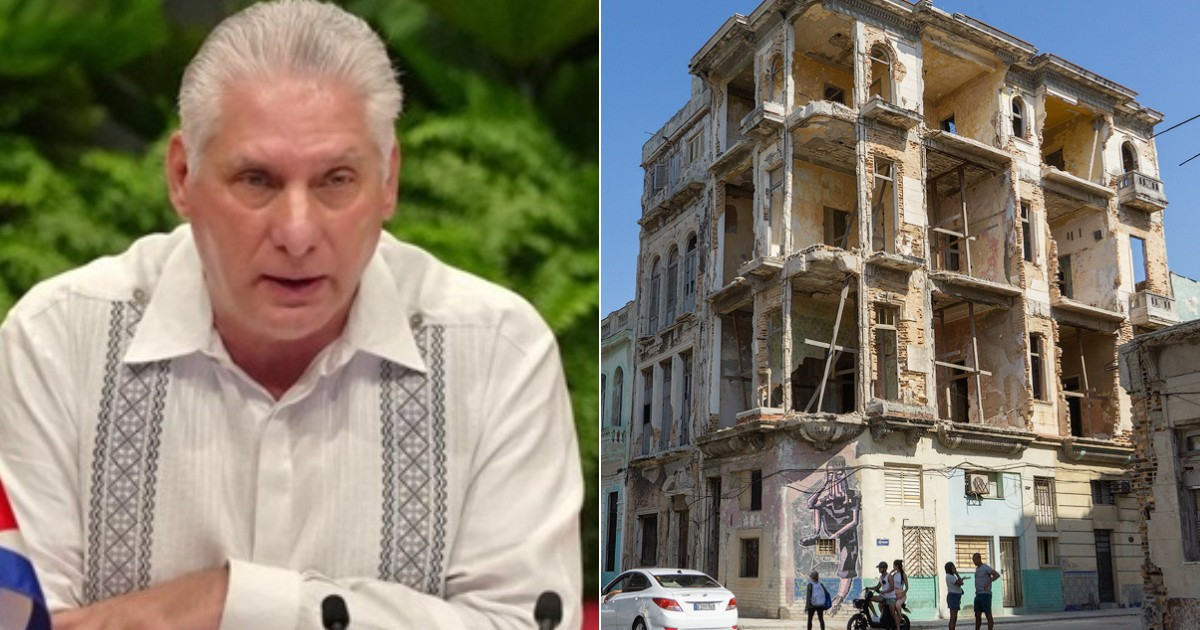
During an interview with the British channel Sky News, President Miguel Díaz-Canel acknowledged that his government has made internal mistakes. However, he firmly argued that these errors do not account for the crisis that is devastating the lives of Cubans, placing the primary blame on U.S. sanctions.
The interview, which took place in Havana and was broadcast on Friday by journalist Yalda Hakim, marked Díaz-Canel's first appearance on a European media outlet this year amidst Cuba's most severe economic downturn since the Special Period.
Hakim directly relayed to Díaz-Canel what Cuban citizens had expressed during her stay in Havana: the situation is "not entirely Washington's fault, but also yours." She posed a pointed question: what responsibility do you take for your people's suffering?
Without sidestepping the inquiry, Díaz-Canel framed his response. "We have always acknowledged our mistakes, and the revolution has been consistently self-critical," he stated.
Nonetheless, he swiftly added, "Regardless of those factors, the primary cause of our country's complex economic and social situation is not the internal mistakes but the impact of the blockade on daily life."
When Hakim reminded him that he had previously admitted to his party the existence of internal factors not linked to the embargo, such as bureaucracy, administrative sluggishness, and delayed decisions, Díaz-Canel did not deny this but maintained the same hierarchy of blame.
"We take responsibility for the things we need to improve, for what we haven't achieved, and for what we've had to postpone due to the blockade. But even if we had done everything perfectly, the country would still be in this situation because the blockade is the main cause," he asserted.
This narrative pattern—limited self-criticism followed by primary attribution to the embargo—is not new. In April 2026, during the 65th anniversary of the declaration of the socialist nature of the revolution, Díaz-Canel admitted to "our own mistakes" but insisted that "the main cause of our problems is the genocidal blockade."
He repeated this framework on June 18 during the most recent Plenary of the Communist Party of Cuba and reiterated it on June 30 at the Council of Ministers, stating that the 176 approved economic reforms aim primarily to "save the Revolution," not the Cuban people.
To illustrate the humanitarian impact, Díaz-Canel provided specific figures: over 67,000 newborns needing special medications but unable to receive them, 34,000 pregnant mothers at risk without full care, more than 12,000 children with cancer lacking complete treatment, and 16,000 patients requiring dialysis without sufficient resources.
He also highlighted that the infant mortality rate has increased from four per 10,000 live births a few years ago to 9.2 per 10,000, a deterioration he directly attributed to the energy embargo imposed by the Executive Order signed by President Donald Trump on January 29, which reduced Cuba's energy imports by 80% to 90% and worsened power outages to over 20 hours daily.
The Sky News interview comes just days before Cuba called for an extraordinary session of the UN General Assembly on July 7 to denounce the tightening of U.S. sanctions, at a time when the Economic Commission for Latin America and the Caribbean (ECLAC) projects a 6.5% contraction in Cuba's GDP in 2026, the worst in Latin America.
Understanding the Impact of U.S. Sanctions on Cuba
How does Díaz-Canel view the role of U.S. sanctions in Cuba's crisis?
Díaz-Canel attributes the primary cause of Cuba's economic and social woes to the U.S. embargo, rather than internal government mistakes.
What internal factors has Díaz-Canel acknowledged?
He has admitted to bureaucratic issues, administrative delays, and postponed decisions but maintains that these are not the main causes of the country's crisis.
What are the humanitarian impacts mentioned by Díaz-Canel?
He mentioned a lack of access to necessary medications for newborns, inadequate care for pregnant mothers, insufficient cancer treatment for children, and resource shortages for dialysis patients.