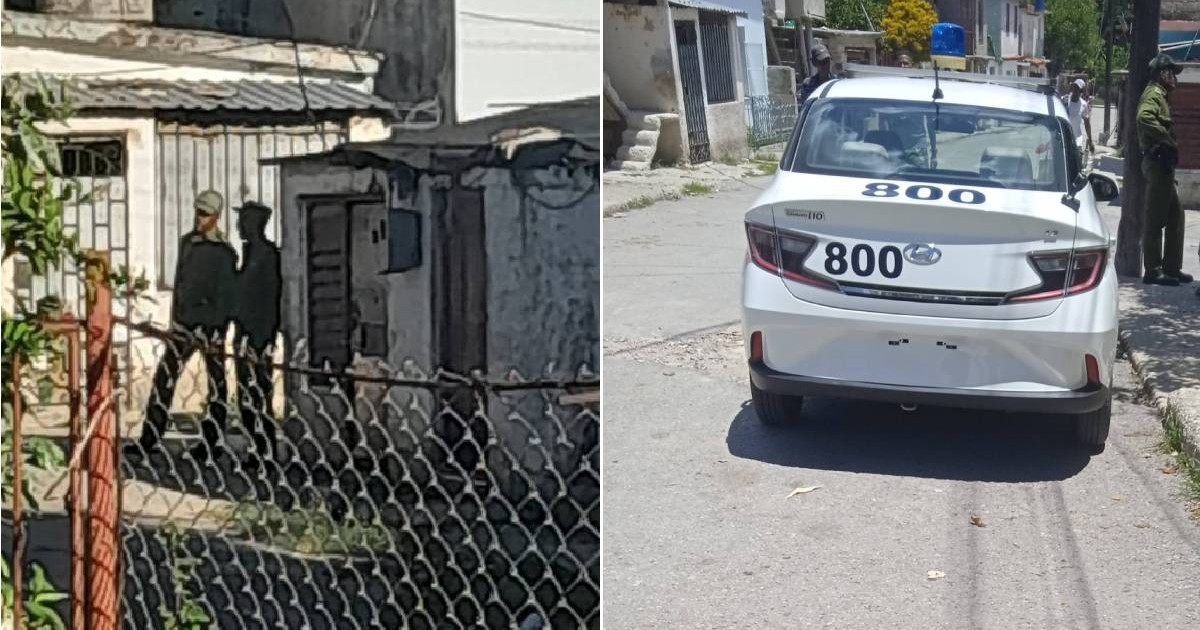
Luis Wilber Aguilar Bravo, whose son Walnier Luis Aguilar Rivera is a political prisoner, reported on Thursday that State Security agents were stationed outside his home, preventing him from leaving. He shared this incident on his Facebook page, accompanied by a photo of a white patrol car—a Hyundai Grand i10 marked with the number 800 and a blue light—parked at his doorstep.
“THIS IS HOW I WOKE UP, TWO AGENTS AT MY DOOR, TODAY YOU CAN'T LEAVE, THIS IS HOW WE LIVE WHO DEMAND FREEDOM AND A DIGNIFIED LIFE,” Wilber Aguilar Bravo wrote in his post, ending with a direct plea: “FREEDOM FOR MY SON WALNIER.”
This situation is not an isolated incident. The Observatorio Cubano de Derechos Humanos (OCDH) has recorded at least six repressive acts against this father in 2026 alone, including a summons for interrogation on March 19—alongside his wife, Rosario Rivera Román, and his other son, Wagner—and another summons by State Security on June 13.
Recurring Harassment and Its Broader Context
Back in January 2026, Wilber Aguilar Bravo had already reported being confined to his home by agents, preventing him from obtaining food for his imprisoned son. The OCDH has pointed out that “in Cuba, repression is not limited to those imprisoned for political reasons,” highlighting a systematic pattern of harassment against the relatives of those arrested following the July 11 protests.
Walnier Luis Aguilar Rivera was handed a 23-year prison sentence for his involvement in the July 11, 2021 protests, when he was just 21 years old. His father has continuously criticized the court for overlooking his son's intellectual disability, which stems from a brain injury.
Impact on Family and Human Rights Concerns
“His son has a mental delay due to a brain injury, and this condition was not considered during the trial,” Wilber Aguilar Bravo has stated repeatedly. Since his sentencing, Walnier has been moved to prisons increasingly distant from his family: first to the Combinado del Este in Havana, then to Agüica prison in Matanzas in November 2025, and finally to the “Nieves Morejón” prison in Guayos, Sancti Spíritus, in January 2026, over 300 kilometers from his home.
Human rights organizations have condemned these forced transfers as a punitive measure to isolate the prisoner and wear down their family's resolve. The Inter-American Commission on Human Rights (IACHR) granted protective measures to the family in 2025 due to threats and reprisals they faced. In November 2025, the U.S. Embassy in Cuba also publicly denounced the abuses against Walnier and demanded his immediate release.
Walnier's case is part of a broader wave of repression that followed the July 11 protests, which were the largest public demonstrations in Cuba in decades. Over 700 individuals remain imprisoned for their participation in those protests, and the March 2026 semiannual report by Cubalex documented 246 rights violations with 540 repressive incidents on the island, including cases involving the families of political prisoners like Wilber Aguilar Bravo.
State Security Tactics in Cuba
Why is Wilber Aguilar Bravo under surveillance?
Wilber Aguilar Bravo is under surveillance due to his vocal demands for freedom and dignified living conditions, particularly in relation to his son, a political prisoner in Cuba.
How has the international community responded to Walnier's case?
The international community, including the Inter-American Commission on Human Rights and the U.S. Embassy in Cuba, has criticized the Cuban government for its punitive measures against Walnier and his family, demanding his release and providing protective measures.
What impact have the July 11 protests had on Cuban society?
The July 11 protests have led to widespread repression and the imprisonment of over 700 participants, reflecting the Cuban government's harsh response to dissent. This has drawn international condemnation and highlighted the ongoing struggle for human rights in Cuba.