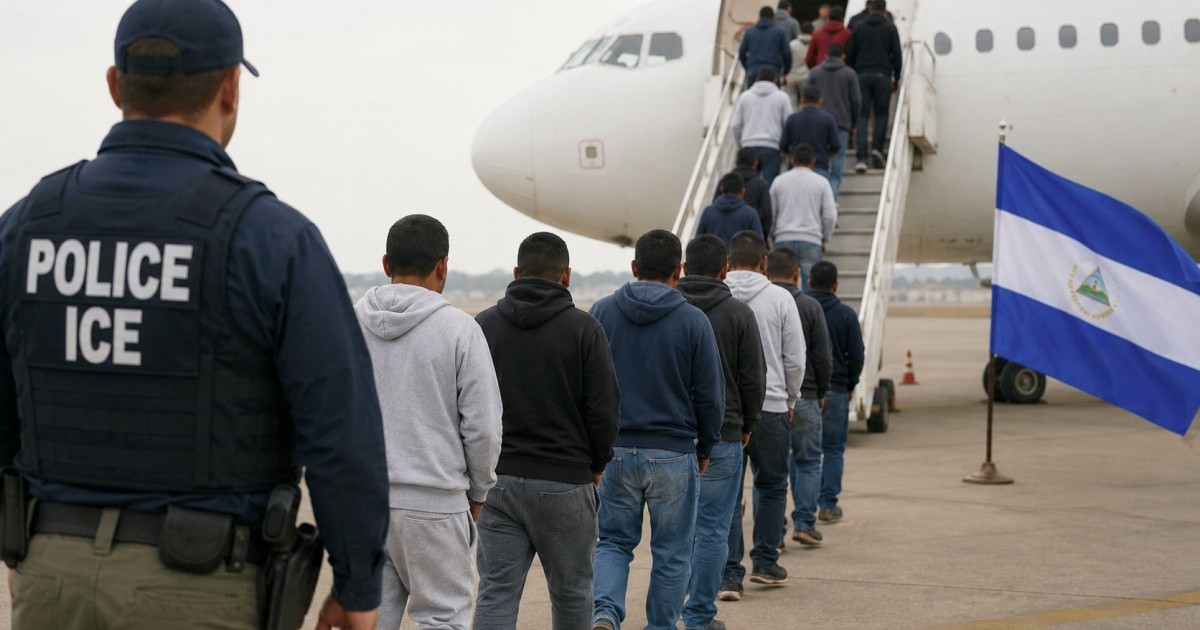
An investigation by the independent Nicaraguan outlet Confidencial has uncovered that the Trump administration deported 116 foreigners from 16 different countries to Nicaragua between January 2025 and June 2026, despite the absence of any formal agreement to justify these transfers.
Among the nationalities identified, Cubans ranked second with 19 individuals sent to Nicaragua, following Hondurans, who numbered 22.
What stands out is that Daniel Ortega's regime reportedly accepted these foreign nationals in secret, contrasting with other Central American countries that have public agreements as "third-country resettlement" locations for deportees.
Nicaragua has neither announced nor officially acknowledged these entries.
Breakdown of the 116 Deportees
Besides the 22 Hondurans and 19 Cubans, the list includes Ecuadorians (17), Guatemalans (11), Colombians (11), Peruvians (7), Venezuelans (6), Salvadorans (6), and Nigerians (5), along with one or two individuals from Bangladesh, Costa Rica, the Dominican Republic, India, Iran, and Mexico.
For Cubans, this adds to an increasingly complicated deportation scenario: Cuba refuses to accept many of its nationals, prompting Washington to redirect them to third countries.
In total, just over 42,000 Cubans have final deportation orders in the United States, leaving thousands stranded in extremely vulnerable situations.
Arrival Methods and Codes Applied
The information cited by Confidencial comes from the Deportation Data Project, run by university academics through public information requests.
Approximately 33% of the deportees departed from Miami International Airport and 25% from Alexandria, Louisiana.
Most were sent individually or in pairs, although groups of five and six were noted on March 19 and May 9, 2025, respectively.
Regarding the codes applied:
- 82 individuals were deported under "code 8" (intercepted at the border or removed from the interior).
- 22 under "code 3" (voluntary departure ordered by a judge).
- 11 under "code 6" (violation of immigration laws).
- One under "code zero" (voluntary departure before an officer).
No Formal Agreement but Case-by-Case Acceptance
The U.S. Embassy in Nicaragua and ICE did not respond to Confidencial's inquiries.
Andrew Selee, President of the Migration Policy Institute, explained to the media outlet the legal framework of such deportations: "The U.S. government can deport a citizen to another country as long as that country allows entry," though he noted there is "little clarity in Nicaragua's decisions regarding who is accepted and why."
Carolina Sediles, legal advisor for the Nicaraguan American Alliance for Human Rights (NAHRA), stated that the lack of an agreement "does not necessarily prohibit sending people of other nationalities to Nicaragua, provided the Government authorizes it."
Authorizations are given "on a case-by-case basis," potentially involving "ad hoc consent, special documents, previous residency, dual nationality, or another individual basis."
Secret Deals and Millions of Dollars
This practice aligns with Trump's immigration policy, which established agreements with more than 30 nations and forcibly sent over 17,400 people to third countries with which many have no ties, as reported by Human Rights First in May 2026.
Washington has paid at least $44 million to recipient governments, several of which are responsible for severe human rights violations, in deals kept secret, potentially violating the Case-Zablocki Act of 1972.
On February 27, 2026, a federal judge in Massachusetts ruled this policy illegal for violating federal immigration law and due process rights.
The Supreme Court temporarily authorized it in June 2026 while litigation continues.
Deportations to third countries have left thousands of migrants in a state of utter defenselessness, with neither their countries of origin nor the receiving countries taking responsibility for their welfare.
Key Questions about U.S. Deportations to Nicaragua
Why are Cubans being deported to Nicaragua?
Cubans are being sent to Nicaragua because Cuba refuses to accept many of its nationals, leading the U.S. to deport them to third countries like Nicaragua.
What legal framework allows the U.S. to deport individuals to Nicaragua?
The U.S. can deport individuals to another country if that country agrees to accept them, although the process in Nicaragua lacks transparency regarding acceptance criteria.