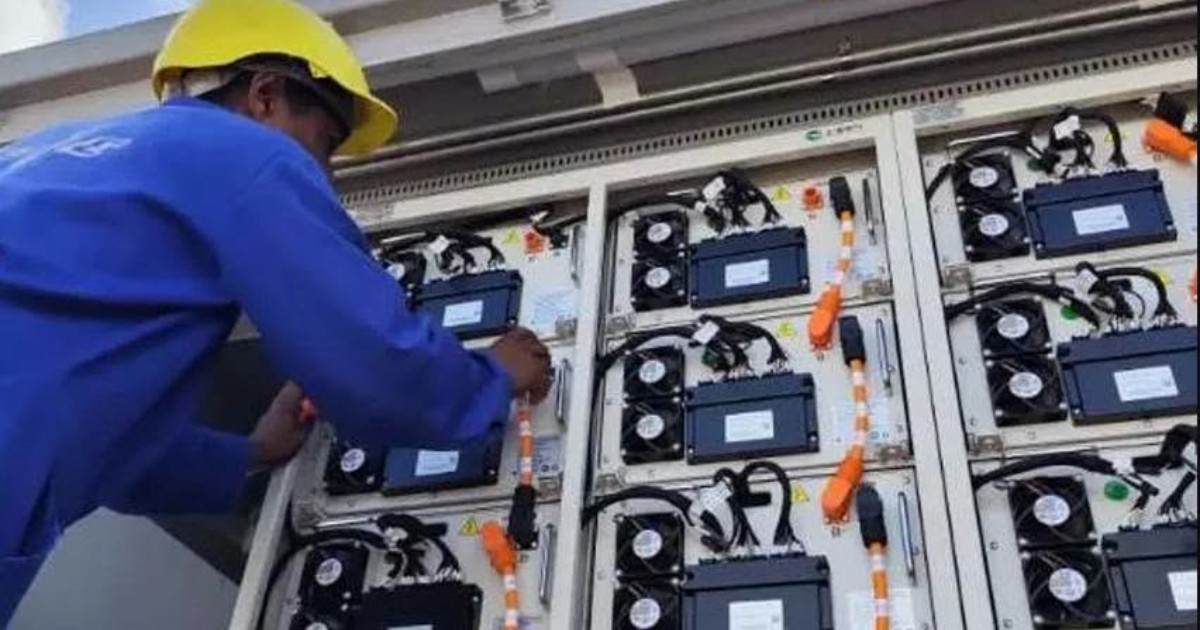
This past Wednesday, the Cuban regime revealed the inauguration of Cuba's inaugural battery bank, a 50-megawatt (MW) system situated at the Cotorro 220 substation in El Cotorro, Havana, as reported by the state-run media outlet Cubadebate.
Ismael Ulloa Rodríguez, an engineer from the Ministry of Energy and Mines, mentioned on the Buenos Días news program that the system is in its final commissioning phase, yielding "satisfactory" outcomes.
The engineer explained that during the activation week, the battery bank effectively responded to the shutdown of the Guitera thermoelectric plant and transmission line failures, without causing disruptions to the National Electric System.
"This week, we've encountered various failures, yet the system managed to supply or consume energy as necessary. There were no automatic frequency disconnections or system collapses," Ulloa Rodríguez emphasized.
Nonetheless, the official announcement starkly contrasted with the reality experienced by Cubans the same day: the Electric Union (UNE) predicted over 2,000 MW of disruptions during Wednesday's nighttime peak, with a mere 1,100 MW of available generation against a demand of 3,200 MW.
The maximum deficit recorded reached 2,211 MW at 10:00 PM, while Cuba endured blackouts exceeding 2,100 MW on the day of the announcement.
Additionally, 106 distributed generation plants remained offline due to fuel shortages, adding up to 1,203 MW unavailable.
The public sentiment is captured in a phrase commonly shared among Cubans: "The blackouts are just the same."
Operational Challenges and Future Prospects
Operating around the clock, the Chinese-origin system stores excess solar energy during the day to feed it into the grid at night, contributing to consistent stability for the SEN.
According to Ulloa, this system will also enable solar photovoltaic parks to function at their full potential, gradually eliminating current constraints. Cuba has 49 solar parks connected, with a total installed capacity of 1,334 MW, though actual generation averages only about 500 MW due to inadequate storage.
The installation of these systems began in August 2025 at four substations, with the energy storage battery connection project announced months earlier as part of the regime's strategy to diversify its energy matrix with support from Beijing.
The Cotorro site is the first of four planned storage systems on the island. The others will be constructed in another part of Havana, in the municipality of Cueto (Holguín), and in Bayamo (Granma). Cuban technicians trained to operate the technology oversee the entire operation.
"These four locations will maximize the use of all solar parks, as well as wind and hydraulic generation, leading to significant fuel savings," Ulloa Rodríguez stated.
What the official narrative omits is the scale of the underlying issue: experts estimate that resolving Cuba's electrical crisis would require an investment between $8 billion and $10 billion, an unattainable amount for a regime that hasn't invested in its thermoelectric infrastructure for decades.
A 50 MW battery bank is insufficient to cover a chronic deficit exceeding 2,000 MW.
Understanding Cuba's Energy Challenges
How does the new battery bank affect Cuba's energy grid?
The new battery bank stores excess solar energy during the day and releases it at night, contributing to the stability of the National Electric System. However, it is insufficient to address the extensive energy deficit Cuba faces.
What are the main challenges of Cuba's current energy situation?
Cuba's primary energy challenges include a significant generation deficit, outdated infrastructure, and a lack of investment in its energy sector, resulting in widespread power outages.
What investments are needed to resolve the energy crisis in Cuba?
Experts suggest that resolving Cuba's energy crisis would require investments ranging from $8 billion to $10 billion. These funds are necessary to update and expand the country's energy infrastructure.