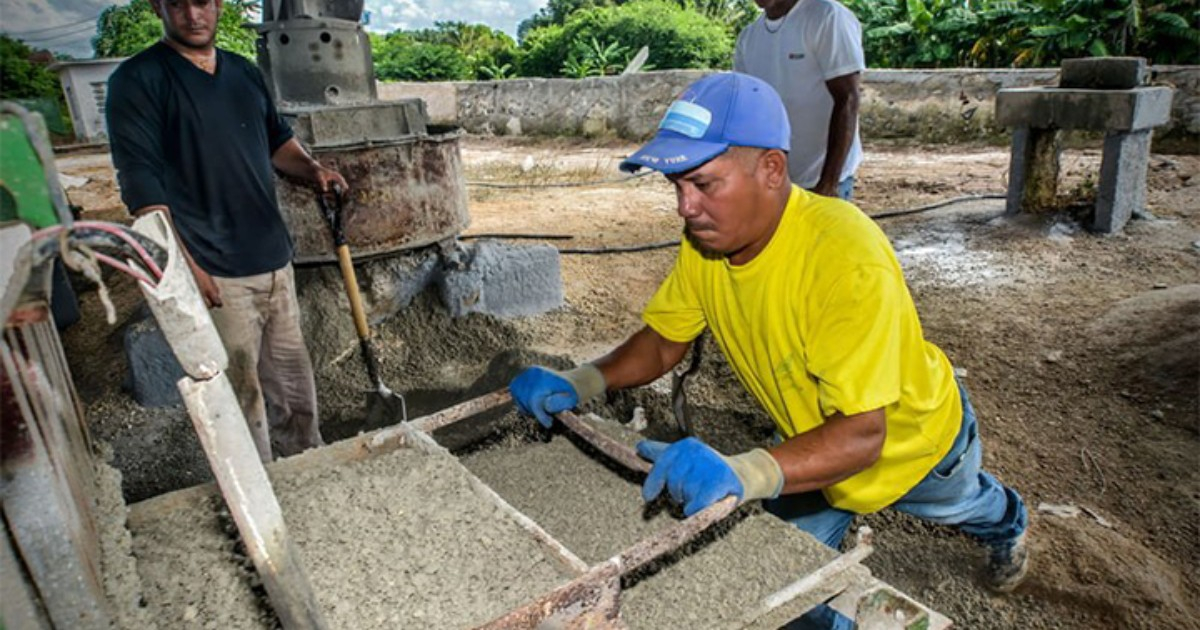
While Cuba grapples with an official housing deficit exceeding 929,000 homes and a staggering 35% of its housing stock in poor or fair condition, the regime is hosting an academic event in Holguín this Wednesday focused on innovation in the construction industry.
According to the state-run ACN agency, the University of Holguín (UHo) and the Médano Construction Materials Company have launched the Hackathon Circular CreLab 2026. This three-day competition aims to develop technological and sustainable solutions for the sector.
The event brings together 10 multidisciplinary teams randomly composed of students from Civil, Mechanical, Industrial, and Computer Engineering disciplines.
Marisol Pérez Campaña, Vice Chancellor of Strategic Management at UHo, explained that "the competition seeks to promote a circular economy and optimize the supply chain through the involvement of young engineering students."
Yudelkis Salcedo Fernández, Technical and Development Director at Médano, detailed that the challenges to be addressed include "reducing, reusing, and adding value to waste; improving both internal and external logistics, and proposing ways to decrease energy consumption in production processes."
This hackathon is part of the international project InnoLabs, co-funded by the European Union through the Erasmus+ program, which will run until January 2028.
In Cuba, the project includes representation from the Havana Technological University (Cujae), the University of Cienfuegos, and UHo.
Winning solutions will earn membership in the Innovation and Entrepreneurship Lab of the Holguín institution, serving as a scientific foundation for the provincial industry.
The disparity with the country's housing reality is stark. In 2025, Cuba managed to complete just 22% of its annual construction plan: 2,382 houses out of the 10,795 planned.
The housing crisis has deepened persistently, with cement plants going over seven years without significant maintenance, operating at just 10% of their installed capacity against a national demand of four million tons per year.
In the informal market, a bag of cement can cost up to 7,000 Cuban pesos (approximately 14 dollars), and 400 bricks are sold for 41 dollars. Official data published in Granma reveals that over 30,000 families still live on dirt floors.
The Isla de la Juventud finished a mere 39 homes throughout 2025, marking the country's poorest performance.
In June 2026, the National Assembly passed a new Housing Law that repeals the 1988 regulation, introducing mortgage financing and subletting for the first time.
The law also limits ownership to two permanent homes per person and empowers the state to reclaim abandoned properties with structural deterioration. Analysts, however, argue that the law does not address the root issues: the lack of materials, bureaucracy, and state control that have stalled construction for decades.
While the hackathon offers real academic value, its impact is negligible compared to a structural crisis that the regime has long failed—and perhaps declined—to address with the necessary tools: investment, decentralization, and opening up the construction sector to private enterprise.
FAQs on Cuba's Housing and Construction Challenges
What is the current housing deficit in Cuba?
Cuba currently faces an official housing deficit of over 929,000 homes, with a significant portion of existing housing in disrepair.
What are the main goals of the Hackathon Circular CreLab 2026?
The hackathon aims to generate technological and sustainable solutions for the construction sector, focusing on waste reduction, logistics improvement, and energy consumption reduction.
How does the new Housing Law affect Cuban citizens?
The new law introduces mortgage financing and subletting, limits ownership to two permanent homes per person, and allows the state to reclaim abandoned properties. However, it does not resolve issues like material shortages and bureaucratic hurdles.