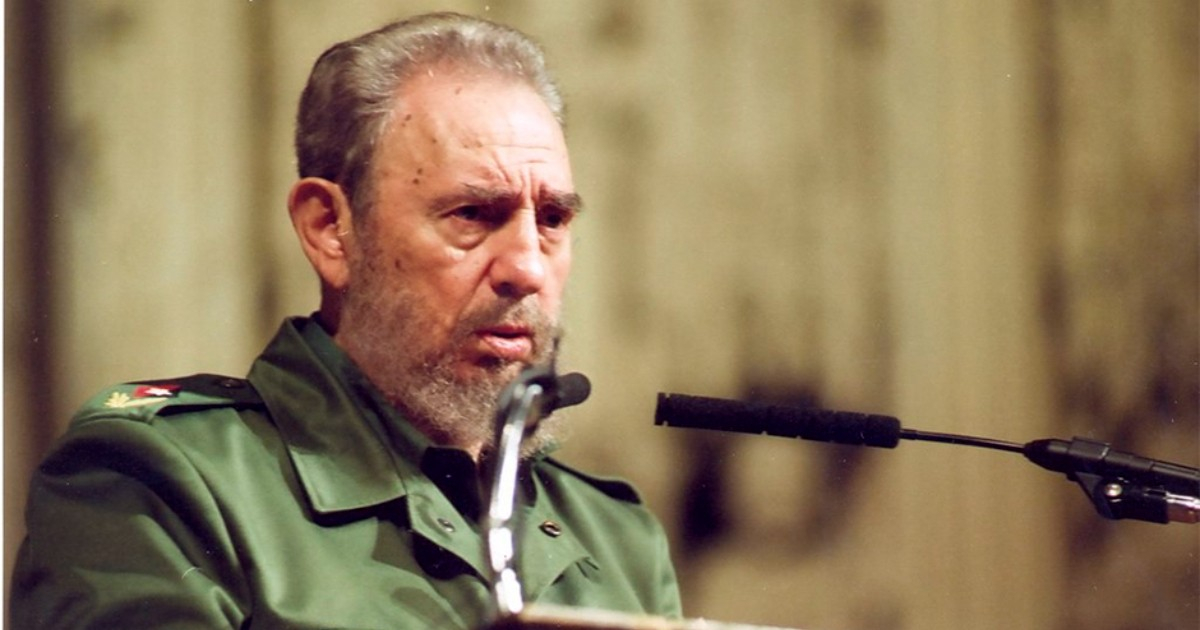
On Tuesday, the Cuban regime marked the 65th anniversary of Fidel Castro's pivotal speech, "Words to the Intellectuals," delivered on June 30, 1961. This political-cultural event, led by Miguel Díaz-Canel, took place at the José Martí National Library in Havana, the very location where Castro asserted the principle that placed the state as the ultimate arbiter of creative expression: "Within the Revolution, everything; against the Revolution, nothing."
The gathering included key cultural and political figures from the regime, such as Roberto Morales Ojeda, a member of the Political Bureau, Culture Minister Alpidio Alonso Grau, and the president of the Union of Writers and Artists of Cuba (UNEAC), Marta Bonet de la Cruz.
Bonet de la Cruz delivered the main address, reaffirming the continuing relevance and necessity of Castro's words: "Sixty-five years have passed, and Fidel's words, still full of relevance, remain an essential reference when we seek answers and defend the continuity of revolutionary cultural policy."
The UNEAC president also echoed another line from the original speech: "The Revolution must only renounce those who are incorrigibly reactionary, who are incorrigibly counter-revolutionary," a sentiment historically used to justify censorship and repression against creators not aligned with the regime.
Critics argue that what the official narrative frames as a cultural celebration is, in reality, a commemoration of the ideological tool that established total control over creative expression in Cuba. The 1961 speech was initially sparked by the censorship of the documentary short PM (Past Meridian), which was banned for depicting Havana's nightlife, deemed incompatible with revolutionary values.
Over six decades later, the plight of Cuban intellectuals remains unchanged: conform or face consequences. Artist Luis Manuel Otero Alcántara is imprisoned in a maximum-security facility and was awarded the Václav Havel Prize 2025 from behind bars. Philosopher Alina Bárbara López Hernández was expelled from UNEAC in 2024 for criticizing the government, and in 2025, the Prosecutor's Office sought a four-year prison sentence in what she denounced as a fabricated case.
The Cuban Observatory for Human Rights reported at least 3,179 repressive actions against Cuban civil society in 2025, including against artists and intellectuals.
This Tuesday's event is also part of preparations for the centennial of Castro's birth, scheduled for August 13, 2026. On June 26, UNEAC inaugurated the "Soldier of Ideas" exhibition with Díaz-Canel's presence, and on June 27, the book Returning to Words to the Intellectuals was presented, affirming Castro's text as the foundation of current cultural policy.
Bonet de la Cruz concluded her address with a phrase encapsulating the regime's stance amid the island's ongoing crisis: "There will only be a future if we endure today."
Understanding the Impact of Castro's Ideological Control
Why was Fidel Castro's speech "Words to the Intellectuals" significant?
Castro's speech established the state's absolute control over creative expression, declaring that only art within the Revolution was acceptable. It has historically been used to justify censorship and repression against dissenting artists and intellectuals.
How has the regime's cultural policy affected Cuban artists?
Cuban artists face a choice between aligning with the regime's ideology or facing censorship, repression, and even imprisonment. This environment has stifled creative freedom and fostered a culture of fear among creators.
What is the significance of the Václav Havel Prize awarded to Luis Manuel Otero Alcántara?
The Václav Havel Prize, awarded to Otero Alcántara, highlights international recognition of his courage and commitment to artistic freedom despite facing severe repression and imprisonment by the Cuban regime.