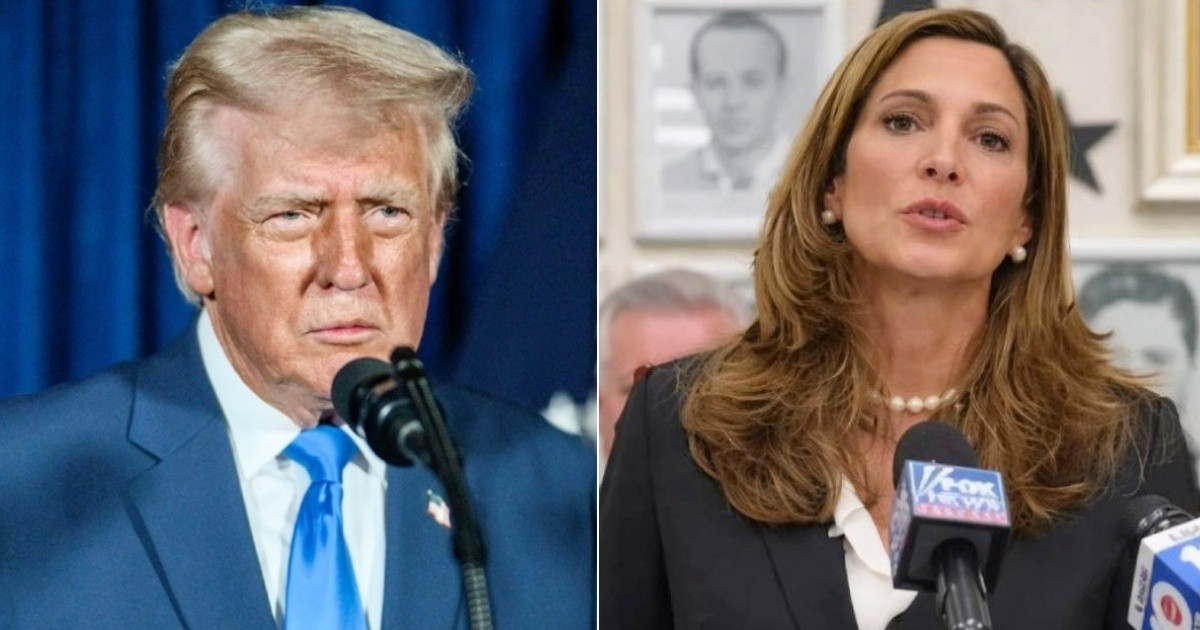
On Tuesday, Cuban-American Republican Congresswoman María Elvira Salazar diverged from President Donald Trump's stance by endorsing the Supreme Court's decision to uphold birthright citizenship for children of undocumented parents. This ruling marks a significant setback for Trump's immigration agenda.
Salazar, who represents Florida's 27th Congressional District, issued a formal statement supporting the Supreme Court's ruling with a notable contrast to Trump's viewpoint: "The Constitution is explicit, and we must always uphold the rule of law."
Salazar Breaks from Trump on Birthright Citizenship
The court's decision, with a six-to-three vote, rejected Trump's attempt to revoke automatic citizenship through Executive Order 14,160, signed on January 20, 2025, during the first day of his second term. Trump had previously labeled birthright citizenship as "ridiculous" and said it would be a "disgrace" if the Court upheld it. Following the defeat, he announced plans to seek a legislative change in Congress.
Salazar openly supported the court's ruling, stating, "The Supreme Court has already ruled on birthright citizenship, and I agree with their decision."
Critique of Executive Orders in Immigration Policy
Beyond endorsing the court's decision, Salazar criticized Trump's approach to immigration reform through executive actions. "While the Court interpreted the Constitution, immigration policy should not be dictated by executive orders or judicial decisions. This approach only creates uncertainty and harms our families, employers, and communities," she wrote.
She further emphasized the role of Congress in addressing immigration issues: "It is Congress's responsibility to fix our immigration system. That is where this debate has always belonged."
Upholding the Constitution without Ignoring Abuses
Salazar acknowledged that the ruling does not address all issues within the immigration system but rejected the notion of bypassing the Constitution. "This decision doesn't change another reality: our immigration laws are outdated and do not address today's challenges," she warned.
She argued that defending constitutional principles and addressing abuses are not mutually exclusive, stating, "We can uphold the Constitution while also ending abuses like birth tourism, combating fraud, and fixing a legal immigration system that has failed America for far too long. These goals go hand in hand."
A Republican Voice Unafraid to Challenge Trump
Salazar's stance is not an isolated incident. As the daughter of Cuban immigrants who fled the Castro regime, she has a history of diverging from her party's hardline position on immigration. She is the author of the Dignity Act, a bipartisan proposal to regularize over 11 million undocumented immigrants without criminal records who have resided in the country for more than five years.
In December 2025, Salazar criticized the suspension of immigration applications from Cuba, Haiti, and Venezuela, describing it as "un-American" and "collective punishment," while fellow Republicans Mario Díaz-Balart and Carlos Giménez supported the measure.
Trump's Defeated Executive Order
Executive Order 14,160 directed federal agencies to deny citizenship to children born if neither parent was a citizen or permanent resident. Federal Judge John Coughenour immediately blocked it, calling it "blatantly unconstitutional," leading to lawsuits from attorneys general in 18 states.
Supreme Court Chief Justice John Roberts authored the majority opinion, asserting that "citizenship, then and now, was the right to have rights" and that the framers of the 14th Amendment extended that promise to "every person born free in this land."
This ruling represents the third significant defeat for Trump in the Supreme Court in recent months. The Migration Policy Institute estimated that around 255,000 children born each year to non-citizen parents would have lost that right if the executive order had been enforced.
Key Questions on Birthright Citizenship and the Supreme Court Ruling
What was the Supreme Court's decision regarding birthright citizenship?
The Supreme Court upheld birthright citizenship, rejecting Trump's attempt to revoke it through an executive order, with a six-to-three vote.
How did María Elvira Salazar respond to the Supreme Court ruling?
María Elvira Salazar publicly supported the Supreme Court's decision, aligning herself with upholding the Constitution and opposing Trump's stance.
What impact does the ruling have on Trump's immigration policy?
The ruling is a significant defeat for Trump's immigration agenda, as it prevents the elimination of birthright citizenship through executive action.