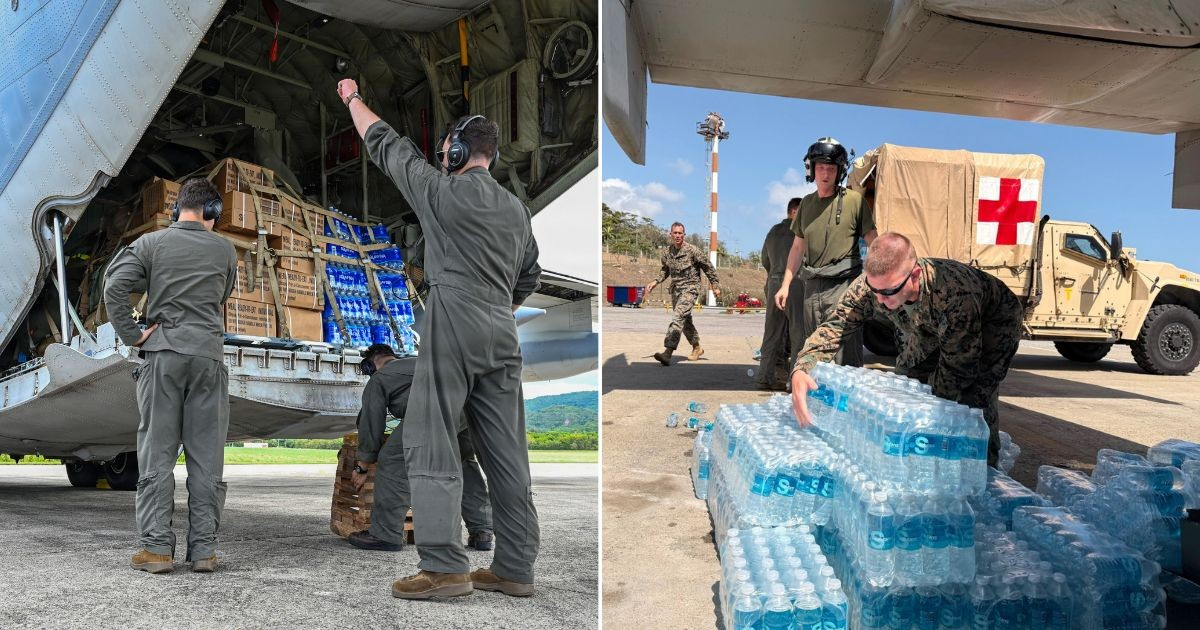
The United States Southern Command (SOUTHCOM) announced an official update on Monday regarding the deployment of U.S. military forces in Venezuela. Various branches of the Armed Forces are actively engaged in humanitarian efforts following the catastrophic earthquakes that struck on June 24th.
In their official statement, SOUTHCOM highlighted that U.S. military assets continue to arrive in the country to bolster earthquake relief efforts, a mission initiated by the Venezuelan government and overseen by the Department of State.
This Monday, six C-17 Globemaster aircraft from the Air Force are set to land, carrying a Marine Combat Logistics Company from Cherry Point Marine Corps Air Station in North Carolina. The deployment includes heavy equipment, engineering resources, and water purification capabilities.
Additionally, C-17 and C-130 Hercules aircraft are consistently transporting personnel and supplies, while a Contingency Response Element of approximately 100 airmen with expertise in airfield management is aiding Venezuelan authorities to enhance air traffic capacity at airports near the earthquake's epicenter.
The USS Fort Lauderdale, a Navy vessel, is operating from the Port of La Guaira, which has resumed operations, to deliver essential supplies and equipment.
Marine Corps MV-22 Osprey helicopters are conducting missions between a logistics hub in Curaçao, hosted by the Netherlands, and the affected areas in Venezuela. Meanwhile, UH-1Y Venom helicopters are performing aerial assessments and transporting State Department personnel, and Army CH-47 Chinook helicopters from Soto Cano Air Base in Honduras are providing additional transport support.
The U.S. Space Force is also involved in the operation, supplying satellite imagery of damaged communities and infrastructure to prioritize rescue efforts in the most critical zones.
This marks the first occurrence in years that U.S. military personnel are operating on Venezuelan soil in a humanitarian mission coordinated with local authorities, a historically significant development given the strained diplomatic relations between Washington and Nicolás Maduro's government.
The earthquakes on June 24 resulted in 1,719 fatalities and 5,034 injuries, according to official Venezuelan figures, while the UN estimates up to 50,000 individuals may be missing beneath the rubble.
The dual tremors, with magnitudes of 7.2 and 7.5, are the strongest recorded in Venezuela in over 125 years, impacting more than 6.76 million people.
Direct economic damages are estimated at 6.7 billion dollars, roughly 6% of Venezuela's GDP, with total projected impact potentially reaching 20.1 billion dollars.
SOUTHCOM stated that further military support planning is ongoing "in close coordination with the Department of State, the Venezuelan government, and other partners and allies contributing to the international relief effort," with announcements to be made once plans are confirmed.
Understanding the U.S. Response to Venezuela's Earthquakes
What role is the U.S. military playing in Venezuela's earthquake relief?
The U.S. military is providing logistical and operational support, including air transport of personnel and supplies, engineering resources, and satellite imagery to aid in rescue efforts following the earthquakes.
How significant are the recent earthquakes in Venezuela?
The earthquakes, with magnitudes of 7.2 and 7.5, are the strongest in over 125 years and have affected more than 6.76 million people, resulting in significant casualties and economic damage.
Why is this U.S. military involvement in Venezuela historically significant?
This operation marks the first time in years that U.S. military forces are engaged in a humanitarian mission in Venezuela, coordinated with local authorities, despite historically tense diplomatic relations.