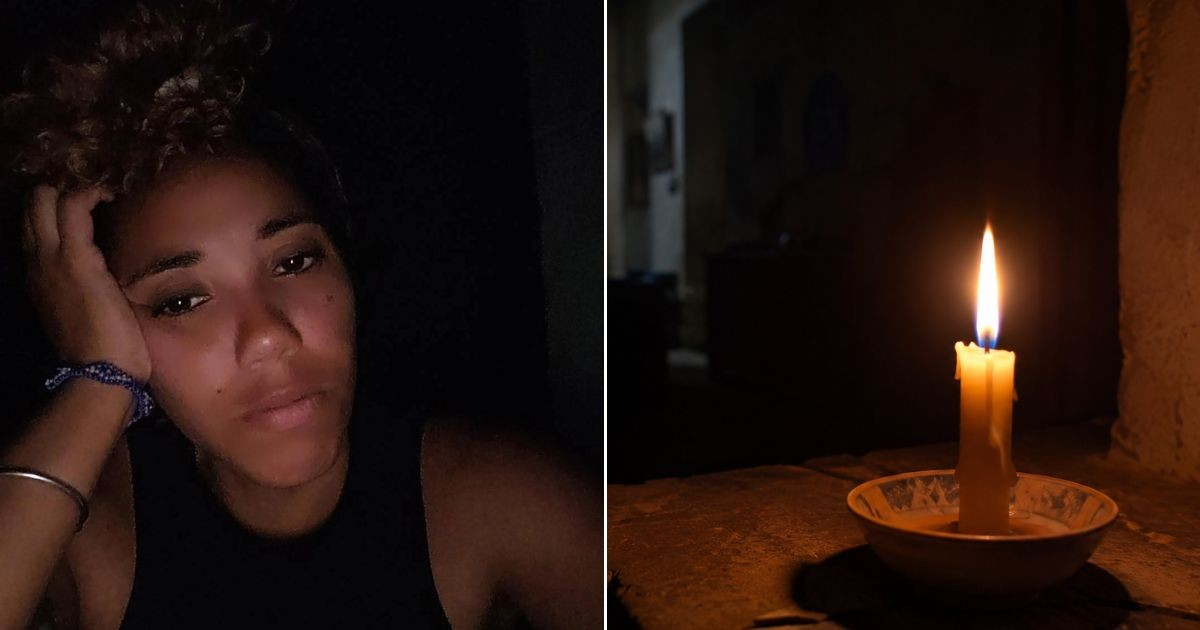
A Cuban woman's heartfelt social media post has quickly become emblematic of the collective exhaustion over the ongoing power crisis: "I can't remember the last time I ate with electricity. I can't recall the last time I used my household appliances normally. I can't remember the last time I relaxed watching a movie without worrying about another blackout."
In her post, Mileydis González shares how power outages have taken away the most basic comforts: cooking peacefully, getting a full night's sleep, preserving food, and spending time with family.
"They have stolen such simple things that once seemed normal," she wrote, concluding with a defiant statement: "Because this is no longer living... it's a daily torture. I WILL NEVER ADAPT TO LIVING IN DARKNESS."
Hundreds of Cubans echoed her sentiments, resonating with every word.
The Impact of Darkness
Anay Hernandez commented, "Cuba feels like a graveyard for the living, each night brings new sleeplessness, I don't want to compare myself to those worse off anymore, I just want to sleep, to rest my mind, is that too much to ask?"
Cecilia Paulina Rumbau Labarrere shared that the darkness is now affecting her vision: "We no longer greet each other with good morning, we barely sleep, and the greeting is whether the power is back or gone. We can't eat at regular times, we are surrounded by eternal gloom."
A Descent into Desperation
Virginio Cabrera warned that the situation extends beyond just the heat: "For those of us who have the power cut for almost the entire day, for several months now, we are also reaching the brink of starvation since we can't diversify our diet without refrigeration. Everything spoils in this Cuban climate."
Yamile Gonzalez reported blackouts lasting up to 50 consecutive hours in various parts of the country: "I will never adapt to the darkness, it's our right to live with light... blackouts lasting 24, 25 hours, in other places even 40 and 50 hours, no one can endure such agony."
Voices of Irony and Resilience
Irony found its place too. Aleixi Batista quipped, "The last time I had electricity for 24 hours, they were showing 'Isaura the Slave,'" referencing the 1976 Brazilian soap opera. Chay Zapata Hechevarria was more direct: "I think people in 'The Walking Dead' lived better than us."
Kenny Orlando Ribalta Consuegra summarized the sentiments of many: "It's becoming a routine, unfortunately, and it looks like we'll continue this way for several more years while the ones in power keep lining their pockets with our suffering."
The Scale of the Crisis
This testimony comes amid Cuba's worst electrical crisis in decades. On Monday, the generation deficit reached 2,080 MW, with only 1,100 MW available against a demand of 3,150 MW.
Sunday saw a maximum impact of 2,140 MW at 8:50 PM. In Havana, blackouts exceed 20 hours a day; in parts of Matanzas, there have been reports of over 85 consecutive hours without power.
A scientific study on the psychological impact of the blackouts found that 54% of Cubans show extremely severe depression levels, 66% suffer from severe anxiety, and 65.8% experience extreme stress.
No participant was classified within normal mental health parameters. One in three households had someone who went to bed hungry due to the outages.
Kenia Cabrera Leon expressed it bluntly: "They are killing us slowly, psychologically, little by little."
Understanding Cuba's Electricity Crisis
What is causing the electricity crisis in Cuba?
The crisis is primarily due to a significant deficit in power generation capacity, insufficient to meet the demand, leading to frequent and prolonged blackouts.
How are the blackouts affecting daily life in Cuba?
Blackouts disrupt basic activities such as cooking, sleeping, and food preservation. They also contribute to psychological stress, anxiety, and depression among the population.
What psychological effects are being reported due to the power outages?
A study revealed that a majority of the population experiences severe depression, anxiety, and stress, with no participants showing normal mental health levels.
Are there any long-term solutions being proposed for the crisis?
As of now, there are no clear long-term solutions proposed by the government, leading to continued uncertainty and frustration among the populace.