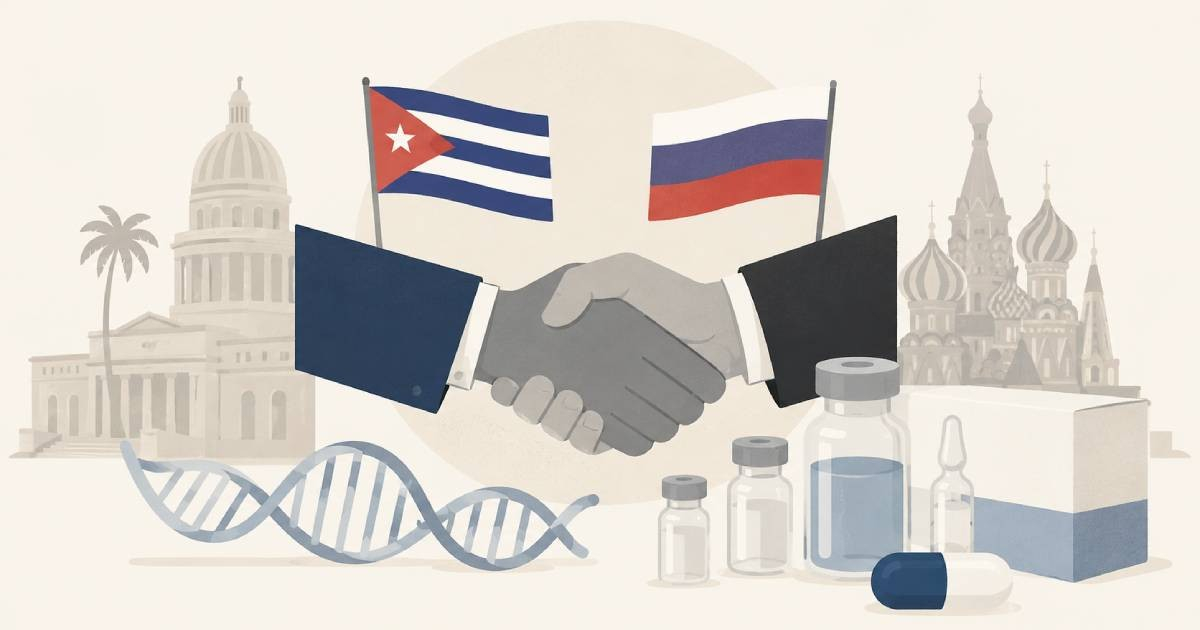
Cuba and Russia have unveiled their latest collaboration with the establishment of "Global Biopharmaceutical Synergy," a groundbreaking joint venture in the biopharmaceutical sector. This initiative, described by official Cuban media as "unprecedented," aims to enhance cooperation in the research, production, and commercialization of pharmaceuticals.
The announcement was made by Eulogio Pimentel, the First Vice President of BioCubaFarma, during the project's presentation, which was officially constituted on June 24 in Russia. This new partnership brings together the Cuban state corporation and multiple Russian partners, including the Russian Direct Investment Fund.
With an initial investment of $11 million, the promoters anticipate a total investment of up to $113 million to foster biotechnology projects, pharmaceutical research, and treatments targeting cancer, chronic diseases, and neurodegenerative disorders.
Several Cuban medications are already part of this collaboration, such as Heberprot-P for diabetic foot ulcers, Hebermin for burns, CIMAvax-EGF—a therapeutic lung cancer vaccine—and Jusvinza for severe inflammatory processes.
Expanding Oncological Innovations
One of the most ambitious projects under this venture is HEBERSaVax, focusing on developing cancer therapies. Additionally, five startups associated with BioCubaFarma are currently incubated within Skolkovo's technology park, Russia's premier innovation hub, concentrating on neurodegenerative diseases and various cancer types.
This joint enterprise builds upon the agreements reached during the St. Petersburg International Economic Forum on June 5, where both governments signed a memorandum to develop cancer vaccines by merging Russian technologies—such as Oncopept, NeoOncovac, and EnteroMix—with Cuban expertise in immunotherapy.
Historical Collaboration and Strategic Strengthening
Collaboration in biopharmaceuticals between Havana and Moscow has been ongoing for over a decade. In 2015, Heberprot-P became the first Cuban biotech product included in Russia's List of Essential and Vital Medicines. Subsequently, in February 2016, both parties signed four cooperation memorandums in fields like oncology and bioinformatics.
The new company also fortifies the strategic alliance between Cuba and Russia. During the XXIII session of the Cuba-Russia Intergovernmental Commission earlier this year, they formalized economic agreements exceeding $1 billion, involving Russian management of Cuban industrial facilities. This is in addition to a $60 million fuel purchase credit granted by Moscow in January 2025, and a military cooperation pact ratified by President Vladimir Putin in March of the same year.
Domestic Challenges Amid International Expansion
Despite these international strides, the situation on the ground in Cuba tells a different story. While BioCubaFarma extends its global footprint—with established presences in Spain, Vietnam, Italy, Australia, and now Russia—the corporation admitted in June it cannot supply nearly 300 of the 395 medications included in the national basic list.
This scarcity is felt acutely by the Cuban people. A survey conducted between February and March 2026 indicated that 54.2% of Cubans face significant challenges in obtaining necessary medications, while only 4.8% reported no difficulties. The juxtaposition of the state biotech industry's global expansion and the ongoing domestic drug shortages continues to fuel criticism from those who argue the regime prioritizes strategic alliances and exports over the healthcare needs of its citizens.
FAQs on Cuba and Russia's Biopharmaceutical Collaboration
What is the focus of the new biopharmaceutical joint venture between Cuba and Russia?
The joint venture aims to enhance cooperation in research, production, and commercialization of pharmaceuticals, with a particular focus on biotechnology projects, pharmaceutical research, and treatments for cancer, chronic diseases, and neurodegenerative disorders.
How much is the initial investment in the Cuba-Russia biopharmaceutical company?
The initial investment is $11 million, with plans to invest up to $113 million in various biotechnology and pharmaceutical projects.
Which Cuban medications are part of this international collaboration?
The collaboration includes Cuban medications such as Heberprot-P for diabetic foot ulcers, Hebermin for burns, CIMAvax-EGF, a therapeutic vaccine for lung cancer, and Jusvinza for severe inflammatory processes.