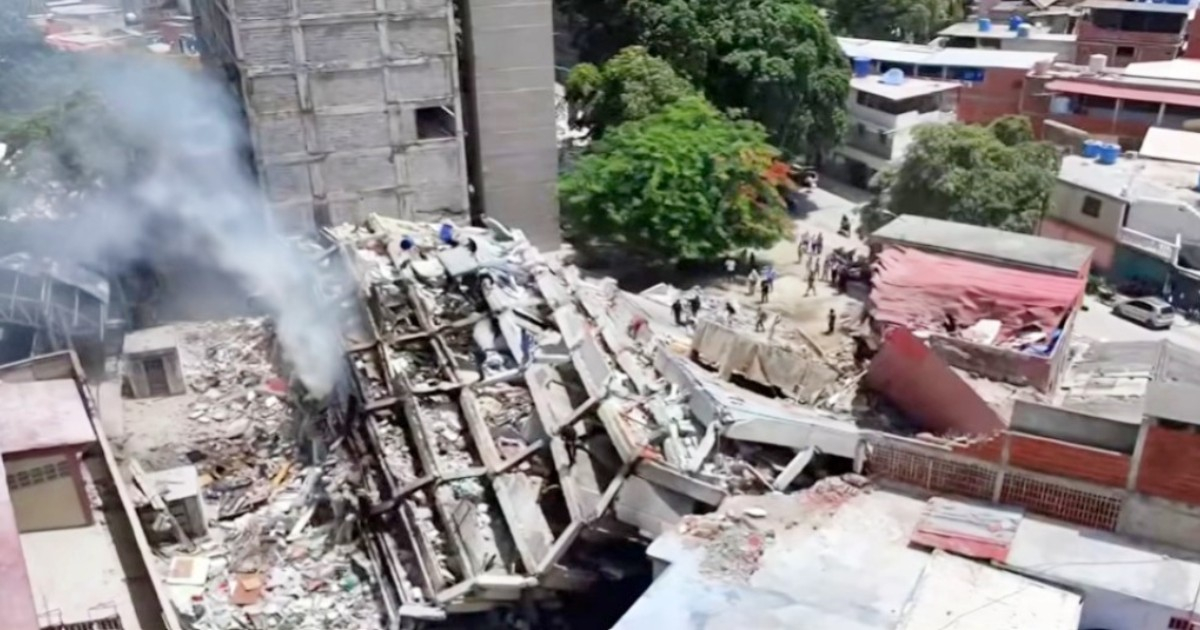
A fresh earthquake rattled northern Venezuela early Monday morning, striking the same coastal region that was devastated just five days earlier by a pair of powerful quakes, which have left at least 1,450 people dead.
The tremor, occurring shortly after 7:00 AM local time (11:01:03 UTC), reignited panic among residents who are still grappling with the worst seismic disaster the nation has seen in over a century.
The United States Geological Survey (USGS) reported that the earthquake measured a magnitude of 4.6, with its epicenter located 27 kilometers north of Caraballeda in the coastal state of La Guaira, at a depth of 10 kilometers.
The intensity felt was classified as a level IV on the Mercalli intensity scale.
However, the Venezuelan Foundation for Seismological Research (Funvisis) recorded a magnitude of 4.2, with the epicenter about 6.2 miles east of La Guaira.
This discrepancy in readings between the two agencies is not unusual, as different seismic networks and calculation methods can yield slightly varied results for the same event.
Most Significant Tremor Since Last Week's Quakes
This latest quake is the strongest aftershock recorded since the dual earthquakes on Wednesday, June 24, when two massive quakes measuring 7.2 and 7.5 struck the northern part of the country just 39 seconds apart. These were the most powerful quakes recorded in Venezuela since 1900.
Since the initial quakes, Funvisis has tracked over 400 subsequent tremors. The most notable ones before Monday were a 4.9 magnitude quake on Friday, June 27, and a 4.8 magnitude quake on Saturday, June 28. Additionally, two smaller aftershocks of 2.5 and 2.7 magnitudes occurred early Monday, followed by another 2.7 magnitude tremor shortly after the main event.
Panic Resurfaces Among Residents
Monday's quake prompted many to flee their homes once more in La Guaira and Caracas.
"It was pretty strong," said Ismel Díaz to the AFP, a resident of La Guaira, where the destruction from the original quakes is widespread: buildings reduced to rubble or precariously tilted, with emergency services working tirelessly.
The La Guaira region remains under military control, with over 14,000 troops deployed to manage the severe infrastructure collapses. Preventive measures include banning elevator use and cutting natural gas services in critical areas, particularly in Caracas.
An Unprecedented Humanitarian Crisis
The backdrop of this latest aftershock is one of extreme devastation. As of Sunday, June 28, official reports indicated 1,450 fatalities and 3,238 injuries, with 12,721 families displaced. The United Nations estimates up to 50,000 missing people and projects that 6.76 million individuals have been affected in total.
The Venezuelan government reported that 774 buildings have been either partially or completely destroyed, with 189 entirely collapsing. The United Nations Development Program (UNDP) assessed the direct damage at $6.7 billion, equivalent to 6% of Venezuela's GDP, with total damages potentially reaching between $10.05 billion and $20.1 billion.
More than 2,200 rescuers from 17 countries are racing against time to sift through the debris, including teams from the United States, Mexico, France, Spain, Brazil, and El Salvador. Washington has pledged $150 million in aid. Venezuelan authorities have reported that 33 individuals have been rescued alive since the earthquakes, though the timeline of these rescues remains unspecified.
Among the missing are 150 Spaniards, 83 Portuguese and their descendants, and at least 32 Cubans concentrated in Caraballeda, Catia La Mar, and Los Corales. The USGS forecasts a 42% probability that the final death toll could range from 10,000 to 100,000, highlighting the enormity of what may still be uncovered beneath the ruins.
Understanding the Recent Earthquake Crisis in Venezuela
What was the magnitude of the earthquake that struck Venezuela on Monday?
According to the USGS, the earthquake had a magnitude of 4.6, while Funvisis recorded it as 4.2.
How many aftershocks have been recorded since the initial quakes?
More than 400 aftershocks have been recorded following the initial dual quakes last Wednesday.
What measures have been implemented in response to the earthquakes?
Preventive measures include military control, a ban on elevator use, and cutting natural gas services in critical areas.