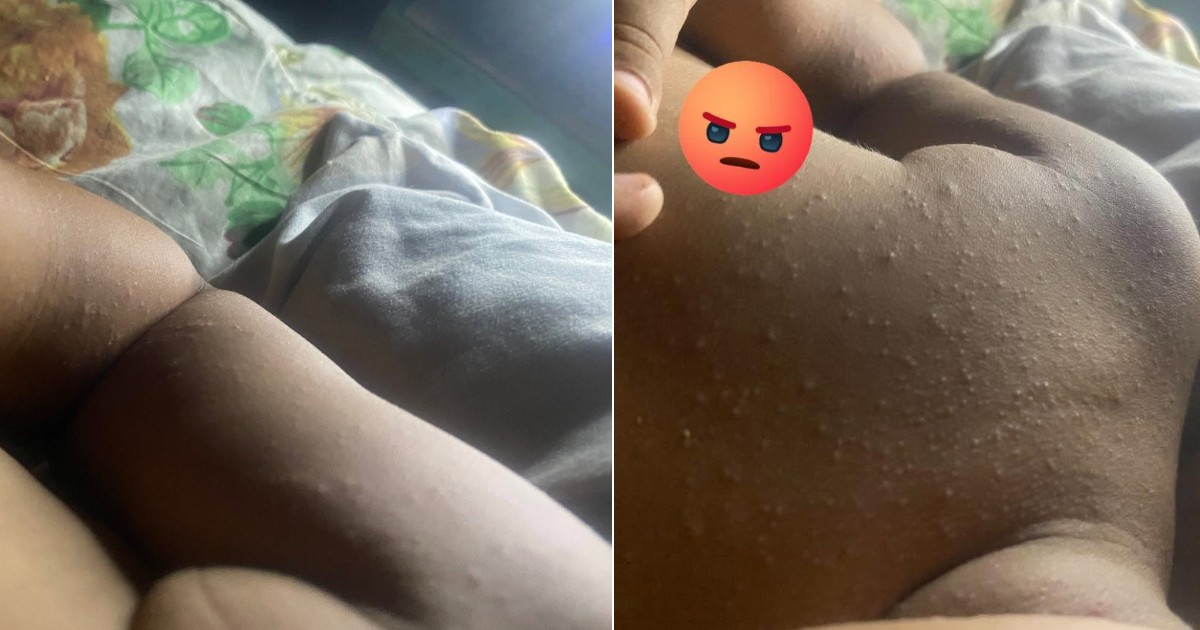
On Monday, a Cuban mother named Evelyn Perera took to Facebook to deliver a pointed message directed at Miguel Díaz-Canel, criticizing the poor living conditions in Cuba. Her young daughter is suffering from a severe rash due to the oppressive heat and frequent power outages. Perera demands Díaz-Canel acknowledge the failure of his leadership and step down.
The images shared on Facebook reveal the baby with numerous red bumps on her back, neck, and legs—symptoms indicative of heat rash, commonly affecting infants who cannot yet regulate their body temperature effectively.
“Look, Canel, is this what we’re supposed to be grateful for? Look at my little one! She has a rash that won’t go away, not with cornstarch, chamomile, or any creams that we can’t even find,” Perera wrote.
She highlights the scarcity of home remedies and the unavailability of creams in Cuban markets to treat her daughter's condition.
The Struggle for Basic Needs
“Do you know what my daughter truly needs? She needs electricity to stay cool and avoid this incessant sweating that keeps her itchy and irritable all day long. She needs to be in front of a fan or air conditioning like people in normal parts of the world,” Perera continued.
Her message ends with a strong rebuke of the regime: “Your so-called revolution only brings misery, blackouts, and suffering to the most vulnerable. You’re incompetent and abusive! Acknowledge your total failure and leave, because nobody wants you or chose you!”
Electricity Crisis Worsens
Perera’s testimony comes during an unprecedented energy crisis in Cuba, where on Monday, a shortfall of 2,150 MW was projected against a demand of 3,100 MW, with only 980 MW available, as reported by the Unión Eléctrica.
The historic deficit record was reached on June 25, with a shortfall of 2,208 MW, surpassing the previous peak on May 14.
In Havana, power outages exceed 20 hours daily, while in Matanzas, residents endured 85 consecutive hours without electricity from June 14 to 17.
A Mother’s Ongoing Outcry
This is not the first time Perera has spoken out. In April, she shared a photo of her family dining by flashlight and cooking with charcoal, captioned, “It breaks my heart to see them like this, growing up in darkness, inheriting a scarcity they didn’t ask for.”
On June 9, she described four sleepless nights and the daily torment of the blackouts: “They are killing us slowly. To make matters worse, after keeping us in the dark like animals, they shamelessly come to collect the electric bill. It’s an insult!”
The crisis is rooted in long-standing structural issues: power plants over 40 years old, chronic fuel shortages, and the cessation of Venezuelan oil supplies since January 2026.
The scorching summer heat, exacerbated by Saharan dust that hit Cuba in June, makes unventilated nights particularly dangerous for infants and young children, who are most at risk from the power outages that the regime has yet to, and seemingly will not, resolve.
Understanding Cuba’s Energy Crisis
What is causing the severe power outages in Cuba?
Cuba's power outages are primarily due to outdated thermoelectric plants, chronic fuel shortages, and the halt of Venezuelan oil supplies since January 2026.
How are the power outages affecting Cuban families?
The blackouts severely impact daily life, causing health issues like heat rashes in infants, and forcing families to live without basic comforts such as fans or air conditioning.
What has been the public response to the Cuban government's handling of the crisis?
Many Cubans, like Evelyn Perera, have expressed their frustration and anger on social media, criticizing the government's incompetence and inability to resolve the crisis.