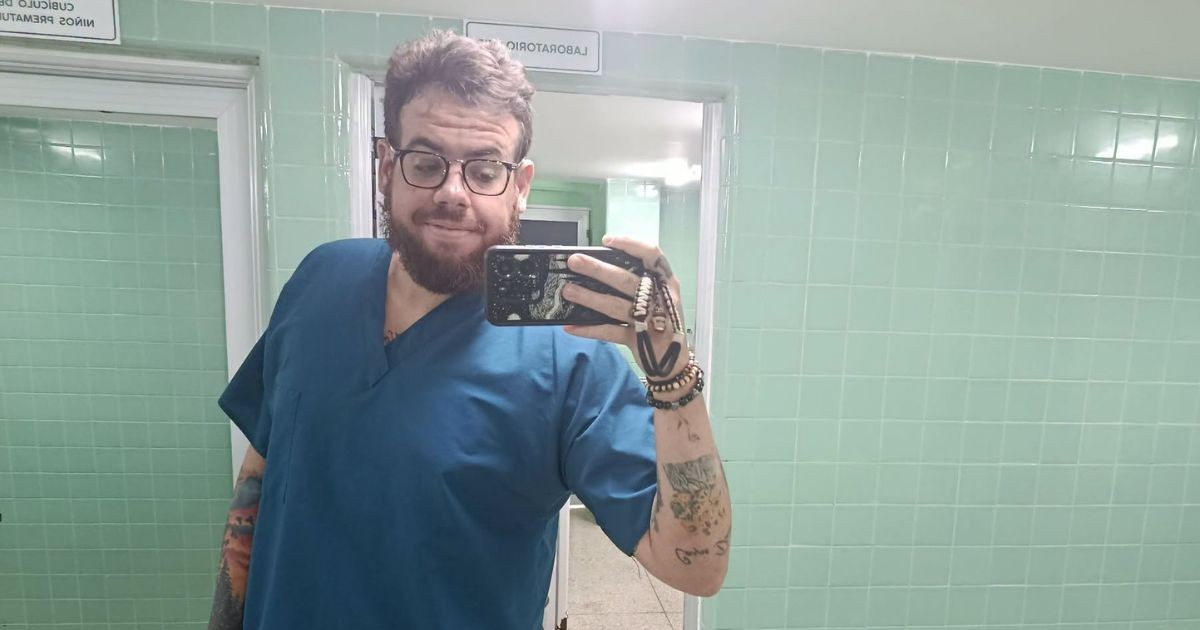
A pediatrician from Las Tunas Hospital recently shared his thoughts on Facebook, capturing the perplexing reality of practicing medicine in Cuba. He described the commitment to the medical profession as a calling, despite a system that nudges doctors toward private sector ventures.
Daniel Del Toro González addressed a recurring question he faced four times in a month on his Facebook profile: "Why do you still work if it seems you don’t really need to and you have complaints?"
His answer was a heartfelt message representing many Cuban doctors who remain in the public healthcare system despite the challenges. "We work because we love it. It’s our calling, beyond the economic issues and the country's situation," Del Toro González wrote, inadvertently crafting a brief manifesto on medical ethics.
The Sacrifice of Medical Training
Reflecting on the arduous journey of six years of medical school—studying late nights with texts like Nelson and Guyton, mastering the detection of heart murmurs—Del Toro González emphasized that this dedication is too significant to abandon. "Those six years were too costly to forget," he stated.
He also acknowledged those who didn't have the same opportunity: "There are thousands of doctors worldwide who had to give up their dream of wearing a white coat to seek a better future, far away."
Economic Pressures and Vocational Commitment
The most striking part of his message directly addresses the financial strain on the medical sector: "In a country that often seems to push us to leave Medicine for a private business, we continue counting a child’s respiratory rate at 3 a.m. despite the challenges."
Regarding complaints, Del Toro González was candid: "Do we complain? Of course. Like anyone who’s been awake for hours, working with what’s available instead of what's needed. Complaining doesn't mean we stop loving what we do."
He concluded with an assertive remark: "We work because we want to, ma'am."
A Healthcare System in Crisis
This testimony emerges during a critical juncture for Cuban public health. Between 2021 and 2024, Cuba saw the departure of over 30,000 doctors, reducing the number from 106,131 to 75,364, according to the National Office of Statistics and Information. The sharpest decline occurred between 2022 and 2023, with the loss of 13,303 doctors in just one year.
Part of the exodus can be explained by wages: a newly graduated doctor earns about 4,610 pesos per month, which is less than 16 dollars. In contrast, those who switch to private micro-enterprises can earn up to seven times more than in the public sector, as revealed by a study involving 70 professionals.
Del Toro González's situation is not unique. In June, a Cuban doctor with a specialty and teaching credentials disclosed that her salary was insufficient to feed her child.
In November 2024, Dr. Yoelvis Estanquero Oliva chose to leave his profession due to the sector’s degrading conditions.
Even the Health Minister, José Ángel Portal Miranda, admitted to an "unprecedented structural crisis" in July 2025, while the regime maintained over 24,000 health workers in about 56 countries under conditions that international entities have criticized as forced labor.
Meanwhile, doctors like Del Toro González continue their night shifts, working with limited resources but unwavering dedication.
Understanding Cuba's Healthcare Challenges
Why are Cuban doctors leaving the public health system?
Cuban doctors are leaving due to low salaries and better financial opportunities in the private sector. The economic pressures make it challenging to sustain a livelihood on public sector wages.
How has the doctor shortage impacted healthcare in Cuba?
The shortage has strained the healthcare system, leading to fewer available medical professionals for patients and increased workloads for those who remain, potentially affecting the quality of care.
What measures are being taken to address the healthcare crisis in Cuba?
Efforts to address the crisis have been limited, with the government focusing on maintaining international medical missions. Domestic improvements are constrained by economic and political factors.